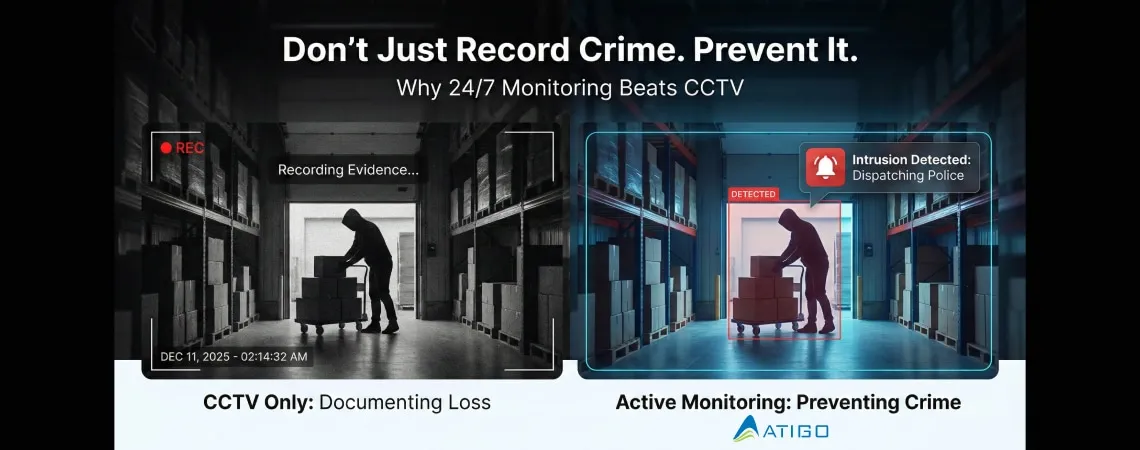
A guide for warehouse owners, developers and occupiers. The park guard watches the gate, the insurer’s policy has conditions, and your client’s goods are in your care. Here is why both sides of the lease now need monitored protection.
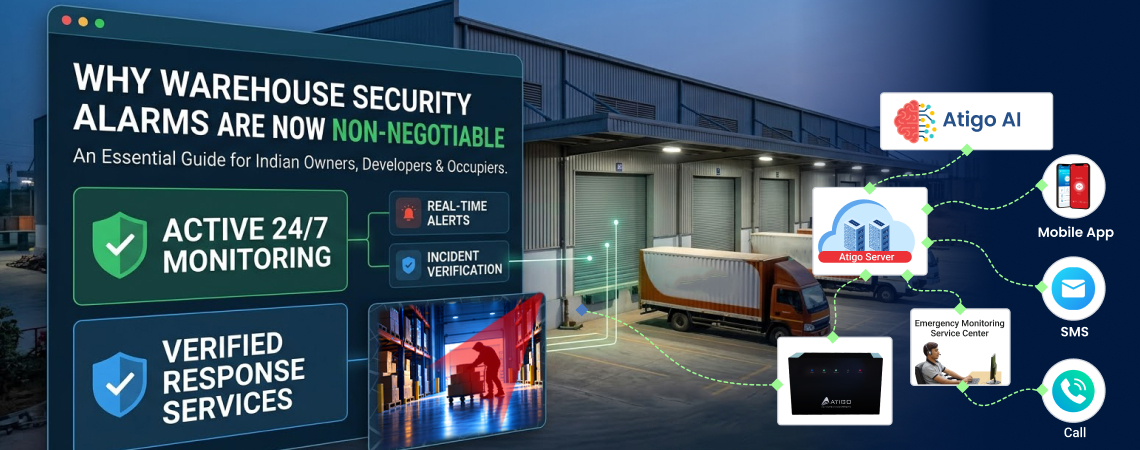
Both warehouse owners and occupiers now need a monitored security alarm system. Owners carry the risk of structural damage, vacant-unit exposure and tenant loss after an incident. Occupiers carry the risk to their own and their clients’ stock. Standard burglary insurance typically covers only theft after forcible entry and commonly excludes staff involvement, while park guards cannot watch every unit’s entry points at night. A monitored alarm closes the gap between the two.
Picture a common arrangement in any Indian logistics park. The developer employs a guard at the main gate and recovers the cost through common area maintenance charges. The occupier runs a 40,000 sq ft unit full of cartons, some of them owned by clients. After the last shift leaves, each side quietly assumes the other has security covered.
Then a rear shutter is forced on a quiet night. The gate guard is 300 metres away and sees nothing. The loss is found in the morning. The occupier calls the insurer and discovers conditions in the policy that nobody read. The owner has a damaged unit and an unhappy tenant considering whether to renew.
None of this is unusual. It is what happens when security is designed around the gate instead of around the places intruders actually enter. This guide explains why, in the current context, a monitored security alarm system has moved from a nice-to-have to a basic requirement for both sides of a warehouse lease. For how the technology itself works, see our complete guide to AIoT warehouse security.
India’s warehousing stock reached about 610 million sq ft in 2025 and is heading towards roughly 850 million sq ft by 2030, with tier 2 cities adding around 12 million sq ft of net absorption in 2025 (JLL). New capacity is increasingly built along freight corridors and on city outskirts, where sites are larger, neighbours fewer and nights quieter.
The latest national data is encouraging on volume. NCRB’s Crime in India 2024, released in May 2026, shows theft down 9.8% and robbery down 13% on 2023, with burglary roughly steady. Recovery is the harder problem: in each year from 2021 to 2023, police recovered only 29% to 36% of the value of property stolen nationally (NCRB data via PTI). For a warehouse, that means planning as if anything that leaves the gate is gone. The case for protection now rests less on rising crime than on the exposure, insider and insurance gaps described in this guide.
In March 2026, an Ahmedabad textile unit reported fabric and finished work worth about ₹36.6 lakh missing after the godown keys were handed to an employee for a late consignment. The material belonged to the firm’s clients, and police have booked the employee and unidentified accomplices (Gujarat Samachar). In May 2026, a stock audit at a Bengaluru warehouse run by two private agencies found goods worth ₹13.18 lakh missing from a businessman’s stored stock. Police suspected insider involvement, and the CCTV cameras were reported to be off (Deccan Herald). Losses involving people with legitimate access matter for a reason many owners have not considered, which the insurance section below explains.
Third-party logistics providers consistently take the largest share of warehousing demand, ranging between 28% and 42% of gross demand from 2021 to the first half of 2026 (JLL, August 2026). Every 3PL unit is, by definition, full of other companies’ inventory. That turns a theft into a question of liability and client trust, not just a stock write-off.
Grade A warehouse rents rose to ₹23.7 per sq ft in the first half of 2026, up 7.7% year on year and ahead of the wider market (JLL, August 2026). Occupiers paying a premium for better buildings expect the operations to match, and security is part of that expectation.
The honest answer is: whatever the lease says, and often the lease says less than people think. In organised parks, common area maintenance typically funds shared infrastructure such as security, roads, drainage and fire systems (WareOnGo, 2026). That usually means the gate, the boundary and the internal roads. What happens inside each unit, and at each unit’s own shutters and doors, is generally left to the occupier unless agreed otherwise.
| Owner or developer | Occupier | |
|---|---|---|
| Typically protects | Park boundary, gate, common areas, building structure | Unit interior and the stock inside |
| Main financial exposure | Damage from forced entry, vacant units, tenant churn, park reputation | Own stock, clients' stock, business interruption |
| Insurance usually held | Building and premises cover | Stock and contents cover, including goods held in trust where specified |
| Blind spot | Assumes the tenant has secured the unit | Assumes the park guard is watching the unit |
The blind spots meet at the same place: the rear shutter, the loading dock and the service door, after hours. That is where both parties need protection, and where a monitored alarm does its work.
A tenant who suffers a theft in your park starts questioning the park. For multi-tenant developments, one serious incident can affect how prospective occupiers view every unit.
Our view is that, as occupiers move up to Grade A space, units that come ready for monitored protection will be easier to lease and easier to renew. Owners can offer this as part of the building rather than leaving each tenant to arrange it from scratch.
A guard controls who enters the park. They cannot watch the rear shutters and docks of every unit through the night, and in a large park they may be hundreds of metres away from yours. A 2017 FICCI-PwC report also identified manpower quality and attrition as major challenges for manned guarding.
For 3PLs, contract manufacturers, job-work units and distributors, a theft means explaining to a client why their inventory is gone. Being able to show professionally monitored protection, with a record of every alarm and response, is increasingly part of earning that trust in the first place.
Keys and codes have to be shared with staff. A modern alarm platform with individual user access, remote arm and disarm, and incident history makes that access visible, so you know when the site was armed and disarmed and by whom.
This is the reason many occupiers underestimate, and it deserves its own section.
Insurance is essential, but it is not a substitute for protection. Three features of typical Indian burglary policies explain why.
Standard burglary cover responds to theft following actual forcible and violent entry into the premises (New India Assurance). Magma General Insurance similarly lists theft without forcible and violent entry or exit as excluded. A theft using a genuine or duplicate key may therefore fall outside a standard burglary policy.
New India Assurance excludes losses where the insured’s “business staff is concerned in the actual theft.” Employee dishonesty is generally addressed through a separate fidelity guarantee policy (TropoGo). Losses involving people with legitimate access, a pattern seen in several recent godown cases, are exactly the kind a standard burglary policy may not cover.
An IRDAI-filed burglary policy wording includes conditions requiring that protections in force at the premises are in full operation when the premises are closed, and that intruder alarm codes are kept confidential to authorised persons. If you have an alarm, it needs to be maintained, armed and managed. An alarm that is routinely left off is a problem waiting for a claim.
This section summarises typical published policy wordings for general information. It is not insurance or legal advice. Terms differ between insurers and policies, so always read your own policy schedule and wording.
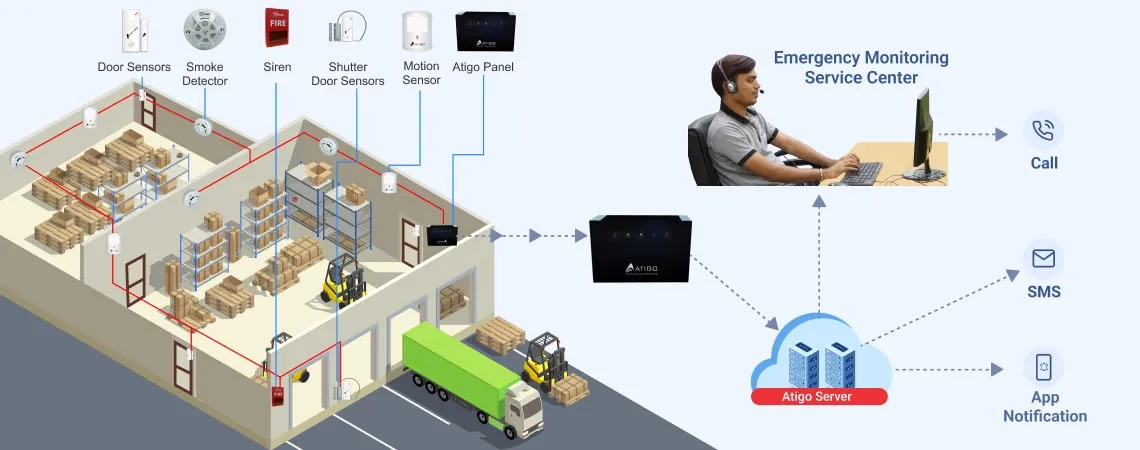
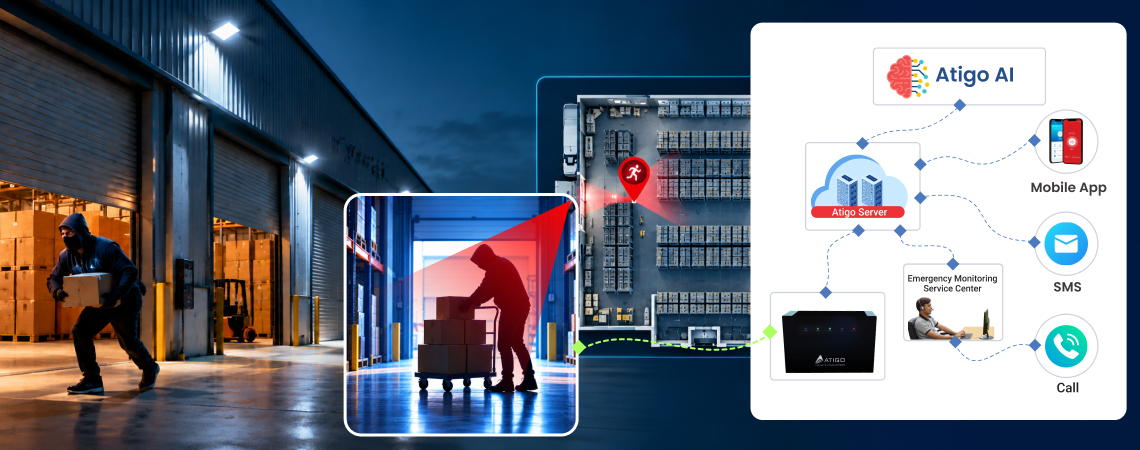
Monitored protection closes that gap. With Atigo’s Professional Protection Platform, sensors at shutters, doors and interiors report to the Alaris 2.0 panel, which transmits over both GSM and Wi-Fi to Atigo’s 24×7 monitoring centre. Trained protection officers work to a 60-second response SLA, contacting the owner and designated representatives and guiding them through organising an effective response, which can include informing the local police. Officers do not dispatch police directly; the people who know the site stay in control.
The model works without cameras. At a warehouse in Uttar Pradesh, sensor data alone, with no CCTV involved, led to the criminals being caught and goods worth more than ₹1 crore being saved.
The strongest arrangement is not the owner doing everything or the tenant doing everything. It is both sides agreeing who covers which layer, and connecting those layers to one response. Atigo serves multi-tenant warehouse parks, and a practical model looks like this.
Record in the lease or a side letter who protects the gate and common areas, who protects each unit’s entry points, and who pays for what.
Shutters, docks, rear doors and service passages in every occupied unit, and in vacant units between tenancies.
A single monitoring arrangement across the park avoids gaps between units and gives park management visibility of incidents that affect the whole site.
Each occupier names people who will answer at night. Park management and the gate guard are included where an incident affects common areas.
A guard who is alerted to a specific unit and entry point can act on it, instead of patrolling blind.
Individual user codes, a clear closing routine and periodic review of arming records by each occupier.
Owners and occupiers review incidents and system health together, at least at each lease renewal.
For the full technical and implementation detail, see the implementation checklist in our pillar guide.
Protect units between tenancies, reduce damage from forced entry, and offer monitored protection as part of your park.
It depends on the lease. In organised parks, common-area security is typically funded through CAM charges, while the unit interior and stock are usually the occupier’s responsibility unless the lease says otherwise. Confirm the split in writing.
Standard burglary policies typically cover theft after forcible and violent entry and commonly exclude losses involving the insured’s staff. Employee dishonesty is usually addressed by a separate fidelity guarantee policy. Check your own wording.
It can. Some policy wordings require protections, including intruder alarms, to be in full operation when the premises are closed, with codes kept confidential. Security measures are also among the factors insurers consider in pricing (TropoGo).
Yes. A gate guard controls entry to the park but cannot watch every unit’s shutters and docks through the night. A monitored alarm protects each unit’s entry points and escalates an intrusion within a defined response time.
Yes. Atigo serves multi-tenant warehouse parks, protecting individual units while supporting a coordinated response between park management and each occupier.
India’s trusted security partner since 2013. Made in India manufacturer of 24/7 monitored alarm systems.
© 2013-2026 Atigo Security – A division of Atigo Enterprises Limited
Made in India. Monitored in India.