India is adding warehouse space faster than ever, and most of it sits unattended every night. This guide explains, with verified data, why alarms and cameras alone keep failing godown owners, and how AI, IoT, cloud computing and a 24×7 monitoring centre turn an intrusion into an organised response while it is still happening.

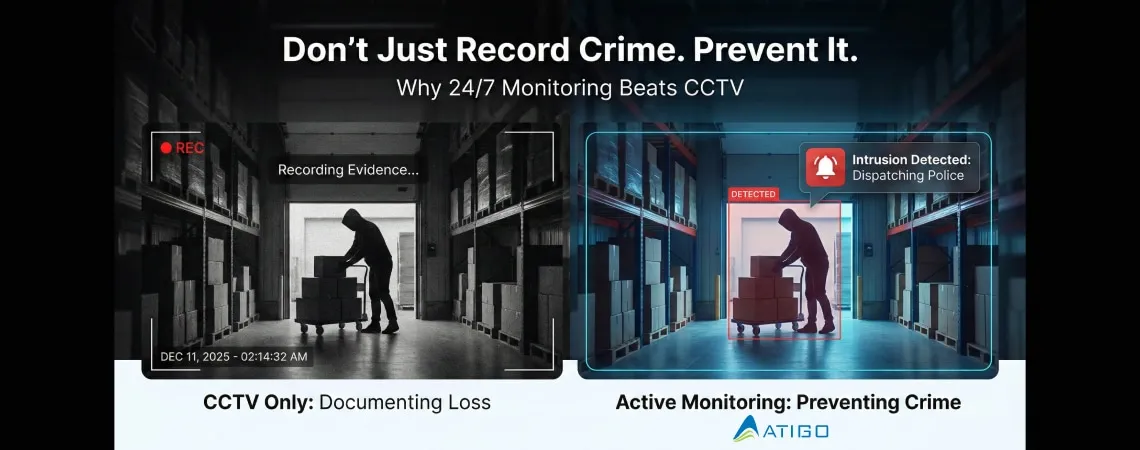
An AIoT warehouse security platform combines wireless intrusion sensors (IoT), cloud-based alarm processing and event verification (AI), and a 24×7 monitoring centre where trained officers escalate every genuine alarm to the owner and designated contacts within a defined response window. Unlike standalone CCTV or sirens, it turns detection into an organised human response while the intrusion is still in progress, which matters because most stolen property in India is never recovered.
India’s warehousing boom is one of the quiet success stories of the decade. According to JLL, national warehousing stock reached about 610 million sq ft in 2025, with more than half of it Grade A space, and is on course for roughly 850 million sq ft by 2030 (JLL, reported February 2026). Vestian recorded 38.7 million sq ft of absorption in 2025, 84% higher than 2020 levels, even after a cooling from the record set in 2024 (Vestian, January 2026).
Growth is also moving outward. Tier 2 cities posted about 12 million sq ft of net absorption in 2025 (JLL), and dedicated freight corridors are pulling new sheds into peri-urban belts where the nearest neighbour may be a kilometre away. Every one of those square feet holds inventory that belongs to someone: a manufacturer, a distributor, an e-commerce seller, or a third-party logistics provider’s client.
And for many hours every night, almost all of it is unattended.
That range frames everything in this guide. When roughly two-thirds or more of stolen value never comes back, recovery after the fact is not a security strategy. The only protection that reliably works is the kind that acts before the truck leaves the gate.
The national picture is mixed. NCRB’s Crime in India 2024, released in May 2026, shows theft down 9.8% and robbery down 13% on 2023, while burglary held roughly steady. Fewer reported thefts nationally is welcome, but it does not change the risk profile of an individual warehouse, which concentrates the conditions that make burglary profitable.
FMCG cartons, textiles, electronics and appliances are standardised and easy to resell. Unlike jewellery, they rarely carry serial numbers that a local buyer would check.
A typical godown has front rolling shutters, loading docks, rear doors, service passages and sometimes skylights or ventilation openings. Each one is a separate point of failure, and most of them face away from the road.
Industrial belts clear out after the last shift. Across Atigo’s retail and commercial work, the highest-risk window for break-ins is between roughly 8 PM and 4 AM, when premises are closed and few people are around to notice.
Keys, shutter codes and shift schedules are shared with staff out of operational necessity, and that access is sometimes abused. Three recent reports show how this plays out.
Ahmedabad, March 2026. A textile unit owner handed the godown keys to an employee so a late-night consignment could be unloaded. Over the following days, fabric and finished work worth about ₹36.6 lakh went missing. The material belonged to the firm’s clients, and police have booked the employee and unidentified accomplices (Gujarat Samachar, 6 March 2026).
Bengaluru, May 2026. A stock audit at a Mahadevapura warehouse run by two private agencies found coolers and electronic goods worth ₹13.18 lakh missing from a businessman’s stored stock. Police suspected insider involvement, and the CCTV cameras were reported to be off (Deccan Herald, 9 May 2026).
Lucknow, August 2022. About 150 cartons of chocolates worth ₹17 lakh were taken from a distributor’s godown, and the thieves removed the CCTV recorder as well. A neighbour heard a pick-up truck at night but assumed the owner had come to collect stock (The Tribune, 17 August 2022).
None of these were failures of detection technology. Two sites had cameras. In each case, the loss was discovered after the fact, because nothing connected the moment of intrusion to a person responsible for acting on it. The Lucknow neighbour is the clearest illustration: a human heard the break-in and still could not tell it apart from normal activity. A monitored system would have known that the site was armed and that nobody was authorised to be there.
Each traditional tool does one job well. The problem is that none of them, on its own, is a response system.
| Traditional tool | What it does well | Where it breaks down in a warehouse |
|---|---|---|
| CCTV | Records evidence for investigation | Records incidents but does not respond. Cameras can be off and recorders removed, as reported in Bengaluru and Lucknow. |
| Local siren | Deters opportunistic intruders | No managed response. In a deserted industrial area, nobody may hear it, and nobody is accountable for acting on it. |
| Self-monitored mobile alerts | Informs the owner directly | The owner may be asleep, travelling or on silent. There is no escalation if the first call goes unanswered. |
| Security guard | Physical presence and deterrence | One person cannot watch a large perimeter all night. A 2017 FICCI-PwC report flagged the shortage of quality manpower and high attrition as major challenges for manned guarding. |
This is the detection-to-response gap. Detection has been solved for years. What remains unsolved at most sites is the handover from “something happened” to “someone responsible is acting on it right now.” Closing that gap is what modern AIoT platforms are designed to do.
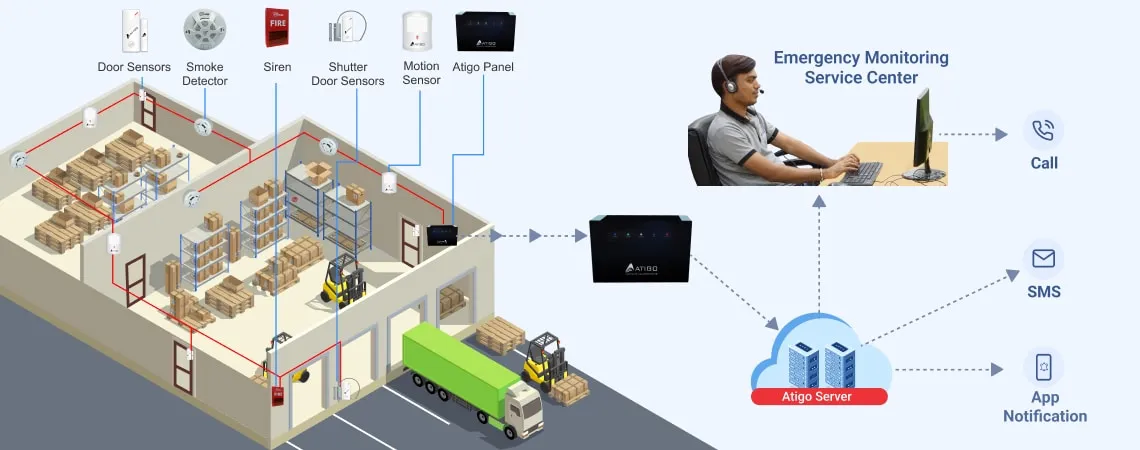
AIoT is shorthand for artificial intelligence applied to data from connected Internet of Things devices. In security, it describes a system in which sensors, a connected control panel, cloud software and trained people work as one chain. The five building blocks are simpler than the jargon suggests.
| Building block | What it does | Why it matters for a warehouse |
|---|---|---|
| IoT sensors | Detect a specific physical event: a shutter being lifted, a door opening, motion inside, glass breaking | Catches intrusion at the entry point, often before goods are touched |
| Connected alarm panel | Collects sensor signals on site and transmits them securely off site | The alarm leaves the building even if the site is cut off from people |
| Cloud platform | Receives, processes and records events from every site in real time | One owner can see many godowns, and every event is logged |
| AI event intelligence | Verifies events in context and monitors the health of the system itself | Officers see a meaningful incident rather than a raw beep, and a silent system gets noticed |
| 24×7 monitoring centre | Trained officers act on every verified alarm under a defined response SLA | Turns detection into accountable, time-bound human action |
The last block is the one most often missing. Without it, the first four simply produce faster notifications for an owner who may not be awake to receive them.
Atigo’s Professional Protection Platform (PPP) is a sensor-based AIoT system backed by professional monitoring. Atigo designs and builds its hardware in India, with R&D collaboration with IIT Gandhinagar and manufacturing in Ahmedabad, and has run professional monitoring for more than 12 years. The platform works in three layers.
Protection starts where intruders start. Shutter vibration sensors respond to lifting, prising or forcing of rolling shutters, the most common way into an Indian godown. Door sensors cover rear doors and service passages. Motion detectors watch the interior aisles, glass-break sensors cover glazed offices and windows, and panic buttons give night staff or guards a silent way to raise an alarm. Because the goal is to detect at the boundary, the alarm is often raised while the intruder is still trying to get in.
Sensors report to the Alaris 2.0 AIoT panel on site. The panel transmits events to Atigo’s AIoT server over two independent pathways, GSM and Wi-Fi, so an alarm still gets out if one link is down. Communication is protected with AES-256 encryption and TLS 1.3.
On the server, real-time event verification adds context to each alarm, so the officer sees which part of the site triggered and whether the premises was armed. System health monitoring keeps watch on the platform itself, so a panel or sensor that stops reporting becomes a visible event rather than a silent gap. That matters because, as the Bengaluru case suggests, protection that is not working is often discovered only after a loss.
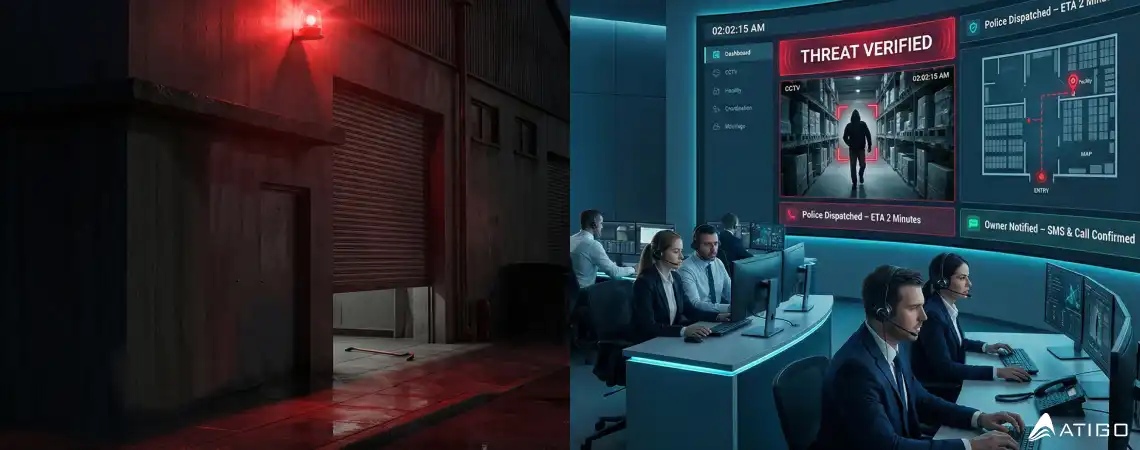
This is the layer that closes the gap. Verified alarms reach Atigo’s 24×7 monitoring centre, where trained protection officers work to a 60-second response SLA. Officers call and message the owner and designated representatives in a pre-agreed escalation order, moving to the next contact if a call goes unanswered, and guide them through organising an effective response. That can include informing the local police, sending a trusted staff member or alerting nearby security.
Atigo officers do not dispatch police directly. The owner and designated contacts stay in control, because they know the site, the people and the right local authorities, while the monitoring centre makes sure the response starts in seconds rather than the next morning.
Owners and managers get real-time alerts on mobile, remote arm and disarm, and multi-user access for supervisors across shifts. Incident history and audit logs create a record of alarms and arming activity, which is useful when keys and codes are shared across a team.
The following scenario is illustrative. It shows how the same intrusion unfolds under two different setups.
| Moment | Alarm and CCTV only | Atigo monitored protection |
|---|---|---|
| Intruders force the rear shutter | Siren may sound. Cameras record. | Shutter sensor triggers. The panel transmits the event over GSM or Wi-Fi. |
| Within 60 seconds | Nobody is responsible for acting. The owner's phone may be on silent. | A protection officer has the verified event and calls the owner. If there is no answer, the next designated contact is called. |
| Next few minutes | Goods are loaded. The recorder may be removed. | The owner, guided by the officer, organises a response: informing police, sending staff, alerting neighbouring security. |
| Next morning | Loss discovered. FIR filed. Recovery unlikely. | Timestamped incident record available. Intrusion interrupted while in progress. |
The technology in both columns can detect the break-in. The difference is whether detection is connected to a person with a duty to act and a clock to act against.
This case is worth pausing on because it overturns a common assumption. Many owners believe that without video, nobody can know what is happening on site. In practice, the chain that mattered was simple: a sensor detected a specific event, the event reached a monitoring centre in real time, and people acted while the intrusion was in progress. It is one of more than 100 verified emergency responses Atigo has handled.
This is not an either-or choice, and CCTV remains valuable for evidence and investigation. But for triggering a real-time response, sensors have practical advantages in Indian warehouses.
A shutter sensor reports one specific event at one specific point. There is no footage to interpret at 3 AM.
Sensors do not depend on lighting, line of sight or clean lenses, which matters in unlit sheds and dusty loading areas.
Alarm events are small data packets, so they travel reliably over GSM where broadband is weak, as it often is in industrial outskirts.
A sensor-based system does not stream images of staff or visitors.
With system health monitoring, a panel that goes offline is itself an event, unlike a camera that is off and unnoticed.
The strongest setup for most warehouses is layered: monitored sensors to trigger a real-time response, and CCTV to document what happened
With national recovery rates between 29% and 36% in recent years (NCRB data via PTI), a warehouse owner should plan as if stolen stock is gone for good. Compare that with the running cost of monitoring. Atigo’s Professional plan is ₹1,200 + GST per month, about ₹1,416 with GST. The ₹13.18 lakh loss reported in Bengaluru would cover more than 75 years of that subscription. The ₹36.6 lakh Ahmedabad loss would cover more than two centuries of it. These comparisons illustrate scale, not a guarantee: no system prevents every loss, particularly where insiders with legitimate access are involved.
Larger warehouses usually need more sensors than the security alarm kit provided free at activation, and those are quoted after a site assessment. Even so, the arithmetic is rarely close.
In the Ahmedabad case, the stolen fabric belonged to the firm’s clients. For 3PL operators, contract manufacturers and job-work units, theft is not just a stock loss. It is a breach of trust with customers, and often a commercial dispute. Demonstrable, professionally monitored protection is increasingly part of what clients expect when they hand over their inventory.
Multi-site owners can see arming status, alarms and history for every location from one app, instead of relying on phone calls to supervisors at closing time.
Timestamped incident history and audit logs give owners a clear record to share with police, clients and insurers if an incident does occur.
1. Start with a risk assessment. Walk the site at night. Map every entry point: front shutters, loading docks, rear doors, service passages, roof access and glazed areas.
2. Protect the perimeter first. Put detection where intruders enter, so alarms are raised before goods are reached. Add interior motion detection as a second line for high-value zones.
3. Build a real escalation list. Name at least three people who will answer at night, in order, and keep numbers current. The monitoring centre can only escalate to people who pick up.
4. Make arming a discipline. Agree who arms and disarms the site and when. Use individual user access rather than one shared code, so audit logs mean something.
5. Integrate with guards and CCTV. Give night guards panic buttons, and position cameras to document the entry points that sensors protect.
6. Test and review. Walk-test sensors periodically, review incident history monthly and update the escalation list whenever staff change.
No system physically stops a determined gang on its own. What monitored protection does is compress the time between intrusion and response, from hours to seconds. Its effectiveness depends on correct sensor placement, which reduces false alarms, on the site staying connected, which dual GSM and Wi-Fi pathways support, and on escalation contacts who actually answer at night.
| Question to ask | Why it matters |
|---|---|
| Who answers the alarm, and within what time? | Ask for a response SLA in writing. Without one, "monitoring" can mean a notification to your own phone. |
| Is the monitoring centre staffed 24×7 by trained officers? | Break-ins cluster at night, when unstaffed or outsourced desks are weakest. |
| How many transmission pathways does the panel use? | A single link is a single point of failure. Look for independent pathways such as GSM and Wi-Fi. |
| How is data encrypted? | Alarm traffic should be encrypted end to end with current standards. |
| Does the platform monitor its own health? | You need to know when a sensor or panel goes quiet, not just when it triggers. |
| What happens after the alarm? | Ask exactly who is called, in what order and what the officer does next. |
| Who supports the hardware locally? | Made-in-India hardware with local support shortens repair and replacement times. |
| Which certifications apply to this product? | Check that certifications cited belong to the security product itself. Atigo's security platform carries ISO 9001 and CE. |
Our view is that security will follow the rest of the warehouse in becoming a live data layer. Owners who already track inventory, orders and trucks in real time will expect the same visibility for intrusion, with a named, accountable human response behind every alarm. The sites that adopt this model early will carry less risk, and will be easier to trust with other people’s goods.
Atigo’s team will map your entry points, your highest-risk hours and your current response gap, and recommend a sensor and monitoring setup for your site.
It combines wireless intrusion sensors (IoT), cloud-based alarm processing and event verification (AI), and a 24×7 monitoring centre where trained officers escalate every genuine alarm to the owner and designated contacts within a defined response window.
CCTV records what happened but does not respond. Cameras can be off and recorders removed, as reported in godown thefts in Bengaluru and Lucknow. CCTV works best alongside monitored intrusion detection that triggers a human response while the intrusion is in progress.
No. Atigo officers contact the owner and designated representatives immediately and guide them through organising an effective response, which can include informing the local police.
No camera is required, because the platform is sensor-based. The Alaris 2.0 panel transmits over GSM and Wi-Fi, so the site stays connected if one pathway fails.
Atigo monitoring plans start from ₹850 + GST per month, and the Professional plan is ₹1,200 + GST per month. A security alarm kit is provided free at activation. Larger warehouses usually need additional sensors, quoted after a site assessment.
It helps by making access visible. Multi-user access, remote arm and disarm, and incident history with audit logs give owners a record of arming activity where keys and codes are shared with staff.
India’s trusted security partner since 2013. Made in India manufacturer of 24/7 monitored alarm systems.
© 2013-2025 Atigo Security — A division of Atigo Enterprises Limited
Made in India. Monitored in India.