At 3:00 AM on a Tuesday in September 2024, three masked men broke the locks of a mobile showroom in Vasant Kunj, South Delhi. Working with practiced speed, they swept over 150 smartphones — worth approximately ₹26 lakhs — into sacks and were gone within four minutes.
The store had CCTV cameras installed. The footage was clear. The burglars were visible in every frame.
The owner found out at 9:00 AM — six hours later — when he arrived to open the shop.
By then, the phones had vanished. The CCTV footage was useful only as police evidence filed alongside an FIR. Recovery, as India’s own data shows, is unlikely: out of 5,45,592 phones lost or stolen in Delhi, only 4,893 were recovered by police — a recovery rate of just 0.90%.
This is not a story about a store owner who neglected security. He had cameras. He had door locks. He may even have had a basic alarm. But none of it stopped the theft. None of it could.
And that is precisely the problem that India’s phone and electronics retailers face today — not a lack of security tools, but a critical gap between what those tools can do and what store owners believe they do.
Walk into almost any mobile phone store in India and you’ll see cameras mounted at the corners, the entrance, behind the display counter. Store owners often treat this as a complete security solution.
CCTV records incidents. It captures useful evidence. But cameras cannot stop theft while it is happening.
Think about what happens when a sensor or camera detects a break-in at 2:30 AM. The footage records every second of the intrusion. But who is watching that footage live? In most stores, the answer is no one. Traditional CCTV recording provides evidence after losses occur, but doesn’t trigger an immediate response that could prevent theft as it unfolds. This delay transforms retail store security systems into cost centres that document problems instead of solving them.
The Vasant Kunj robbery is not an anomaly. Across India, phone store break-ins follow the same pattern: entry after midnight, high-value units cleared in minutes, discovery at opening time. By the time a case is registered, the merchandise is already being redistributed through grey-market channels.
CCTV is a critical evidence tool. It is not a protection system. There is a fundamental difference, and confusing the two is expensive.
A standalone alarm system is an improvement over CCTV-only security. When a sensor is triggered, a siren sounds and an alert is sent to the owner’s mobile. Experienced burglars know exactly what to do next.
They move faster.
Most high-value mobile store burglaries are completed in under five minutes. A loud alarm is an annoyance, not a barrier. The store owner receives a notification on their phone at 2:30 AM. Groggy and kilometres away, what do they do? Call the police? Which station? Which number? And what happens while they fumble for a response?
An unmonitored alarm system only sends alerts to your phone — leaving you to figure out what to do next, often at 2 AM when you’re asleep or unable to respond effectively.
An alarm that alerts only you transfers the entire burden of emergency response to a panicked store owner with no protocol, no authority, and no speed.
Security guards are India’s most common retail security measure and arguably its most unreliable one. The operational reality is difficult to ignore.
A guard is one person, managing fatigue across a 12-hour night shift, without training in emergency escalation protocols. They cannot be in two places at once. They can be intimidated, overpowered, or simply absent at the moment that matters.
More critically: a guard watching the door is still a passive deterrent, not an active protection system. If three individuals enter simultaneously with the intent to clear a store, the guard is not the last line of defence they are simply the first obstacle.
The question is not whether you have security in place. The question is whether your security can respond and intervene within the time window that burglars operate in.
India’s mobile and electronics retail crime pattern is predictable. After-hours break-ins — between 8 PM and 4 AM — account for the overwhelming majority of losses for high-value electronics stores. This is when stores are unoccupied, police patrols are thinner, and response times are longest.
Burglars targeted a mobile shop in Lucknow’s Hasanganj area at around 4:30 AM, using an advanced hydraulic jack to lift the shop shutter. One member slipped inside and stayed for around 40 minutes, collecting approximately ₹2.5 lakh in cash and mobile phones worth ₹18 lakh. The incident was discovered when the shopkeeper opened the shop at around 11 AM.
The pattern repeats across cities. The window between intrusion and discovery is measured in hours. And it is entirely within that window that a professional protection platform makes the defining difference.
Real-time theft protection is not about receiving an alert faster. It is about ensuring that a trained, authorised professional acts on that alert within seconds — verifying the threat, engaging the emergency response chain, and actively guiding an intervention — before the thieves have finished loading their bags.
This is the architecture of Atigo’s Professional Protection Platform: a four-layer system designed specifically for high-value retail environments like mobile phone stores.
At the foundation is Atigo’s Alaris 2.0 — India’s first AIoT security panel, manufactured in Ahmedabad with R&D in partnership with IIT Gandhinagar. This is not a basic alarm panel. It is an intelligent sensor network designed specifically for Indian environmental conditions.
Imported sensors commonly fail in India’s climate — temperatures above 40°C combined with high humidity cause false triggers, sensor drift, and system failures precisely when reliability matters most. Atigo’s hardware was engineered from the ground up for Indian conditions, addressing this challenge directly.
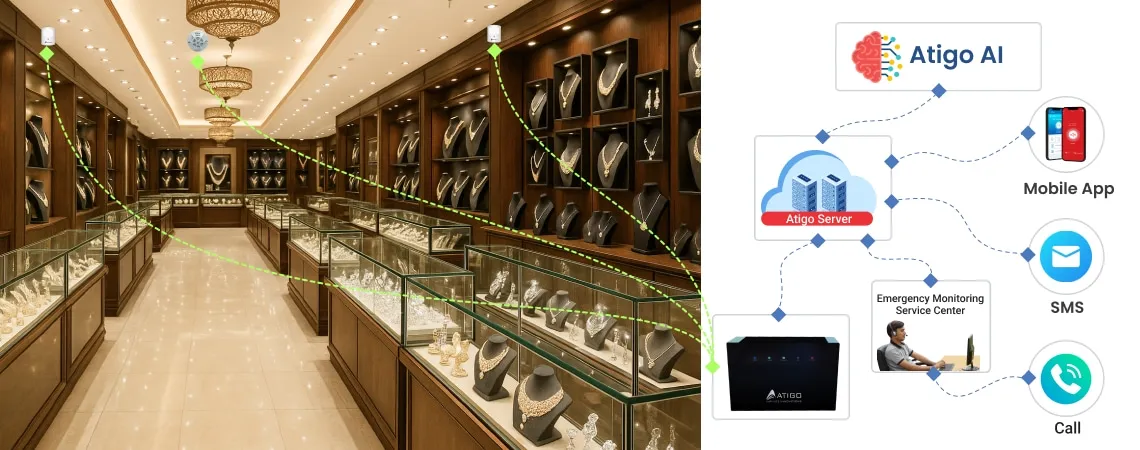
The Alaris 2.0 uses a multi-sensor approach: PIR (passive infrared) motion detectors, door/window contact sensors, glass-break detectors, and shock sensors — all networked to the central panel. The moment an intruder breaches the perimeter, the system generates a verified, encrypted alert.
Communication uses triple-pathway connectivity — GSM, Wi-Fi, and Bluetooth — ensuring that even if one channel is compromised (a common tactic used by sophisticated burglars who attempt to jam signals), the alert reaches the monitoring centre through the redundant pathways. All data is secured with AES-256 encryption and TLS 1.3 protocols — the same standards used in defence and banking applications.
When a sensor triggers, the encrypted signal travels instantly to Atigo’s AI-powered cloud infrastructure. This is where the intelligence layer operates.
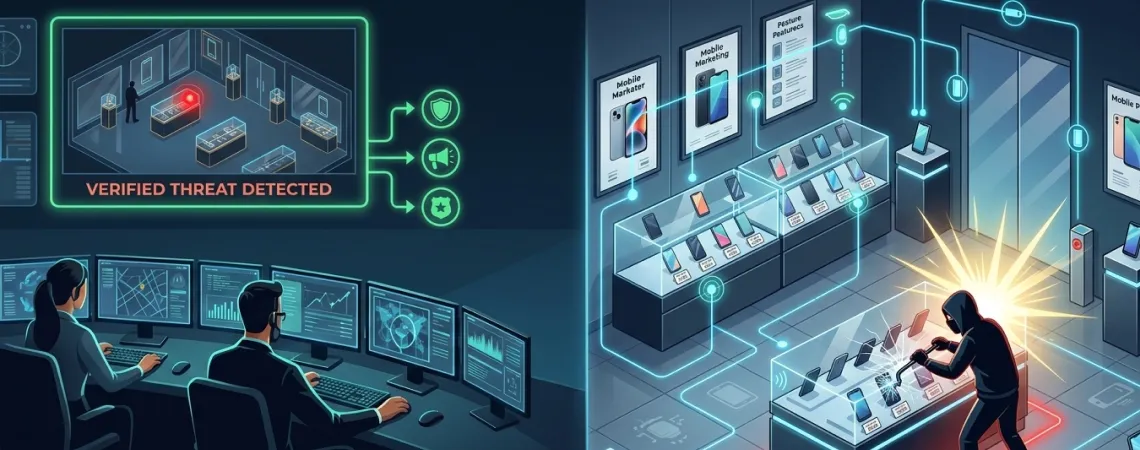
The AI cloud analyses the incoming signal against contextual data: time of day, sensor combination, trigger pattern, and historical baseline for that specific store. This multi-variable analysis helps distinguish a genuine intrusion from a spurious trigger — a critical function that prevents alert fatigue and ensures that when a monitoring officer is engaged, the alert is real.
This verification step happens in seconds — not minutes. The result is passed immediately to the human layer of the platform.
Simultaneously, the Atigo mobile app delivers a real-time alert to the store owner’s phone. Not just a notification — a live status view showing which sensor triggered, at what time, with the verified threat classification.
This matters because it keeps the store owner informed and in control without placing the burden of response on them. You know what is happening. You know it has been escalated. You can track the intervention in real time rather than waiting for a call at 7 AM.
For multi-location phone retailers managing two or three stores across a city, this centralised visibility across all sites — from a single app — is a transformative operational advantage.
The question is not whether you have security in place. The question is whether your security can respond and intervene within the time window that burglars operate in.
This is the layer that none of the three traditional approaches — CCTV, standalone alarms, or security guards — can replicate.
Atigo’s 24/7 monitoring centre is staffed by trained Protection Monitoring Officers who operate on a structured emergency response protocol. These are professionals with defined escalation procedures, trained to act quickly and guide the right people into the right actions — within the first 60 seconds of a verified threat.
When a verified intrusion alert arrives, the monitoring officer acts immediately:
The SLA is 60 seconds from verified trigger to active response initiation. This is not a target — it is a committed service standard.
To understand why this matters: professional security monitoring goes beyond traditional security measures by providing round-the-clock surveillance and services for businesses — responding to alerts from commercial security systems, verifying concerns, and working closely with owners or managers to dispatch authorities immediately in case of security incidents.
The difference between a 60-second professional response and a store owner receiving a notification at 2 AM is the difference between intervention and documentation.
Technology handles detection, verification, and communication at speeds no human can match. But the final act of emergency response — reaching the right person, communicating precisely what has happened, and guiding an effective on-ground response — requires a trained human with protocol, composure, and experience.
Atigo’s monitoring officers are not call-centre operators reading from a script. They are security professionals trained specifically in physical intrusion response. They reach the store owner or a pre-designated representative immediately, guide them through exactly what steps to take, and remain on the line as the response is organised. For store owners alone at midnight with a phone notification and no protocol, this guidance is the difference between paralysis and effective action.
This is the component most underestimated in traditional security planning — and the one that determines whether a triggered alarm results in a criminal prosecution or an unanswered FIR.
Consider a single mid-sized mobile phone store in Tier 1 or Tier 2 India, carrying an average inventory value of ₹20–40 lakhs. A single after-hours break-in — the kind that clears ₹15–25 lakhs in display stock — does not just create a financial loss. It creates:
Atigo’s Professional Protection Platform for retail starts at ₹14,400 per year — hardware, monitoring, and the 60-second response SLA included. That is ₹1,200 per month, or ₹40 per day, to have a trained monitoring officer watching your store through every hour it is unoccupied.
Professional 24/7 emergency monitoring is significantly less expensive than hiring a security guard (₹15,000–25,000 per month) and provides superior protection through expert threat verification and immediate emergency coordination.
A security guard costs 10–20x more per month and introduces the reliability risks described earlier. A standalone alarm system costs a fraction of that but leaves you alone with a notification at 2 AM.
The professional protection platform sits at the intersection of affordability and genuine effectiveness — designed for store owners who cannot absorb a ₹20-lakh inventory loss but who also cannot carry the overhead of a full private security operation.
When selecting a professional protection platform for a high-value electronics store, certifications are not marketing language — they are operational commitments that signal consistent manufacturing standards, quality management, and design compliance.
Atigo’s alarm platform carries:
For retailers dealing with insurance providers, landlords, or corporate clients, certified equipment and a documented monitoring protocol directly strengthens the risk management argument and can support insurance premium negotiations.
Before the next audit of your store’s security arrangements, consider these practical questions:
1. What happens when your alarm triggers at 2 AM? Who receives the alert? What is their protocol? How quickly can a meaningful response be initiated? If the answer is “my phone gets a notification and I figure it out,” you have a documentation system, not a protection system.
2. How long would it take to discover a break-in if no one was watching? In the Vasant Kunj case, the answer was six hours. For many stores operating without professional monitoring, that window is similar. In six hours, merchandise can be distributed, disassembled, or moved across state lines.
3. Is your alarm system tamper-resistant? Experienced burglars know how to disable single-pathway alarm systems — cutting landline connections, jamming basic GSM signals, or simply overpowering the deterrent before it reaches anyone. Does your system have redundant communication pathways?
4. Can you document your emergency response protocol to an insurance provider? Professional monitoring creates a verifiable record of your security posture — timestamps, response logs, incident documentation — that standalone alarms and CCTV systems cannot replicate.
Atigo is not an imported solution retrofitted for India. The company was founded in Ahmedabad in 2013 with a specific mandate: build safety and security technology for Indian environments, not adapted from Western products designed for different climates, infrastructure, and threat landscapes.
The R&D journey began in 2009 — specifically because imported sensors were failing in Indian climate conditions. The Alaris 2.0’s triple-pathway connectivity addresses India’s infrastructure realities, where power fluctuations and network variability are operational facts, not edge cases. The monitoring centre has been operational since 2013, with officers trained on India’s local emergency response landscape.
For a phone store owner in Surat, Indore, Hyderabad, or any Indian city with a growing retail crime challenge, this local engineering context is not incidental — it is what makes the system reliable in practice.
India’s mobile phone retail market is growing. Display values are increasing. And the criminal infrastructure targeting after-hours retail break-ins is sophisticated, fast, and increasingly organised, with metropolitan cities recording a 10.6% rise in crime according to the NCRB Crime in India 2023 report, with theft accounting for the largest share of urban crime at 44.8% of cases.
CCTV records what happened. A basic alarm tells you it happened. A sleeping guard may or may not notice it happened. None of these answers the only question that actually matters in the moment of a break-in:
Atigo’s Professional Protection Platform answers that question with a committed 60-second response SLA, a trained monitoring officer, and a four-layer technology architecture that was built in India for India’s retail security realities.
The choice for phone store owners is no longer between expensive and affordable security. It is between security that records and security that responds.
Atigo Smart Security provides professional protection for mobile phone stores and electronics retailers across India, starting at ₹14,400 per year — including hardware, AI-powered alarm system, 24/7 monitoring, and the 60-second response SLA.
To assess your store’s current security gaps and get a no-obligation consultation, contact the Atigo team today.
A basic alarm system sends an alert to your phone when a sensor triggers. Professional monitoring means a trained officer receives that alert, verifies the threat, and initiates an emergency response — all within 60 seconds — while you are informed in real time via the mobile app. One places the response burden entirely on the owner; the other deploys a prepared professional on your behalf.
Professional monitoring can prevent a break-in from being completed. When a perimeter sensor triggers at the point of entry — door, window, or glass-break — the 60-second response initiation often begins while the intruder is still on-site. Audible deterrents, emergency coordination, and the knowledge that a monitored response is underway can interrupt and abort a burglary in progress.
The Alaris 2.0 uses triple-pathway connectivity — GSM, Wi-Fi, and Bluetooth — with battery backup. If one pathway is disrupted, communication continues through the redundant channels. This is specifically designed to defeat signal-jamming and infrastructure sabotage attempts.
Atigo’s retail monitoring starts at ₹14,400 per year — approximately ₹40 per day. This includes the hardware system, AI cloud verification, mobile app access, and 24/7 monitoring with a 60-second response SLA. For context, a single mid-range smartphone theft exceeds this annual cost many times over.
No. Atigo’s protection platform is sensor-based. Monitoring officers respond to verified sensor alerts — intrusion detection, motion triggers, door/window breach signals — and follow a structured emergency response protocol. This design ensures rapid, accurate response without privacy concerns for store owners or their customers.
For Indian retail deployments, look for STQC certification (India’s government quality standard for electronic security equipment), ISO 9001 (quality management), and EN54 or IS/ISO 7240 compliance for fire and safety systems. Atigo’s platform carries all of these.
India’s trusted security partner since 2013. Made in India manufacturer of 24/7 monitored alarm systems.
© 2013-2025 Atigo Security — A division of Atigo Enterprises Limited
Made in India. Monitored in India.