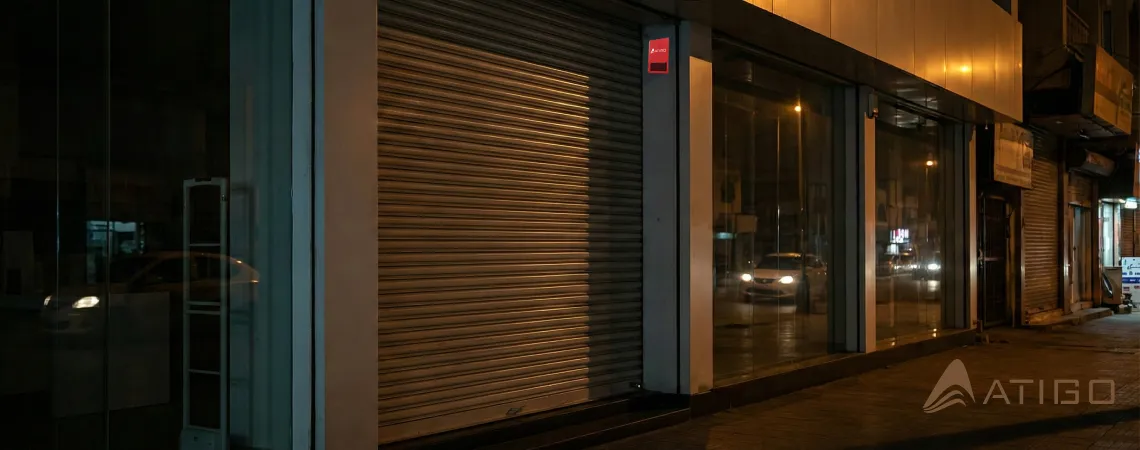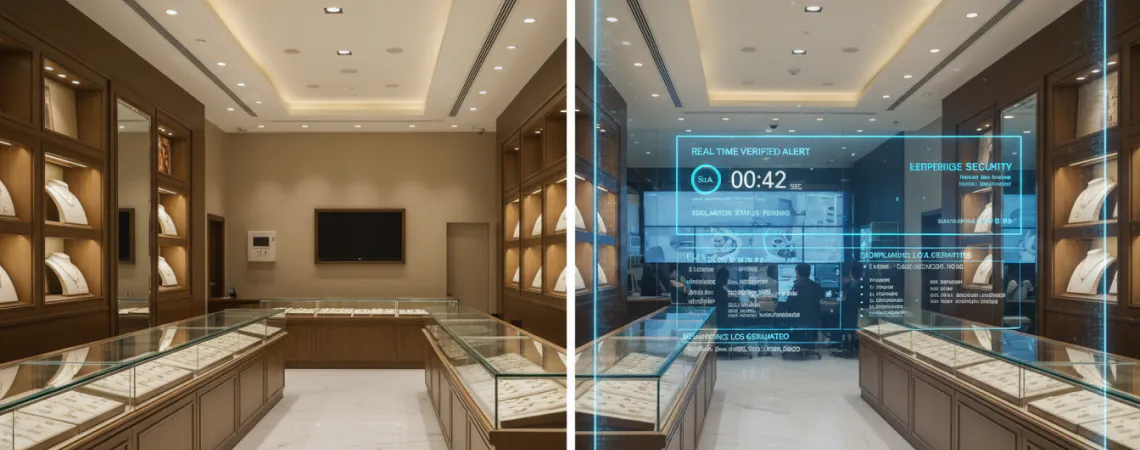
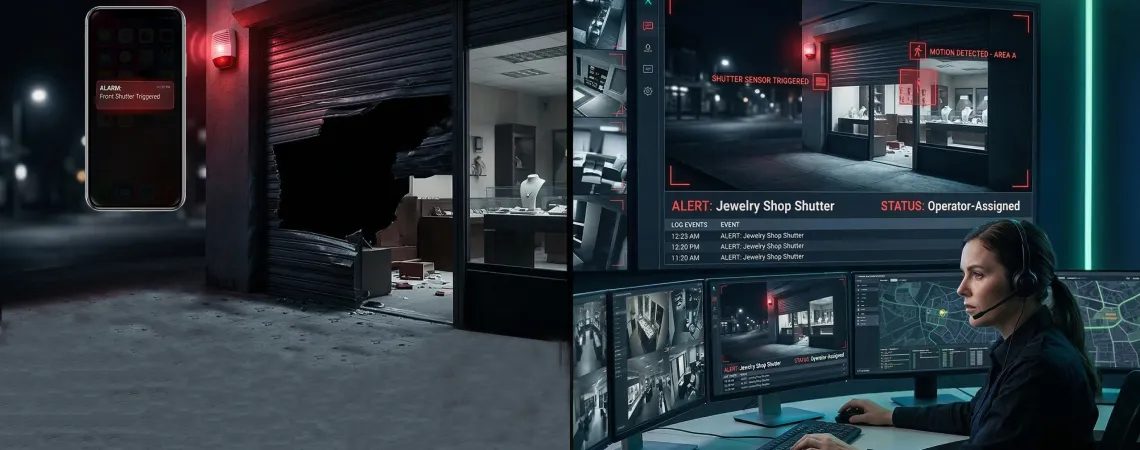
A jewellery showroom closes at 8 PM on a Sunday evening. Staff lock up. The owner drives home. A market guard — shared between six adjacent shops — begins a slow circuit of the lane. Sometime after midnight, three men enter through the terrace access.
Their first act is not to touch a display case. It is to disable six CCTV cameras and cut the WiFi router cable. Then they work through the night, drilling a two-foot hole through a reinforced concrete safe room wall.
By 10:30 AM on Tuesday — more than 36 hours after closing — the owner arrives to find ₹20 crore worth of gold and diamond jewellery gone. Gone cleanly. Gone completely. Not a single usable frame of footage. Not a single alert triggered to anyone.
This incident, reported by Outlook India in January 2024, is one of the largest retail burglaries in Delhi’s recent history. But what makes it instructive for every retailer in India is not its scale. It is how entirely predictable every step of it was. The criminals did not improvise. They executed a blueprint that works — and works specifically because most Indian retail security setups are built on assumptions that organised criminals understand better than their victims do.
What is India’s retail shrinkage rate?
India has the highest retail shrinkage rate in the world, at 2.7% of total retail revenue, according to the Global Retail Theft Barometer Study by the Centre for Retail Research, Nottingham. The total cost of retail crime in India reached ₹9,295.9 crore annually.
India’s retail crime problem is not an occasional bad-luck story. It is a systemic, measurable crisis with escalating numbers every year.
The Global Retail Theft Barometer Study (Centre for Retail Research, Nottingham) places India at the top of a list no economy wants to lead: the highest retail shrinkage rate in the world, at 2.7% of total retail revenue. The total cost: ₹9,295.9 crore lost annually to retail crime. That burden does not stay in the supply chain — it translates to an estimated ₹6,631 extracted from every Indian household through higher consumer prices.
The National Crime Records Bureau (NCRB) 2023 Report — the Government of India’s definitive survey of crime — recorded 62.4 lakh cognizable crimes nationally, a 7.2% rise over 2022. Property offences constitute 23.3% of all IPC crimes. Theft is the single most prevalent property crime category in urban India, year after year.
The global picture compounds the urgency. According to ASIS International’s November 2025 report, external retail theft incidents rose 26% from 2022 to 2023, and a further 19% in 2024. Organised Retail Crime (ORC) incidents jumped 57% between 2022 and 2023 (National Retail Federation, 2024). Global retail losses are projected to reach $55 billion by 2028 (Capital One Shopping Research, 2025).
The trend line for India’s retail crime environment is upward. The criminal organisations executing retail break-ins are growing more sophisticated, more mobile, and more precise. The security gap most retailers are operating with was never adequate — and it is widening every year.
Retail burglary is not random. It is not opportunistic in the way a street-level snatch theft is opportunistic. The break-ins that cost Indian jewellery showrooms, electronics retailers, and luxury goods stores crores of rupees are planned events — surveyed in advance, risk-assessed, and executed by individuals who have already concluded that the risk environment is acceptable.
Here are the five structural advantages the retail criminal systematically exploits — and why they remain so reliable.
When do most retail break-ins happen in India?
Most retail break-ins occur at night or on weekends when stores are unoccupied. The gap between closing and opening — 14 hours on a weekday, up to 36 hours over a Sunday-Monday closure — is the criminal’s operating window, during which no staff, customers, or on-site human presence can observe or interrupt them.
The single most important structural advantage a retail criminal has is time. Unconstrained, unobserved time.
The gap between a store closing and opening is the criminal’s canvas. A standard weekday creates a 14-hour window. A Sunday closure stretching into a Monday public holiday gives organised crews a 36-hour uninterrupted operating period — as the Delhi jewellery case demonstrated.
Within that window there are no staff, no customers, no human witnesses, and — in most conventional retail security setups — no active alert system watching the premises. Professional burglars targeting a safe or strongroom can execute their entire operation, including entry, asset extraction, and clean exit, within two to three hours. The remaining ten or thirty-three hours are irrelevant. The job is already done.
This is the foundational geometry of retail break-in crime. Every other structural advantage the criminal exploits is built on this first one. Remove the unobserved overnight window — by maintaining active, sensor-based monitoring and professional human response throughout every unoccupied hour — and every downstream advantage collapses with it.
Can CCTV prevent retail break-ins?
No. CCTV is a recording and documentation system, not a detection or prevention system. It captures footage for post-incident review but does not trigger real-time alerts or initiate responses. Organised criminal crews routinely disable CCTV cameras as the first step upon entry cutting cables or disabling WiFi routers to stop cloud backup
The most expensive misunderstanding in Indian retail security is treating a CCTV installation as security.
A CCTV system is a recording device. Its footage exists to document what happened after an event for police investigation, for insurance claims, for potential legal proceedings. It does not detect an intrusion. It does not alert a monitoring agent. It does not dispatch a response. It records.
Organised retail criminals have understood this for years. In virtually every documented high-value retail break-in, camera disabling is the first operational step not the last. In the Delhi case: six cameras disabled, WiFi severed, cloud backup stopped. Standard procedure.
Research on Indian smart city CCTV infrastructure has found that camera coverage is frequently incomplete stockrooms, secondary exits, corners behind shelving creating predictable blind spots that experienced criminals account for in advance.
To be clear: CCTV has real value in investigation, in court, and in insurance settlement. The argument is not against cameras. It is against the common and dangerous belief that cameras equal protection. A retailer whose primary security layer is CCTV is not protected. They are documented.
The critical distinction: A CCTV system asks “what happened?” An active sensor-based alarm system with professional monitoring asks “what is happening right now?” — and acts on the answer in seconds.
What is the average police response time for a burglary in India?
Based on data from the UP 100 centralised dispatch system — one of India’s most advanced — the average emergency response time is 13.5 minutes across urban and rural areas combined, and 35+ minutes in rural locations. In areas without centralised dispatch systems, response times are inconsistent and can be significantly longer.
Here is what experienced retail criminals understand that most store owners do not: the gap between a triggered alarm and a police officer arriving at the premises is the criminal’s operating budget.
Even the best-case scenario an alarm triggers, a notification reaches the owner immediately, the owner calls 100 without hesitation, and a patrol vehicle happens to be close produces a response that arrives, optimistically, 10 to 15 minutes after first contact. Research data on India’s UP 100 emergency system cited by Hexagon Safety & Infrastructure and The Better India reports an average response time of 13.5 minutes across the system’s coverage area. Rural calls extend to 35 minutes or more. In cities and districts without a centralised dispatch architecture, response times vary sharply and, as documented by The Better India, an officer “may not even turn up depending on the nature of the complaint.”
Human Rights Watch’s detailed study on the Indian police system noted that resource constraints shortages of patrol vehicles, fuel limitations, and staffing gaps directly impair response capability, with a national average of approximately seven vehicles per 100 officers.
A professional retail break-in crew needs 10 to 20 minutes from forced entry to clean exit. In most real-world scenarios across India’s tier-2 and tier-3 cities, they win that calculation comfortably. They are planning to be gone before a patrol vehicle departs the station.
The only operational response to this reality is not hoping police arrive faster. It is compressing the alert-to-escalation chain so dramatically that the criminal’s window closes before they have finished opening it.
Why is retail burglary low-risk for criminals in India?
Retail break-ins offer high asset value per operation, physical anonymity (working at night in unoccupied premises), and a meaningful probability of escaping detection. NCRB 2023 data shows 29.2% of IPC cases pending investigation at year-end. Organised retail crime groups operating across multiple cities further reduce the probability of attribution and prosecution on any single incident.
Criminal deterrence follows a straightforward economic logic: the probability of getting caught, multiplied by the severity of consequence, must outweigh the reward for crime to be effectively deterred. In India’s retail break-in context, that calculus leans consistently in the criminal’s favour.
NCRB 2023 data shows that 29.2% of IPC cases were pending investigation at year-end before prosecution even begins. Property crimes particularly night-time break-ins where cameras were disabled, forensic traces were minimised, and perpetrators operated with protective gear present significantly lower detection and conviction rates than violent crimes with witnesses.
The National Retail Federation’s 2024 research found that 65% of retailers globally report fewer than half of theft incidents to law enforcement at all, most commonly because they do not expect recovery. Under-reporting further depresses the statistical deterrent.
For an organised criminal group operating across multiple cities the ORC network model documented by both ASIS International and the NRF the probability of attribution, arrest, charge-sheeting, and conviction on any single retail break-in is meaningfully low. The expected reward per operation (₹10 lakh to ₹20 crore in a jewellery or electronics context) versus the expected probability of consequence creates a rational incentive to continue.
The only thing that concretely changes this calculation is verified, professional monitoring which transforms a break-in from an undetected overnight operation into an actively tracked event with law enforcement engaged within 60 seconds of detection, and a complete tamper-evident audit trail generated automatically.
How do retail criminals choose which stores to target?
Research from Arizona State University’s Centre for Problem-Oriented Policing shows that organised retail burglars actively select targets based on security profile assessment — favouring stores with high-value goods and passive, unmonitored security systems. ASIS International documents that ORC groups specifically target premises with unmonitored alarms because it extends their uninterrupted operating time on site.
This is the piece most retailers do not fully absorb: your store is not randomly selected. It is assessed.
Research from Arizona State University’s Centre for Problem-Oriented Policing the most comprehensive criminological study of retail burglary methodology documents that sophisticated retail burglars “show some care in selecting safer targets” and specifically evaluate whether an alarm is monitored, because an unmonitored alarm buys them undisturbed time. ASIS International’s reporting confirms that ORC groups specifically identify premises with passive, unmonitored security as preferred targets.
Advance reconnaissance of retail corridors noting market guard schedules, shared security arrangements, camera positions, and alarm signage is standard operating procedure for organised crews. A store with a passive, local-siren alarm and shared market security looks, to a professional criminal, like an open invitation. A store with a visible Atigo monitoring installation, STQC-certified hardware, and professional monitoring signage reads as a high-risk target — one that will generate a verified, rapid response, and leave a forensic record.
Target selection is the criminal’s first decision. Making your security visibly professional and actively monitored is itself a primary crime prevention measure — before a single sensor has ever triggered.
What is India’s retail shrinkage rate?
India has the highest retail shrinkage rate in the world, at 2.7% of total retail revenue, according to the Global Retail Theft Barometer Study by the Centre for Retail Research, Nottingham. The total cost of retail crime in India reached ₹9,295.9 crore annually.
The five structural advantages that make retail break-ins a criminal’s preferred enterprise are not inevitable. Each one maps directly to a specific, solvable gap in the conventional retail security model — and Atigo’s Professional Protection Platform is built to close all five, in sequence, as an integrated system.
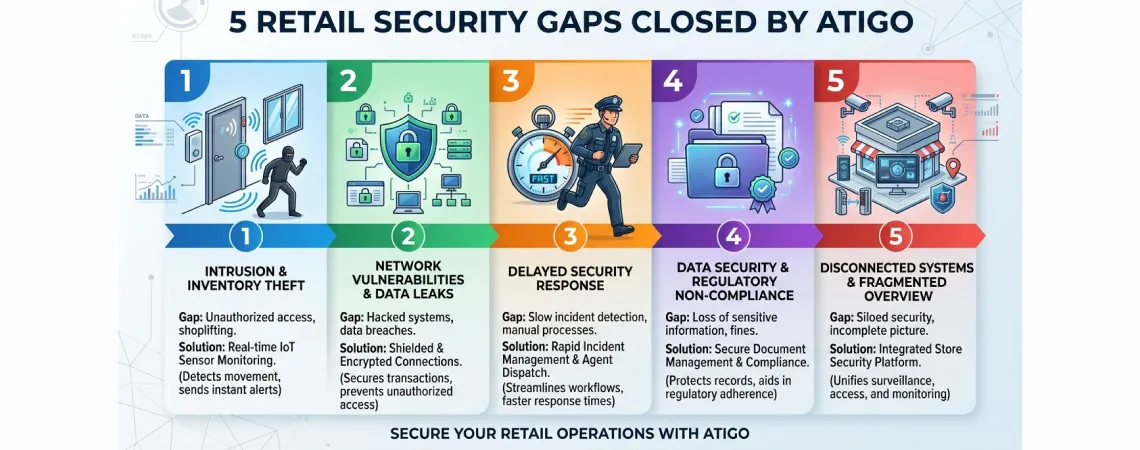
| Criminal Structural Advantage | Conventional Security Gap | Atigo's Counter |
|---|---|---|
| Overnight unobserved window | No human coverage after hours | Continuous 24/7 AIoT sensor monitoring |
| Passive CCTV, disableable | Records only; no real-time detection | Active sensor detection; triple-path GSM connectivity |
| Police response: 13–35 mins | Passive notification to owner | 60-second SLA professional escalation |
| Low prosecution probability | No forensic alert trail | Encrypted, timestamped, tamper-evident audit trail |
| Deliberate target selection | Unmonitored premise = easy target | Visible professional monitoring = high-risk target |
The Alaris 2.0 panel — India’s first AIoT security panel with simultaneous Wi-Fi, Bluetooth, and GSM connectivity — maintains active, real-time sensor monitoring throughout every unoccupied hour, seven days a week, 365 days a year. Motion sensors, door and window contact sensors, glass break detectors, and perimeter sensors form overlapping detection fields that leave no blind spot and no offline period.
Every sensor event is processed in real time by the AIoT platform. When an anomalous condition is detected — movement in a secured area, contact breach on a door or shutter, vibration consistent with forced entry — the system immediately escalates to Atigo’s 24/7 professional monitoring centre. The overnight window remains dark for the criminal. For Atigo’s monitoring agents, it is fully visible.
The Alaris 2.0 panel uses three independent communication pathways: Wi-Fi, GSM, and Bluetooth. If a criminal severs the WiFi cable or disables the router — the standard first move in organised break-ins — the system automatically routes alert communications through the GSM mobile network pathway. That pathway operates on infrastructure that is not located in your store and cannot be accessed by anyone inside your premises.
All system communications are encrypted with AES-256 military-grade encryption and TLS 1.3 protocols. The alert pathway to the monitoring centre is not just resilient — it is cryptographically secured against interception and spoofing.
The sensors are not passive recorders. They are active detection devices that initiate an immediate, verified alert the moment threshold conditions are met. There is no footage to review after the fact. There is an escalated alert before the crime has progressed.
What is Atigo’s monitoring response time?
Atigo’s professional monitoring centre delivers a Service Level Agreement-backed response of 60 seconds from confirmed alert to active escalation. A trained monitoring agent immediately contacts the designated keyholder and coordinates with local police emergency services — compressing the alert-to-law-enforcement chain from India’s average 13–35 minutes to 60 seconds
Atigo’s 24/7 professional monitoring centre — operational since 2013 — is the operational heart of the Professional Protection Platform. When a verified intrusion event is detected on your premises, a trained monitoring agent initiates the response protocol within 60 seconds: contacting your designated keyholder, and coordinating with local police emergency services.
This is not a push notification to a mobile phone. It is a professional, trained human being executing a defined, SLA-contractual protocol — the moment your alarm triggers.
The 60-second SLA compresses the total alert-to-law-enforcement chain from India’s documented average of 13 to 35 minutes to under one minute. Criminals who have calculated their operating window based on passive alarms and owner notification delays find that window effectively closed.
The Atigo UP warehouse case demonstrates this in documented Indian conditions: a ₹1 crore+ asset-saving outcome using sensor-based detection alone — no CCTV involved — with the monitoring centre’s response catching the intrusion in progress before significant loss could occur.
A monitored break-in attempt — even one that is interrupted before significant loss — produces a complete forensic record that meaningfully improves investigation outcomes and insurance settlement timelines. This quality of evidence materially changes the prosecution probability calculus for the organised criminals who factor that probability into their target selection decisions.
Atigo’s AIoT Security Intelligence Platform generates a timestamped, encrypted, tamper-evident audit trail of every sensor event — entry detection sequence, alert escalation time, system communications, and monitoring centre response record. This data is securely stored and fully exportable for police investigation, insurance claims, and legal proceedings.
Atigo’s installation is visible. The certified hardware, professional monitoring signage, and industry-recognised compliance marks — STQC tested, ISO 9001 certified, EN54 and IS/ISO 7240 compliant communicate to any criminal conducting advance reconnaissance that this store has active, professional monitoring and will generate a verified, rapid response.
Research consistently shows that organised retail burglars prefer targets where security is passively documented over targets where it is actively monitored. Making your security visibly professional is itself a primary crime prevention measure. Atigo-monitored premises move off the target list. That change happens before a single sensor is ever triggered.
What does Atigo’s Professional Protection Plan include for retail stores?
Atigo’s Professional Protection Plan includes the Alaris 2.0 AIoT intrusion detection panel with triple-pathway GSM/Wi-Fi/Bluetooth connectivity, 24/7 professional monitoring with a 60-second SLA-backed response, AES-256 encrypted communications, STQC-tested hardware, and a tamper-evident audit trail for insurance and legal use starting from ₹850 + GST per month.
For retail businesses across India jewellery showrooms, electronics and IT stores, luxury goods retailers, pharmacy chains, and any business carrying high-value inventory — the Professional Protection Plan delivers:
AIoT Intrusion Detection The Alaris 2.0 panel integrates multi-sensor detection (motion, door/window contact, glass break, vibration) into a unified intelligence platform. Detection is active, continuous, and multi-layered across all unoccupied hours.
Dual-Pathway Connectivity Wi-Fi, GSM communication pathways maintain monitoring continuity even when local connectivity is disrupted. GSM operates on mobile infrastructure outside your premises and cannot be disabled from inside your store.
24/7 Professional Monitoring Centre Atigo’s agents operate around the clock, 365 days a year, with a contractual 60-second SLA from confirmed alert to active escalation. Operational since 2013, following international emergency monitoring protocols.
Military-Grade Encrypted Communications AES-256 encryption and TLS 1.3 protocol secure all alert pathway communications against interception and spoofing.
STQC-Tested, ISO 9001 Certified Hardware All hardware is STQC-tested, manufactured in Ahmedabad, and engineered for Indian operating conditions including 40°C+ heat and high-humidity environments. EN54 and IS/ISO 7240 compliant.
Timestamped Forensic Audit Trail Every monitored event generates a complete, encrypted, tamper-evident record for police, insurers, and legal proceedings.
Starting from ₹850 + GST per month. Enterprise-grade professional monitoring made accessible for independent and mid-size retailers.
The primary structural factor is the convergence of three conditions: an extended unoccupied window (overnight and weekends), passive CCTV that records but does not detect or alert in real time, and a police response time that — even in well-served urban areas — rarely falls below 10 to 15 minutes. Organised criminal crews can enter, execute, and exit a retail premises within that window. Sensor-based professional monitoring with a 60-second SLA-backed response is the only measure that operationally closes this gap.
No. CCTV is a recording and documentation system, not a detection or prevention system. Organised criminal crews routinely disable CCTV cameras as their first operational step upon entry — cutting cables, unplugging equipment, or disabling WiFi routers that support cloud backup. A sensor-based alarm system with triple-pathway GSM, Wi-Fi, and Bluetooth connectivity cannot be disabled from inside the premises in the same way, because the GSM communication pathway operates on mobile infrastructure independent of local connectivity.
Based on UP 100 centralised dispatch data — one of India’s most advanced emergency systems — the average response time is 13.5 minutes across urban and rural areas, and 35 or more minutes in rural locations. In areas without centralised dispatch systems, response times are inconsistent. Atigo’s professional monitoring centre initiates escalation to police emergency services within 60 seconds of a confirmed alert — compressing the total response chain from minutes to seconds.
Professional monitoring means trained Atigo monitoring agents actively watch for alerts from your store’s sensor network — 24 hours a day, every day of the year. When an intrusion alert is verified, an agent immediately contacts your designated keyholder and coordinates with local police emergency services within 60 seconds. This is not a push notification to your phone. It is a staffed, professional response by a trained human being executing a defined, contractually committed protocol.
The Alaris 2.0 panel uses three independent communication pathways: Wi-Fi, GSM, and Bluetooth. If Wi-Fi connectivity is disabled — by a criminal or a power cut — the system automatically routes through the GSM pathway, which operates on mobile network infrastructure not located in your premises. The GSM path cannot be severed by anyone inside your store. Monitoring continuity is maintained even under deliberate local disruption.
Yes. The plan starts at ₹660 + GST per month and is designed for the full range of Indian retail — jewellery showrooms, electronics stores, pharmacy chains, and independent specialty retailers. The hardware is STQC-tested, ISO 9001 certified, and manufactured in India for Indian conditions. The monitoring infrastructure — 24/7 agents, 60-second SLA, AES-256 encrypted communications — is identical regardless of store size.
For hardware: STQC testing certification (India’s government testing authority), ISO 9001 quality management certification, and EN54 or IS/ISO 7240 compliance for intrusion and fire detection components. For the monitoring centre: a documented Service Level Agreement with a defined response time, trained agents operating to a verified protocol, and AES-256 encryption across all communications. Atigo’s hardware and monitoring centre meet all of these standards.
Retail crime in India is not random. It is systematic. Organised criminal networks assess targets before they move — evaluating the security infrastructure, the monitoring posture, and the probable response window they face if an alert is triggered. They select the premises where those factors work in their favour.
The five structural conditions that make retail break-ins a calculated, low-risk enterprise — the unobserved overnight window, passive CCTV, slow police response, low prosecution probability, and deliberate target selection — are not self-correcting problems. India’s NCRB data shows property crime volumes rising every year. ORC networks are becoming more coordinated, more mobile, and more precise in target selection. India’s retail shrinkage rate is already the highest in the world, and the gap is widening.
Professional monitoring from Atigo starts at ₹850 + GST per month.
Atigo’s team will evaluate your current setup, identify the specific gaps in your security posture, and recommend the right Professional Protection Plan for your business.
India’s trusted security partner since 2013. Made in India manufacturer of 24/7 monitored alarm systems.
© 2013-2025 Atigo Security — A division of Atigo Enterprises Limited
Made in India. Monitored in India.