
In three separate break-ins at mobile phone shops this summer, the owners found out the same way: the next morning, standing in front of a damaged shutter. The alarm, the camera and the lock had all done their jobs. Nobody had been told in time to do anything about it.
Most commercial break-ins in India happen after closing and are discovered hours later. CCTV records the theft and a siren makes noise, but neither puts a person in charge of responding. Professional monitoring sends every alarm to a 24×7 monitoring centre where a trained officer contacts the owner within seconds, so the response can begin while intruders are still inside rather than after the stock is gone.
Consider three incidents reported between July and August 2026.
In Patna district, a mobile showroom owner closed at around 11 PM. Burglars cut the shutter with a gas cutter and took cash, iPhones, laptops and other stock worth close to ₹40 lakh. The owner learned of it the following morning when an acquaintance called about the damaged shutter (IANS via The Hawk, July 2026).
In Puri, Odisha, a shop owner closed at 9:30 PM and found the shutter broken open the next morning. He reported phones worth about ₹1 crore stolen. Police later recovered 40 handsets and found that the stolen phones had already been moved to Uttar Pradesh and sold (Ommcom News, September 2026).
In Ludhiana, a showroom owner arrived in the morning to find his staff waiting outside and the shutter bent out of shape. Expensive models had been picked out and cheaper phones left behind. He estimated the loss at ₹30 lakh, and police began working from the CCTV footage to trace the suspects (The Tribune, August 2026).
The pattern is consistent. The shops were closed, the intruders had hours, and the first person to know was the owner arriving to open up. By then, the only thing left to do was file a complaint and hand over footage.
These are not isolated cases. According to the National Crime Records Bureau’s Crime in India 2023 report, India recorded 8,78,307 property offences that year, including 6,89,580 thefts and 1,07,573 burglaries. Property worth ₹6,917 crore was stolen, and only 29.9% of it was recovered.
The Crime in India 2024 report, released in May 2026, showed theft falling by 9.8% and robbery by 13%, but burglary remained broadly flat. In other words, break-ins into closed premises did not follow the overall decline.
Closer to home, NCRB figures reported by Gujarat Samachar show that property worth around ₹346 crore was stolen in Gujarat in 2024, of which police recovered ₹94.2 crore. Over 2022 to 2024, Gujarat’s recovery rate stayed between roughly 27% and 30%.
For a business owner, the implication is simple. Roughly seven rupees out of every ten stolen never come back. Recovery after the fact is a weak safety net. The only reliable way to protect inventory is to interrupt the theft while it is happening.
India’s emergency response infrastructure is genuinely improving. Haryana’s 112 service, for example, reported in May 2025 that average police response had fallen to 7 minutes 3 seconds, down from over 12 minutes in 2022. Punjab has committed ₹178 crore to upgrade its Dial 112 system.
But every one of those minutes starts from the moment someone calls. In the incidents above, nobody called during the night because nobody knew. The delay that costs shop owners their stock is not police travel time. It is the hours between the break-in and anyone becoming aware of it.
Policing capacity also sets realistic limits on what night patrols alone can cover. Data from the Bureau of Police Research and Development (BPR&D), analysed by Factly, shows that in 2022 India had 26.8 lakh sanctioned police posts against 20.9 lakh filled, a vacancy rate of about 22%. Officers cannot watch every shutter in every market. A closed shop needs its own way of raising the alarm to a human being.
Most Indian retailers already invest in some security. The issue is that each common measure solves only part of the problem.
| Measure | What it does well | Where it falls short at 3 AM |
|---|---|---|
| CCTV | Records evidence for investigation and insurance | Records incidents but does not respond; intruders in several reported cases damaged cameras or removed the DVR |
| Local siren | Creates noise that may deter an intruder | In a closed market at night, there may be no one who hears it and takes responsibility |
| Self-monitored app alerts | Sends a notification to the owner's phone | Depends on one person waking up, noticing and deciding what to do; phones are often on silent |
| Night guard | Physical presence on site | Limited coverage of rear doors and service entries, and a single person facing an organised group |
| Professional monitoring | Trained officer receives every alarm 24x7 and contacts the owner within a defined response time | Depends on correct contact details and power/connectivity, which good systems monitor continuously |
CCTV remains valuable. In the Ludhiana and Keonjhar cases, footage helped police begin their investigation. But evidence is what you need after a loss. Monitoring is what helps prevent it.
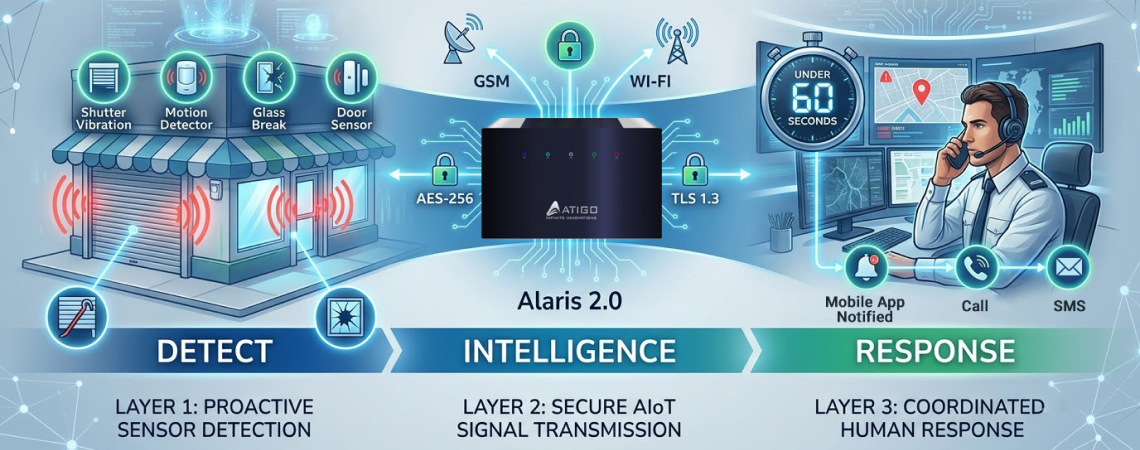
Atigo’s Professional Protection Platform (PPP) combines sensor-based intrusion detection with a 24×7 monitoring centre in three layers.
Sensors are placed where Indian break-ins actually happen: shutter vibration sensors that detect lifting, cutting or forcing, motion detectors inside the premises, door sensors on rear and service entries, glass break sensors for display areas, and panic buttons for staff during business hours. The system detects the attempt at the point of entry, rather than waiting for someone to review footage.
The Made-in-India Alaris 2.0 panel transmits alarms instantly over two independent pathways, GSM and Wi-Fi, so a cut cable or a router failure does not silence the system. Communication is protected with AES-256 and TLS 1.3 encryption. The platform also monitors system health, flagging power loss, connectivity issues or tampering, and supports real-time event verification before escalation.
Every alarm reaches the 24×7 Atigo monitoring centre, where a trained protection officer acts under a 60-second response SLA. The officer contacts the owner or designated representatives, explains exactly which sensor has been triggered and where, and guides them through organising an effective response, such as calling 112 or the local police station, alerting a nearby staff member or neighbour, or contacting the market association. If the first contact does not answer, the officer escalates to the next person on the list.
This is an important distinction. The monitoring officer does not replace the police and does not dispatch them. What the officer does is make sure that the right people know within seconds, with accurate information, and that the call to authorities is made while it can still make a difference.
At a warehouse in Uttar Pradesh protected by Atigo, sensor data alone, with no CCTV involved, alerted the monitoring centre to an intrusion. The response that followed led to the criminals being caught and goods worth more than ₹1 crore being saved. It is a clear example of why detection plus organised human response matters more than footage.
A single display counter of premium smartphones, a jewellery tray or a shelf of laptops can hold lakhs of rupees in stock that fits into a few bags. The Ludhiana case showed thieves deliberately choosing costlier models.
Recent cases involved gas cutters in Patna and small crowbars in Puri. Police in Lucknow have previously described the “Chaddar gang”, which hid its work behind bedsheets and used a hydraulic jack to lift shutters (Hindustan Times, 2017). These groups plan, and they plan around the fact that no one is watching.
In the Puri case, phones stolen in Odisha were transported to Uttar Pradesh and sold. Once stock leaves the city, the 29.9% recovery rate starts to look optimistic.
The Ministry of Home Affairs notes that ERSS-112 is designed to receive distress signals through multiple channels, including IoT-based signals. As India’s public safety systems modernise, businesses with connected, professionally monitored alarms are better placed to raise accurate, timely alerts.
Typically less than the price of one mid-range phone on your counter
Plan and sensors recommended after a free Security Risk Assessment
Security alarm kit, with extended warranty while your subscription is active
Put that against the incidents above: ₹30 lakh lost in a single night in Ludhiana, close to ₹40 lakh in Patna. Monitoring is paid for in small, predictable monthly amounts. A break-in is paid for all at once, usually without warning, and roughly 70% of what is taken never comes back. A single prevented break-in like Ludhiana’s covers the cost of protection many times over.
The plan also adds day-to-day value beyond break-in protection: remote arm and disarm from your phone, multi-user access for partners and managers, real-time alerts on mobile, and a full incident history with audit logs, which is useful for insurance claims and for knowing who opened and closed the shop.
Not every “monitored” system is the same. Before you sign up with anyone, ask:
It is also worth being clear about what any monitored system needs from you: correct and current contact numbers for the escalation list, someone on that list willing to act at night, and a panel installed with the right sensors for your premises. A good provider will walk you through all of this during the site assessment.
CCTV records what happens so it can be reviewed later. A professionally monitored alarm detects an intrusion through sensors and sends the alert to a 24×7 monitoring centre, where a trained officer acts on it immediately by contacting the owner or designated representatives. CCTV provides evidence; monitoring starts the response.
No. Atigo officers contact you or your designated representatives within the response SLA, share what the sensors are reporting, and guide you in organising an effective response, which may include calling 112 or your local police station and alerting people nearby.
Plans are tailored to your premises, entry points and stock exposure. The monthly fee is typically smaller than the price of one mid-range phone on your counter, and the security alarm kit is free at activation, with extended warranty while your subscription is active. Request a free Security Risk Assessment for a quote.
The Alaris 2.0 panel uses two communication pathways, GSM and Wi-Fi, so an alarm can still reach the monitoring centre if one fails. The platform also monitors system health and flags connectivity or power issues.
No. Atigo is sensor-based and works alongside your existing CCTV. Your cameras keep recording evidence while Atigo handles real-time detection and response.
India’s trusted security partner since 2013. Made in India manufacturer of 24/7 monitored alarm systems.
© 2013-2025 Atigo Security — A division of Atigo Enterprises Limited
Made in India. Monitored in India.