The short answer: Retail theft in India and globally is accelerating — and the methods criminals use have become faster, more coordinated, and harder to stop with conventional CCTV monitoring services or passive burglar alarm systems.
Globally, shoplifting and merchandise theft incidents rose 19% in 2024 over the previous year, compounding a 26% surge from 2022 to 2023 (ASIS International, November 2025). The global retail industry is projected to lose $55 billion to theft by 2028 (Capital One Shopping Research, January 2025).
In India, the picture is equally concerning. Retail shrinkage — losses from customer theft, employee theft, vendor fraud, and supply chain errors — is a growing crisis. Publicly listed retailers report shrinkage costs nearly doubling as a percentage of revenue in a single financial year (Business Standard, June 2024). India’s NCRB data consistently confirms theft and robbery among the most prevalent crimes in urban India — precisely where high-value retail businesses operate in the highest concentration.
For jewellery showrooms, luxury electronics stores, premium fashion outlets, and gold shops, the stakes are uniquely high. These stores hold enormous inventory value in a compact footprint. They operate with predictable hours. And they often rely on intrusion detection systems and security infrastructure that has not meaningfully evolved in a decade.
That mismatch — between a rapidly evolving criminal threat and a static security posture — is the core vulnerability that professional monitored protection plans are designed to close.
Is your store genuinely protected or just equipped?
Use Atigo’s 27-point professional security assessment checklist to audit your store’s current protection posture, identify critical gaps, and benchmark against the professional standard. Takes 15 minutes. Could save you crores.
Organised Retail Crime (ORC) refers to coordinated criminal networks — not opportunistic individuals — that plan, resource, and execute theft and robbery operations targeting high-value retail businesses. Understanding ORC is essential context for any high-value retail store evaluating its burglar alarm monitoring needs.
Unlike a lone shoplifter, ORC groups conduct reconnaissance over multiple days. They assign roles across participants. They use stolen vehicles for rapid exit. They time their operations around known vulnerabilities — shift changes, store closing windows, reduced staff periods — and execute within 60 to 90 seconds.
Before selecting a target, organised criminal groups conduct their own version of a security audit. They look for:
Documented cases in India illustrate the sophistication of these networks. In Assam, law enforcement dismantled a robbery gang described for its “terror-like” efficiency — targeting jewellers across districts using high-speed motorcycles, with evidence of insider complicity from a local gold shopkeeper involved in fencing stolen goods (India Today North East, February 2026). In metropolitan cities, organised groups have demonstrated the capability to cut communications infrastructure during break-ins — not merely to steal, but to sever the alert pathway that connects a store to any emergency response.
A store protected by a professional remote monitoring centre with verified response protocols and AIoT-enabled intrusion detection fundamentally changes the criminal’s risk calculus. Organised groups prefer predictable, easy targets. Professional protection removes your store from that category.
Featured Snippet Answer: Passive security systems — standard CCTV cameras and basic alarm panels — fail high-value retail stores because they react after a crime has begun rather than preventing it. They depend on response chains that take 8–15 minutes. Professional criminals operate in under 90 seconds. Only a 24/7 professional monitoring service with SLA-backed escalation protocols can bridge that gap.
Failure 1: It reacts instead of preventing
A CCTV camera records what happens. It cannot stop it. A standalone alarm siren alerts a criminal that they have been detected — but a professional criminal already has an exit plan factored into their 90-second operational window. The incident is over before any human response is possible.
Failure 2: The notification chain is too slow
A standard unmonitored alarm triggers a chain reaction: the system alerts a phone number → the owner calls back → the owner contacts the police → a report is filed → a response is dispatched. This chain takes 8 to 15 minutes on average (Verkada, 2024). Organised retail criminals are gone in under three minutes.
Failure 3: No verified escalation to emergency services
Without professional monitoring and verification, an alarm signal has no credibility attached to it. There is no trained professional confirming what is actually happening. This creates a gap between the moment of breach and any meaningful emergency response a gap that organised criminals have learned to exploit.
| Threat Type | CCTV Only | Basic Burglar Alarm | Professional Monitoring |
|---|---|---|---|
| Smash-and-grab robbery | Records only | Siren only | Verified emergency escalation |
| After-hours perimeter breach | Records only | Alert to phone | Immediate trained response |
| Communication line disruption | Records only | Alarm fails | Redundant multi-pathway monitoring |
| Insider threat / collusion | Records only | No detection | Behaviour analytics + audit trail |
| Pre-attack reconnaissance | Records only | No detection | Anomaly detection alerts |
| Fire and environmental threat | No detection | No detection | Integrated fire & intrusion monitoring |
The 27-point High-Value Retail Security Checklist 2026 walks you through every critical control — from perimeter protection and intrusion detection to monitoring SLAs and compliance documentation. Identify exactly where your gaps are before a criminal does.
Featured Snippet Answer: A professional security monitoring ecosystem is a comprehensive, SLA-backed security service that combines AIoT-powered early detection hardware with 24/7 professionally staffed monitoring and verified emergency escalation protocols — providing end-to-end accountability for your retail store that passive CCTV monitoring services and standalone alarm systems cannot deliver.
A professional monitoring ecosystem has three integrated layers:
AIoT (Artificial Intelligence of Things) security panels continuously analyse data from multiple sensors simultaneously: motion detectors, door and window contacts, glass-break sensors, environmental monitors, and access control systems. Rather than waiting for a single sensor to trip, the system recognises patterns — what normal activity looks like at your specific store — and flags anomalies before a physical breach occurs.
This is the shift from detection to prediction: identifying suspicious patterns during the criminal’s reconnaissance phase, not just triggering an alarm after entry has already been made. This is what fundamentally separates a modern AIoT intrusion detection system from a conventional burglar alarm.
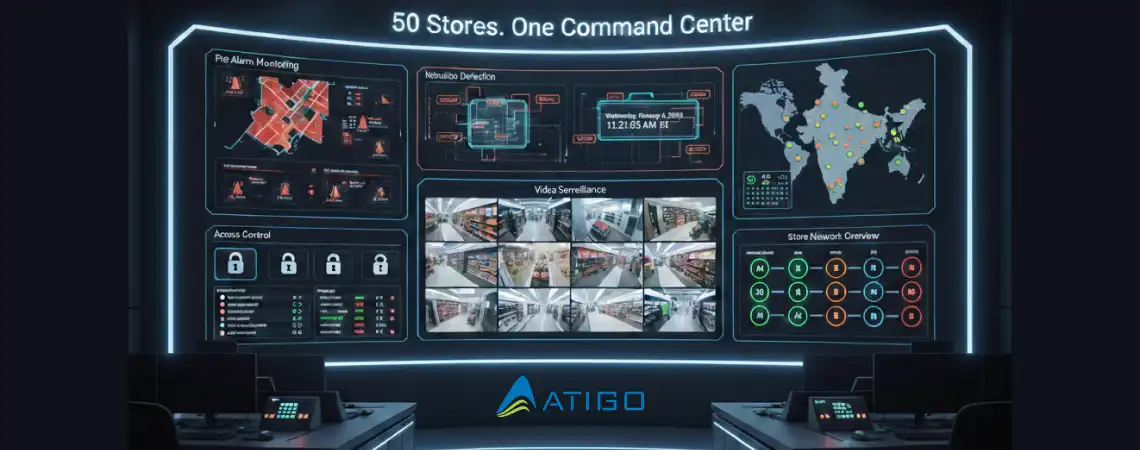
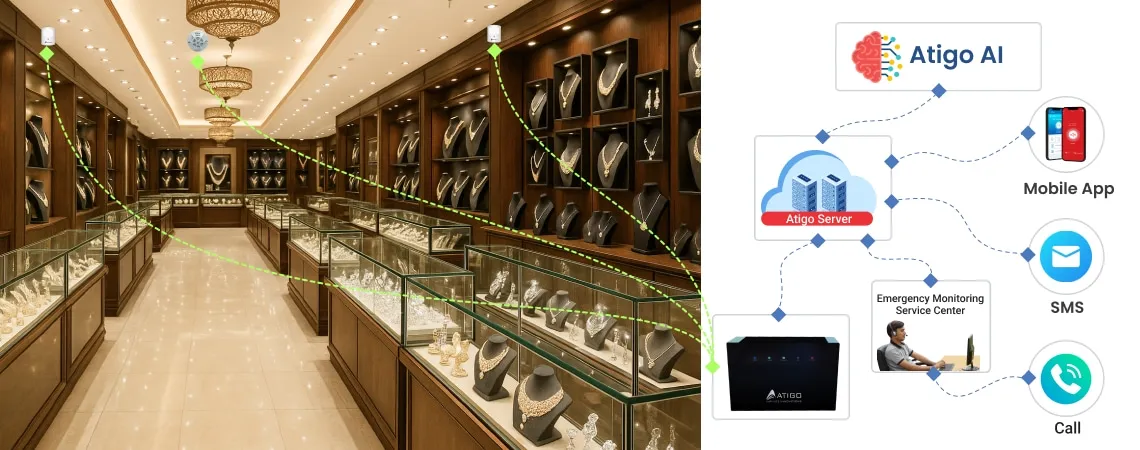
Trained security professionals at a staffed remote monitoring centre receive real-time alerts from the detection hardware and assess the nature and severity of each event using established protocols. When a verified security event is confirmed, escalation to emergency services happens immediately — not through a personal phone call made by a store owner who may be asleep, travelling, or unreachable.
This is the critical difference: a professional monitoring centre operates independently of the store owner’s availability. Your store is protected consistently, around the clock, regardless of what you are doing at that moment.
A Service Level Agreement (SLA) is a contractual commitment specifying response times, escalation steps, and service standards. Every alert, response action, and escalation is timestamped and logged — creating the audit trail that insurers, franchise agreements, and regulatory bodies increasingly require from high-value retail operators.
The Atigo Security Professional Protection Plan is built on 12 years of AIoT safety system engineering in India — hardware designed and tested specifically for Indian climate conditions (operating reliably above 40°C and at 90%+ humidity where imported intrusion detection systems routinely fail), and a monitoring framework adapted for the Indian emergency response environment.
Atigo’s professional monitoring centre operates with trained security professionals around the clock. When the AIoT detection system generates a verified security event, the monitoring centre follows defined escalation protocols — contacting emergency services, notifying designated response contacts, and maintaining a live incident record — all within guaranteed SLA timeframes.
Your store has consistent, accountable protection during every hour it is unattended: through the night, through public holidays, through weekends. The protection does not depend on your phone being charged or your availability to respond.
Atigo’s Alaris 2.0 — India’s first AIoT security panel with integrated Wi-Fi, Bluetooth, and GSM connectivity — provides the detection hardware backbone of the professional protection plan. All communications are protected by AES-256 encryption — the same standard used by banking systems and national defence infrastructure — making the system resistant to signal interception and tampering attempts that sophisticated criminal groups have demonstrated capability to execute against standard alarm systems.
The multi-pathway connectivity (Wi-Fi + Bluetooth + GSM simultaneously) means that disrupting one communication channel does not disable the system. This redundancy is a critical resilience feature: sophisticated criminal groups have been documented attempting to cut or jam alarm communications as a pre-robbery tactic, and single-channel alarm systems have no defence against it.
Every event the system detects, every response action the monitoring centre takes, and every escalation initiated is logged with a timestamp and stored as a verifiable record. This documentation serves multiple business-critical functions:
Atigo’s hardware is STQC-tested, ISO 9001 certified, CE-marked, and RoHS compliant. The NFire addressable fire alarm system carries EN54 and IS/ISO 7240 compliance — meaning the protection ecosystem extends to fire safety as well as intrusion, under a single professional monitoring framework.
Featured Snippet Answer: Retail theft and jewellery shop robberies in India are concentrated in high-density commercial zones across major cities including Mumbai, Delhi NCR, Surat, Jaipur, Ahmedabad, Hyderabad, Bengaluru, and Chennai — where organised criminal networks specifically target high-value retail corridors.
High-value retail theft is not evenly distributed. India’s NCRB data identifies urban concentrations as the highest-risk environments for property crime, and industry experience confirms that specific commercial corridors in large cities account for a disproportionate share of organised retail incidents.
Mumbai & Mumbai Metropolitan Region India’s largest commercial retail market. High-density jewellery corridors in Zaveri Bazaar, Dadar, and Andheri, combined with organised criminal networks operating across Maharashtra, make professional burglar alarm monitoring a non-negotiable baseline for any jewellery showroom or gold shop in the region.
Delhi NCR (Delhi, Gurgaon, Noida, Faridabad) The capital region’s large premium retail footprint — from Karol Bagh jewellery markets to luxury malls in Gurgaon — faces both organised theft networks and the complexity of multi-jurisdiction emergency response. Professional monitored alarm systems with verified escalation protocols are essential to bridge that complexity.
Surat India’s diamond trading capital. Surat’s concentration of diamond merchants, jewellery manufacturers, and high-value export businesses creates a uniquely high-stakes security environment. CCTV monitoring services alone are entirely inadequate for the asset values involved.
Jaipur The Pink City’s jewellery export industry — particularly gem-set and Kundan jewellery — makes Jaipur one of India’s highest-risk cities for targeted jewellery retail crime. Professional remote monitoring centre coverage is increasingly standard among major Jaipur jewellers.
Ahmedabad As the commercial capital of Gujarat and home to a significant concentration of gold jewellery retailers, Ahmedabad has seen documented organised theft activity. Atigo’s own manufacturing and monitoring infrastructure is based in Ahmedabad, with deep knowledge of the local threat environment.
Hyderabad & Bengaluru South India’s rapid premium retail growth — luxury showrooms, electronics flagships, and jewellery chains expanding into new commercial zones — has outpaced security infrastructure upgrades in many stores. Professional 24/7 alarm response services are critical in these fast-growing markets.
Chennai Tamil Nadu’s established jewellery retail market — including major chains operating across the state — requires professional intrusion detection systems with compliance documentation to meet both insurer and franchise security standards.
Featured Snippet Answer: When evaluating a professional security monitoring plan for a retail store in India, assess seven criteria: SLA response time commitment, multi-pathway communication redundancy, certification standards, compliance documentation output, AIoT vs. passive sensor technology, climate-tested hardware, and integration with fire safety systems.
Not all monitored alarm services are equal. Use these seven criteria to compare providers:
1. SLA Response Time Is It Documented or Just Verbal? A genuine SLA is a written contractual commitment with defined response time windows. Ask for the SLA document before signing. Verbal assurances of “fast response” are not enforceable and not acceptable for compliance purposes.
2. Multi-Pathway Communication Redundancy Does the system maintain connectivity if one channel fails or is disrupted? The minimum standard for high-value retail is dual-pathway (GSM + internet). Atigo Alaris 2.0 uses three pathways simultaneously — Wi-Fi, Bluetooth, and GSM — providing resilience that single-channel systems cannot match.
3. Certification Standards — STQC, ISO, EN54 Hardware certifications are not marketing badges. STQC testing, ISO 9001 certification, and EN54 compliance confirm the equipment meets independently verified standards. Ask your provider to share certification documents, not just logos.
4. Compliance Documentation Output Does the system automatically generate timestamped incident logs, response records, and audit trails? For insurance and franchise compliance, you need records that are automatically created — not manually assembled after an incident.
5. AIoT Pattern Detection vs. Passive Sensors Passive sensors respond to single triggers. AIoT systems analyse patterns across multiple data streams simultaneously. For high-value retail, pattern-based intrusion detection systems provide the pre-breach warning capability that passive sensors cannot.
6. Climate-Tested Hardware for Indian Conditions Imported security hardware is frequently rated for European or North American climate ranges. Indian summer conditions — 40°C+ temperatures and 90%+ humidity in coastal cities — cause accelerated failure in non-tested hardware. Ask specifically whether equipment is tested for Indian operating conditions.
7. Integrated Fire and Intrusion Coverage A retail store faces both intrusion and fire risk. A single professional monitoring framework covering both — as Atigo’s plan does through the NFire system — reduces complexity, eliminates coverage gaps, and provides a single audit trail for all safety events.
Before you speak to any security monitoring provider — including Atigo — download the High-Value Retail Security Checklist 2026. Use it as your assessment framework: tick what you already have, identify what you’re missing, and walk into the conversation knowing exactly what questions to ask.
| What the Checklist Covers | Points |
|---|---|
| Perimeter & Physical Security | 5 |
| Intrusion Detection System | 6 |
| Communication & Monitoring | 5 |
| Access Control & Key Management | 5 |
| Compliance & Documentation | 4 |
| Fire Safety Integration | 3 |
| Total Assessment Points | 27 |
Featured Snippet Answer: For high-value retail stores in India, preventing one organised theft or robbery incident typically saves ₹10 lakh to several crores in direct inventory loss, property damage, and business interruption — meaning a professional monitoring plan pays for itself many times over after a single prevented incident.
Professional security monitoring plans for retail stores in India are structured as monthly service fees — covering 24/7 staffed monitoring, SLA-backed response protocols, incident logging, and compliance documentation. The specific fee varies based on store size, location, inventory value, and the hardware configuration required.
The more useful question is not “what does it cost?” but “what does it cost compared to the alternative?” One prevented smash-and-grab robbery at a jewellery showroom holding ₹2 crore of inventory recaptures the plan’s cost many times over. Contact Atigo Security for a tailored quote based on your store’s profile.
Security professionals and industry analysts calculate the full cost of a retail robbery incident across five categories (Interface Systems ROI Analysis, November 2025; Riot Glass, May 2025):
1. Direct Inventory Loss For a jewellery showroom or gold shop, a single organised smash-and-grab can remove inventory worth ₹20 lakh to several crores in under two minutes.
2. Physical Property Damage Smashed display cases, broken entry points, and damaged fixtures typically cost ₹5–20 lakh to repair and replace — costs that arrive alongside lost trading days.
3. Business Interruption A post-robbery store closure for investigation, repair, and security assessment can run from days to weeks. Lost daily revenue, staff wages during closure, and inventory reordering lead times create a compounding financial impact that balance sheets rarely capture fully.
4. Insurance Deductible and Premium Escalation A major theft claim increases your renewal premium and can affect your coverage terms for multiple subsequent years — creating a recurring cost that extends well beyond the incident itself.
5. Customer Confidence Erosion For jewellery and luxury retail, customer trust is a commercial asset. A publicly known robbery incident — especially in the era of social media — can reduce footfall and purchasing intent for months.
Many commercial insurers explicitly reduce premiums for businesses that can demonstrate professional monitored alarm systems with documented SLA-backed response standards (Sirix Monitoring, January 2026). The Atigo Professional Protection Plan’s compliance documentation directly supports this insurer conversation — meaning the plan can partially offset its own cost through reduced insurance expenditure.
Three converging forces make 2026 the critical inflection point for high-value retail security in India:
Retail theft incidents rose 19% in 2024 following a 26% rise in 2023 — a sustained multi-year escalation documented by ASIS International. Organised criminal networks are becoming more sophisticated, more coordinated, and more specifically targeted at high-value retail. The window to upgrade your burglar alarm monitoring before your store becomes a selected target is narrowing.
Insurance underwriters, franchise networks, and industry regulatory bodies — including the Gem and Jewellery Council and BIS-regulated gold retailers — are progressively converting “best practice” security standards into formal requirements. Businesses that upgrade proactively stay ahead of these requirements. Businesses that wait face forced, reactive upgrades under less favourable commercial terms — or face coverage gaps when they need protection most.
The capability represented by Atigo’s professional monitoring plan — AIoT-powered intrusion detection, 24/7 staffed remote monitoring centre, SLA-backed response, compliance documentation — was previously available only to large corporate retailers with dedicated security budgets. The Atigo Professional Protection Plan packages this enterprise-grade protection into a structured service model accessible to independent jewellery showrooms, premium boutiques, and high-value retail stores of all sizes.
Yes. All device communication is encrypted using AES-256 and secured via TLS 1.3. Access is controlled with MFA and role-based permissions.
CCTV alone is insufficient for high-value retail protection in 2026. CCTV records events but cannot prevent them and creates no immediate response pathway. For jewellery stores and gold shops, professional monitored alarm systems with AIoT-powered intrusion detection provide verified emergency escalation that CCTV monitoring services cannot deliver. Many commercial insurers now require documented professional monitoring as a condition of jewellery retail coverage.
SLA stands for Service Level Agreement — a written, contractual commitment from your security monitoring provider that specifies guaranteed response times, defined escalation steps, and documented service standards. SLA-backed monitoring gives you formal accountability: a written standard your provider must meet, with records of every response action for compliance and insurance purposes. It is the difference between a promise and a contract.
Standard alarm panels respond to a single sensor being triggered. AIoT (Artificial Intelligence of Things) security panels simultaneously analyse data across multiple sensors — motion, access control, environmental conditions, and communication signals — and identify anomalous patterns rather than waiting for a single threshold to be crossed. This enables earlier detection during pre-breach phases, fewer false alarms through contextual analysis, and better intelligence for monitoring centre professionals to assess events accurately.
Professional security monitoring plans are structured as monthly service fees, with pricing based on store size, location, inventory value, and the hardware configuration required. For a jewellery showroom or gold shop, the monthly plan cost is a fraction of the value of a single prevented robbery incident. Contact Atigo Security for a no-obligation quote tailored to your specific store.
When the AIoT system generates a verified security alert, trained professionals at Atigo’s monitoring centre receive the notification and assess the event against established response protocols. They then escalate immediately to emergency services and designated contacts — all within SLA-guaranteed response times. Every action taken is timestamped and logged automatically, creating a complete incident record for insurance and compliance purposes.
Yes — significantly so for high-value retail. CCTV passively records events. AIoT intrusion detection systems actively monitor patterns across multiple sensors simultaneously, trigger verified professional response, and are designed to prevent incidents rather than document them after the fact. For a jewellery showroom or premium electronics store, the distinction is not technical — it is the difference between a record of your loss and the prevention of it.
Retail shrinkage is total inventory loss from customer theft, employee theft, vendor fraud, and supply chain errors. Professional monitored alarm systems reduce shrinkage by deterring opportunistic theft through visible security infrastructure, detecting insider anomalies through behaviour pattern analytics, and creating verifiable audit trails that support internal accountability. NCRB data confirms theft remains India’s most prevalent property crime — professional monitoring is the most direct operational response.
Yes, in many cases. Commercial insurers for high-value retail — particularly jewellery, luxury goods, and electronics — assess security infrastructure as part of their risk underwriting model. A professionally monitored alarm system with SLA documentation and compliance-ready records demonstrates lower risk and can qualify your business for reduced premiums. The Atigo Professional Protection Plan’s compliance documentation is specifically structured to support this conversation with your insurer.
The Atigo Alaris 2.0 panel uses three-pathway connectivity simultaneously — Wi-Fi, Bluetooth, and GSM. If any communication channel is disrupted, the system automatically continues operating through the remaining pathways. This triple-redundancy architecture is specifically designed for the threat environment where sophisticated criminal groups have been documented attempting to disable alarm communications before executing a break-in.
Start With the Checklist. Then Start the Conversation.
Before upgrading your security or even before renewing your existing plan download the High-Value Retail Security Checklist 2026 and score your current protection posture honestly. It takes 15 minutes. It reveals gaps that could cost you crores. And it gives you a clear, evidence-based starting point for choosing the right professional protection plan for your store.
Your high-value retail store is the product of years of investment, customer trust built one transaction at a time, and a reputation earned through consistent delivery. In 2026, protecting it with a passive CCTV system and an unmonitored burglar alarm means leaving that investment exposed to a criminal threat environment that has become faster, more organised, and more specifically targeted than anything the previous decade produced.
The Atigo Security Professional Protection Plan delivers what the moment requires: SLA-backed, compliance-ready, AIoT-powered monitored protection — built on 12 years of Indian innovation, certified to international standards, engineered for Indian conditions, and trusted by Indian Railways, Adani Power, State Bank of India, Tata Tanishq, and over 10,000 active installations nationwide.
Atigo Security | Secure. Compliant. Connected
India’s trusted security partner since 2013. Made in India manufacturer of 24/7 monitored alarm systems.
© 2013-2025 Atigo Security — A division of Atigo Enterprises Limited
Made in India. Monitored in India.