
Yet most Indian warehouses continue to rely on a security approach that amounts to little more than recording crimes after they happen: standalone CCTV systems with no active human oversight.
According to recent industry data, cargo thefts surged 68% year-over-year in Q4 2023 compared to 2022. For warehouse operators managing high-value inventory across remote locations on city outskirts, this isn’t just a statistic—it’s a wake-up call.
The harsh reality? A CCTV camera doesn’t prevent a crime. It simply documents it.
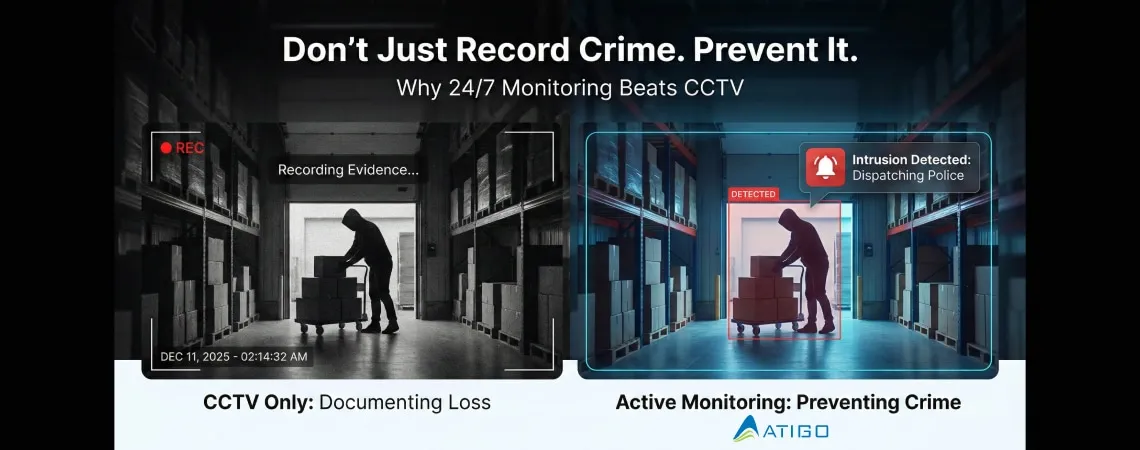
Walk into any Indian warehouse today and you’ll likely see dozens of CCTV cameras mounted at strategic points.
These installations create what security experts call “the illusion of protection”—a false sense of safety that crumbles the moment an actual emergency unfolds.
Here’s what warehouses discover too late about CCTV-only security:
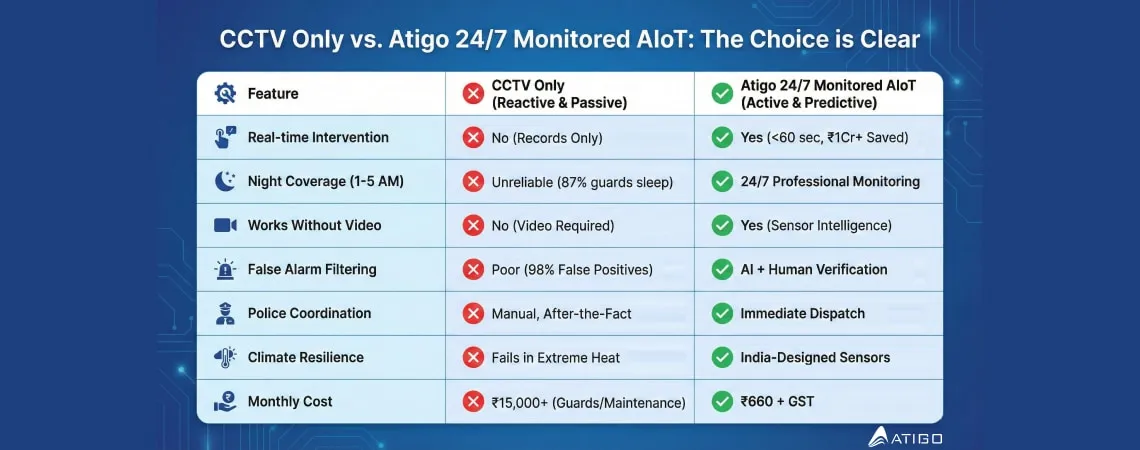
CCTV systems are inherently reactive. They record footage for later review, but provide zero intervention during an active incident.
When a break-in occurs at 2 AM, or when inventory is being stolen from a loading dock, the cameras silently capture every devastating second while no one responds.
By the time footage is reviewed the next morning, inventory is gone and damage is done.
Consider this: A white goods warehouse in Uttar Pradesh had been targeted multiple times at night for theft.
Each time, their CCTV cameras faithfully recorded the break-ins. Each time, they discovered the losses the next morning.
The footage was clear enough to see the perpetrators, but not clear enough for positive identification. Police investigations led nowhere.
The criminals knew they could strike repeatedly with impunity because cameras without active monitoring meant no one would intervene during the crucial 10-15 minutes they needed to load goods and escape.
Even when security guards are stationed to watch CCTV feeds, human factors undermine effectiveness.
Research consistently shows that security personnel sleeping on the job isn’t an occasional problem—it’s endemic in the industry.

One warehouse security analysis found that 87% of security guards sleep between 1-5 AM, precisely when most warehouse break-ins occur.
Alert fatigue sets in quickly when monitoring multiple feeds. Even the most diligent guard can miss critical events in real-time.
According to security industry data, false alarms account for up to 98% of all security system activations, costing businesses an estimated $1.8 billion annually in wasted resources.
CCTV motion detection triggers constant false alerts from:
Without intelligent verification, these systems train operators to ignore alarms—a dangerous conditioning that leaves facilities vulnerable when real threats emerge.
CCTV footage has a limited lifespan. Storage constraints mean recordings are typically retained for 7-30 days, then recorded over.
In many documented cases, warehouse managers discover breaches or safety violations weeks after they occurred, only to find the crucial footage has been erased.
Worse, footage can be deliberately deleted by individuals with access to the system, eliminating evidence of internal theft.
India’s extreme environmental conditions pose unique problems.
Warehouses in locations like Gujarat, Rajasthan, Uttar Pradesh, and central India experience temperatures exceeding 45°C with humidity levels above 90%.
Standard CCTV systems, particularly imported solutions designed for temperate climates, frequently malfunction under these conditions.
Sensors fail. Cameras fog. Equipment degrades rapidly—rendering the entire surveillance infrastructure unreliable precisely when protection is most critical.
A recent industry survey revealed that 98% of Indian homes lack insurance coverage, and the situation is similar for small to medium warehouses.
Without insurance safety nets, a single major theft incident can be financially catastrophic.
CCTV footage of the disaster provides no compensation.
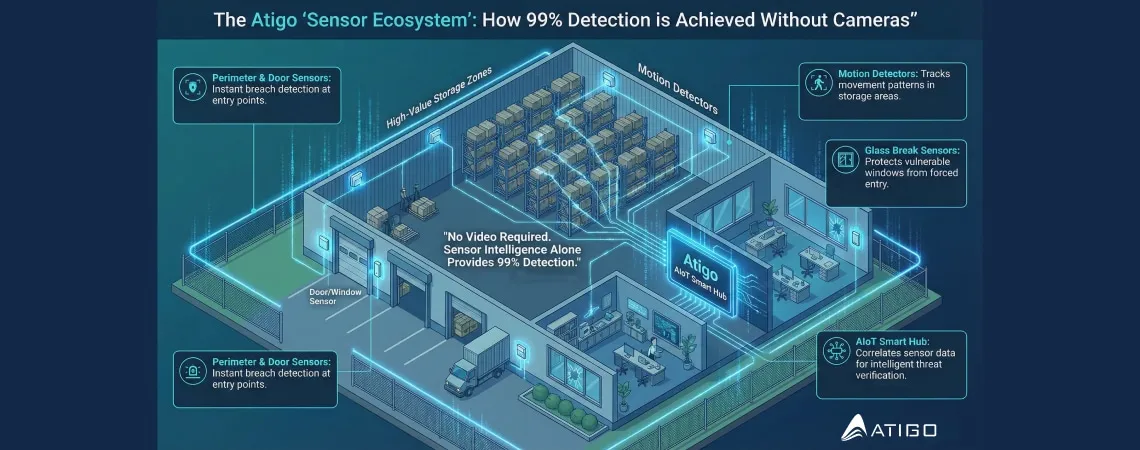
Modern security has evolved beyond passive recording to active intelligence.
The convergence of Artificial Intelligence (AI) and Internet of Things (IoT)—collectively known as AIoT—transforms security systems from documentation tools into predictive, responsive protection platforms.
Intelligent Threat Detection
Unlike simple motion detection, AI-powered systems analyze patterns across multiple data streams simultaneously.
They distinguish between a forklift moving inventory and an unauthorized person accessing restricted areas.
Machine learning algorithms establish behavioral baselines—what’s normal for your warehouse at different times—and flag deviations in real-time.
Multi-Sensor Data Fusion
AIoT security integrates data from multiple sources:
This creates a comprehensive threat picture that no single camera could provide.
When a door sensor triggers simultaneously with unexpected motion in a high-value storage area, the system correlates these events to identify a genuine security breach versus a false alarm.
Predictive Analytics
Advanced AI algorithms don’t just respond to current threats—they predict them.
By analyzing historical incident data, access patterns, and usage behaviors, these systems can identify elevated risk periods and proactively alert personnel before incidents escalate.
For example, detecting unusual access attempts during off-hours or repeated triggering of perimeter sensors that might indicate reconnaissance activity.
Automated Response Protocols
When integrated with building management systems, AIoT platforms can trigger automated responses:
Edge Computing for Speed
Modern AIoT systems process data locally at the edge, not in distant cloud servers.
This means threat detection and alerts happen in under 2 seconds—critical when every second counts in preventing theft or responding to emergencies.
The key distinction? Traditional CCTV says “this happened.” AIoT says “this is happening now, and here’s the appropriate response.”
Even the most sophisticated AIoT system has limitations.
24/7 Emergency Monitoring Centre — Manned by Trained Professionals
AI excels at pattern recognition and rapid data processing, but human judgment remains irreplaceable for nuanced threat assessment, de-escalation, and coordinating emergency responses with local authorities.
This is where 24/7 live emergency monitoring transforms technology into true protection.
Continuous Human Oversight
Trained security professionals actively monitor all connected sensors and cameras around the clock, 365 days per year.
Unlike on-site guards who might become fatigued or complacent, monitoring center personnel work in shifts with strict protocols.
Immediate Verification and Action
When an AIoT system detects an anomaly, monitoring personnel immediately verify the threat through multiple channels.
They analyze sensor data patterns, check system status indicators, and review the event context.
Within seconds, trained operators determine if the situation requires emergency dispatch, owner notification, or system adjustment.
According to industry standards, professional monitoring centers respond to verified alarms within 60 seconds of detection.
Sensor-Based Intelligence
Professional monitoring doesn’t always require video verification.
Trained monitoring officers can assess threat credibility based on sensor data alone—the combination of sensors triggered, the sequence of events, time of occurrence, and historical patterns.
This sensor intelligence is often sufficient to verify genuine threats and coordinate immediate response.
Escalation Expertise
Monitoring officers are specifically trained for different emergency scenarios:
They follow established protocols to contact property owners, dispatch local police, and coordinate responses based on the specific threat type and severity.
Reducing False Alarm Burden
Professional verification dramatically reduces false alarm dispatches to emergency services.
Rather than automatically calling police for every sensor trigger, monitoring personnel use AI-assisted classification and pattern analysis to ensure only genuine emergencies result in emergency service dispatch.
This protects warehouse operators from false alarm fines imposed by many municipalities and maintains credibility with local emergency responders.
Documentation and Legal Support
Every alarm event is logged with timestamps, sensor data, and response actions.
This documentation proves invaluable for insurance claims, legal proceedings, and operational analysis.
Unlike standalone CCTV where footage might be lost or overlooked, monitoring services maintain comprehensive incident records.
The Proven Impact
Industry research shows that professionally monitored alarm systems have 99% detection and deterrence rates compared to 40-60% for unmonitored systems.
When potential intruders know that every alarm triggers immediate human verification and response, they face substantially higher risk of apprehension.
This makes monitored facilities far less attractive targets.
The difference between passive CCTV and active 24/7 monitoring isn’t theoretical—it’s the difference between documenting losses and preventing them entirely.
A major white goods warehouse in Uttar Pradesh had become a repeat target for organized theft.
Despite having a comprehensive CCTV system covering all entry points and storage areas, criminals struck multiple times over several months.
The Pattern of Failure
Each incident followed the same pattern:
The Business Impact
The warehouse management faced an impossible situation:
Insurance premiums skyrocketed after the second incident. Clients began questioning the facility’s security measures.
The business reputation suffered as word spread about the repeated thefts.
Most frustrating was watching CCTV footage showing thieves calmly loading inventory while no intervention occurred.
The warehouse operators made the decision to upgrade from passive CCTV to an actively monitored security system.
They installed Atigo’s AIoT smart security alarm system with comprehensive sensor coverage:
The thieves, unaware of the security upgrade, attempted another break-in.
This time, the outcome was dramatically different:
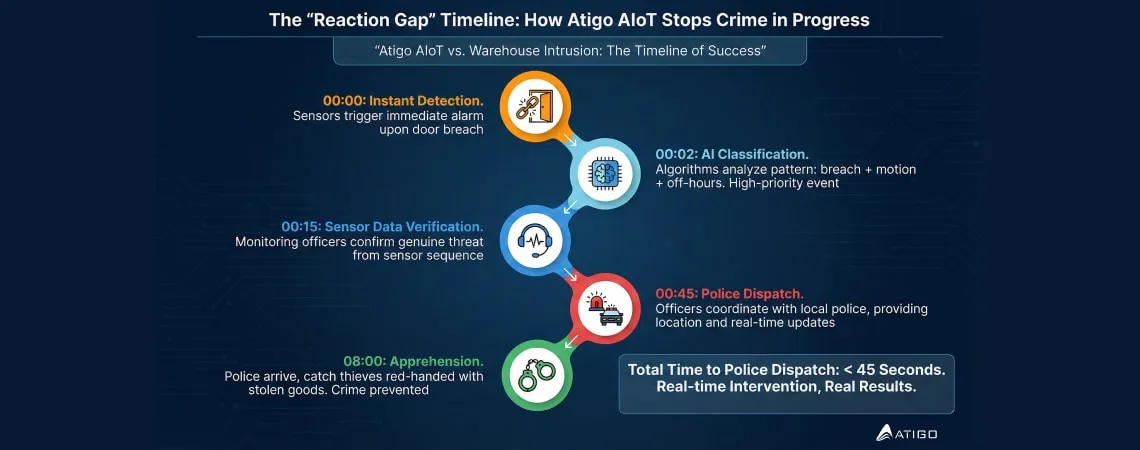
The Timeline of Success
00:00 – Instant Detection The moment the perimeter door was breached, sensors triggered an immediate alarm to Atigo’s EMS monitoring center.
00:02 – AI Classification Within 2 seconds, Atigo’s AI algorithms analyzed the alarm pattern—door breach + motion detection in storage area + off-hours timing—classifying it as a high-priority intrusion event.
00:15 – Sensor Data Verification Monitoring officers analyzed the sensor event sequence: entry point breach followed by progressive motion detection deeper into the facility.
The pattern indicated active intrusion rather than false alarm.
The timing, sensor correlation, and historical context confirmed unauthorized access in progress.
00:30 – Owner Alert The warehouse owner received an emergency call from Atigo EMS with situation details:
“Sir, we have a confirmed intrusion alert at your facility. Multiple sensors indicate unauthorized persons have entered through the north loading dock and are moving toward the storage area. We are coordinating police response now.”
00:45 – Police Dispatch Monitoring officers simultaneously coordinated with local police, providing exact location, entry point details, and real-time sensor updates as the intruders moved through the facility.
08:00 – Apprehension Police arrived while thieves were still loading inventory.
The criminals were caught red-handed with stolen goods, leading to immediate arrest.
The coordinated response prevented the theft of goods worth over ₹1 crore.
More importantly, the arrests broke the pattern of repeated victimization.
The criminals’ network was disrupted, and the successful apprehension sent a clear message that the facility was no longer a soft target.
What makes this case particularly compelling is that no video verification was used.
The facility had CCTV cameras, but Atigo EMS officers relied entirely on sensor data to verify the threat and coordinate the response.
The intelligent placement and integration of multiple sensors—door contacts, motion detectors, and glass break sensors—provided enough information to:
The warehouse owner’s statement captured the transformation:
“For months, we watched CCTV footage of our losses. With Atigo EMS, we finally had someone watching the sensor alerts in real-time who could actually stop the crime instead of just recording it.
The fact that they caught the thieves using sensor data alone—no video needed—shows how powerful this system really is.”
This incident demonstrates the fundamental distinction between surveillance and security.
CCTV had documented every previous theft perfectly—but documentation doesn’t protect inventory.
Active monitoring with intelligent sensor systems and immediate human response transformed the same facility from a repeated victim into a protected, secure operation.
Since 2013, Atigo Enterprises has pioneered integrated security solutions specifically engineered for Indian conditions.
Understanding that imported systems often fail in India’s extreme climate and that warehouses need more than passive surveillance, Atigo developed a comprehensive approach combining indigenous AIoT technology with professional monitoring services.
Built for India’s Extreme Conditions
Atigo’s intrusion detection systems represent a significant technological leap beyond conventional alarm panels.
The company’s security platforms integrate multiple communication technologies—Wi-Fi, Bluetooth, GSM, and 4G connectivity—ensuring reliable transmission even in areas with inconsistent network coverage.
This redundancy is critical for warehouses in industrial zones where connectivity can be unreliable.
AES-256 Military-Grade Encryption All data transmission between sensors and control panels uses bank-level encryption, preventing signal jamming or spoofing attacks.
Wireless Addressable Architecture Each sensor has a unique address, enabling precise identification of which zone triggered an alarm and allowing easy system expansion without complex wiring.
Environmental Hardening Sensors designed and tested for operation in 45°C+ temperatures and 90% humidity—conditions where imported systems typically fail.
Multi-Path Communication Redundant connectivity options ensure alarm signals reach monitoring centers even if primary network fails.
Low Power Operation Battery-backed wireless sensors maintain protection even during power outages, common in industrial areas.
Smart Sensor Technology Door/window contacts, motion detectors, glass break sensors, perimeter protection, and panic buttons that integrate seamlessly into a unified security ecosystem.
The Alaris security control panel series represents the culmination of Atigo’s research and development.
It features India’s first truly smart wireless security system with integrated AIoT capabilities designed specifically for commercial and industrial applications.
Where Atigo’s technology truly delivers transformational value is through integration with their Emergency Monitoring Service.
This professionally staffed monitoring center has operated continuously since 2013, protecting thousands of installations across India.
As Atigo emphasizes: “An alarm system is only as good as its monitoring.”
Step 1: Instant Alert Reception Every alarm generated by any Atigo-connected panel instantly transmits to custom-built EMS servers housed in multiple global data centers for redundancy.
Typical alert delivery occurs in under 2 seconds
Step 2: AI-Assisted Classification Advanced algorithms immediately analyze the alarm type, location, time, historical patterns, and sensor combinations to classify severity and recommend appropriate response protocols.
This classification happens automatically, giving monitoring officers instant context about the nature and urgency of the threat.
Step 3: Sensor Intelligence Verification Trained monitoring officers immediately assess the situation by analyzing sensor event patterns, sequence of triggers, and contextual data.
Officers are specifically trained to distinguish genuine threats from false alarms based on sensor intelligence alone—no video required.
They evaluate:
Step 4: Coordinated Response Based on verified sensor data, EMS officers execute response protocols:
The monitoring center maintains relationships with local police and emergency services to ensure rapid response.
Step 5: Event Documentation Every alarm event is logged with complete details—trigger time, sensor identification, event sequence, response actions, officer notes, and resolution status.
This creates comprehensive security records for insurance and legal purposes.
Step 5: Event Documentation Every alarm event is logged with complete details—trigger time, sensor identification, event sequence, response actions, officer notes, and resolution status.
This creates comprehensive security records for insurance and legal purposes.
Beyond the Uttar Pradesh warehouse case, Atigo EMS has documented numerous interventions across India:
Maharashtra Retail Shop A retail shop owner in Maharashtra received an immediate call from Atigo monitoring officers at midnight when someone attempted to force open the shutter door.
The owner arrived within minutes, preventing the break-in entirely.
Multi-Site Warehouse Operations Multiple warehouse facilities across India have reported that visible “Atigo 24/7 Monitoring” signage alone has deterred attempted break-ins.
Suspects caught on CCTV surveying the facility but leaving without attempting entry.
Panic Button Activations Panic button activations have enabled rapid assistance during confrontational situations.
Monitoring officers provide real-time support and police coordination.
Comprehensive Warehouse Protection
For warehouses, this level of protection addresses multiple vulnerabilities simultaneously:
After-Hours Security When facilities are unoccupied overnight, EMS provides human oversight that on-site guards cannot match.
Especially during the 1-5 AM period when guard alertness is lowest.
Perimeter Protection Immediate response to fence line breaches, gate access violations, or loading dock intrusions before criminals can penetrate deeper into the facility.
Sensor-Based Verification Professional assessment of threat credibility without requiring video infrastructure, making comprehensive security accessible and cost-effective.
Panic Button Response Instant activation of emergency protocols when warehouse staff trigger panic buttons during confrontations or threatening situations.
Multi-Site Management For operators with multiple warehouse locations, centralized monitoring provides consistent security oversight across all facilities.
For warehouse operators evaluating security investments, professional monitoring often faces skepticism about ongoing subscription costs versus one-time CCTV installation expenses.
However, financial analysis consistently demonstrates that monitored systems deliver superior return on investment.
Atigo’s 24/7 Emergency Monitoring Service starts from just ₹850 + GST per month—a remarkably affordable investment for round-the-clock professional security oversight.
Breaking Down the Cost
Compare to Alternatives
Single Security Guard Salary ₹15,000-25,000 per month (and guards sleep during critical 1-5 AM hours)
CCTV System Maintenance ₹5,000-15,000 annually (with no active intervention capability)
Average Theft Loss ₹5-50 lakhs per incident
Insurance Premium Increase After Major Incident ₹50,000-2,00,000 annually
The UP Warehouse ROI Calculation
The Uttar Pradesh white goods warehouse case illustrates the dramatic ROI clearly.
In a single intervention, Atigo EMS prevented losses exceeding ₹1 crore.
Direct Loss Prevention
Indirect Benefits
Total Single-Incident Value: ₹1.08-1.23 crores
Return on Investment
Even if Atigo EMS prevents just one ₹5 lakh theft in a year, the ROI is 6,208%.
This isn’t a marketing claim—it’s documented reality from the Uttar Pradesh case and numerous other interventions.
Consider what you’re protecting against:
Insurance Benefits
Many insurance providers offer 10-25% premium discounts for warehouses with professionally monitored alarm systems.
Five-Year Discount Analysis
For a warehouse paying ₹1 lakh annually in insurance premiums:
Unlike discounts for unmonitored CCTV (which some insurers have eliminated due to ineffectiveness in preventing losses), monitored alarm system discounts are increasing.
Insurers recognize the proven loss prevention value.
When incidents do occur, comprehensive monitoring documentation protects against liability claims.
Timestamped logs showing rapid emergency response, appropriate escalation procedures, and coordination with authorities demonstrate due diligence.
CCTV footage alone cannot provide this level of accountability.
This documentation is increasingly important as courts and insurance adjusters scrutinize whether property owners took reasonable security measures.
Visible signage indicating “Atigo 24/7 Professional Monitoring” serves as a powerful deterrent.
Sophisticated criminals know that monitored facilities present far higher risk than CCTV-only locations.
The certainty of immediate police dispatch changes the risk-reward calculation that drives criminal targeting decisions.
The Uttar Pradesh thieves didn’t attempt another break-in after their arrest—the facility’s reputation as actively monitored spread through criminal networks.
At ₹850 + GST per month, Atigo’s 24/7 monitoring service costs less than:
Yet it provides 24/7/365 protection that has proven capable of preventing crore-rupee losses.
The question isn’t whether you can afford professional monitoring—it’s whether you can afford not to have it.
Transitioning from passive CCTV to active monitored AIoT security requires thoughtful planning.
Here’s how to implement comprehensive protection for your warehouse:
Phase 1: Assessment
Map Your Facility Identify all entry points, high-value storage zones, and vulnerable areas requiring protection.
Document critical access points:
Evaluate Infrastructure Assess existing network infrastructure and connectivity reliability.
Determine if current CCTV needs integration or if sensor-based protection alone is sufficient.
Define Response Protocols Establish emergency escalation procedures and designated contact personnel.
Create clear hierarchies for who gets called first, second, third during different emergency types.
Phase 2: System Design
Select Appropriate Sensors Choose sensors designed for warehouse environments:
Ensure Coverage Design wireless coverage across entire facility, including remote structures and perimeter areas.
Plan redundant communication paths (primary Wi-Fi/ethernet + backup cellular).
Design Zone Architecture Create sensor zones that allow granular threat localization.
Design sensor placement for intelligent event correlation:
Plan for Growth Consider expansion capacity for future facility growth.
Phase 3: Installation & Integration
Professional Installation Atigo provides turnkey installation capabilities including:
Monitoring Center Setup Provide detailed facility information to monitoring center:
Training Train on-site personnel on:
Phase 4: Testing & Optimization
Initial Testing Conduct simulated alarms to verify monitoring center response times and procedures.
Test all sensor zones and communication paths.
Relationship Building Establish coordination between monitoring center and local police for rapid response.
Provide local authorities with facility information and emergency contacts.
Fine-Tuning Review initial alarm patterns to identify false trigger sources.
Adjust sensor sensitivity for optimal detection without false alarms.
Ongoing Management
Monthly Reviews Analyze alarm patterns to identify trends or vulnerabilities.
Update contact information and escalation procedures as personnel change.
Quarterly Testing Conduct system tests with simulated alarms.
Verify monitoring center response procedures remain effective.
Annual Assessment Review incident reports to identify security pattern vulnerabilities.
Refine zone coverage based on operational changes or threat evolution.
Let’s be explicit about CCTV’s fundamental limitations in warehouse security.
The Timeline Problem
The average warehouse burglary takes 8-12 minutes from entry to exit.
Professional thieves—like those targeting the Uttar Pradesh warehouse—know exactly where high-value items are stored and how to access them quickly.
CCTV provides no intervention during these critical minutes.
By the time footage is reviewed—often not until the next business day—criminals are long gone with your inventory.
The Repeat Victimization Pattern
Criminals specifically target facilities with CCTV-only security because they know these systems present minimal risk.
Once thieves successfully strike an unmonitored location, they often return repeatedly.
The Uttar Pradesh case demonstrated this perfectly: the same warehouse was hit multiple times.
CCTV footage from the first theft actually helps criminals on subsequent attempts by showing them blind spots and optimal approach routes.
The Infrastructure Dependency
CCTV systems require significant ongoing maintenance:
In the Uttar Pradesh case, the facility had invested heavily in comprehensive CCTV coverage—yet it provided zero protection.
Meanwhile, the AIoT sensor system with professional monitoring caught the criminals without any video whatsoever.
This demonstrates that expensive camera infrastructure isn’t necessary for effective security.
The Blind Spot Reality
Even comprehensive CCTV coverage creates blind spots.
Cameras can be:
A 2024 warehouse security study found that 40% of CCTV systems have at least one non-functional camera at any given time, creating security gaps that criminals exploit.
The After-Dark Problem
Most CCTV systems struggle in low-light conditions despite “night vision” capabilities.
Warehouse lighting is typically minimal after hours to save electricity.
Grainy, dark footage often proves insufficient for:
This reduces CCTV’s value even for post-incident investigation.
The Data Overload Challenge
A typical warehouse might have 20-50 cameras generating hundreds of hours of footage daily.
No security team can effectively monitor this volume in real-time.
Reviewing footage after incidents is time-consuming and often fruitless.
Professional monitoring centers solve this by having dedicated personnel with AI-assisted sensor alerts.
They focus their attention exactly where threats emerge—without requiring video analysis.
The False Confidence Trap
Perhaps the most dangerous aspect of CCTV-only security is the false sense of protection it creates.
The Uttar Pradesh warehouse management believed they had “good security” because they had invested in comprehensive cameras.
This false confidence meant they didn’t take additional protective measures until after suffering repeated, devastating losses.
CCTV cameras made them feel secure while providing no actual security.
The Accountability Gap
CCTV without active monitoring creates no accountability.
Criminals know that cameras without human oversight simply create evidence that might never be used effectively.
Professional monitoring creates certainty of consequence.
Every intrusion triggers immediate human response and police coordination, dramatically increasing apprehension risk.
The Uttar Pradesh case proves this: the same criminals who repeatedly targeted an unmonitored facility were caught immediately once 24/7 monitoring was implemented—using sensor data alone, no video required.
Atigo’s 24/7 emergency monitoring service starts from just ₹850 + GST per month, providing round-the-clock professional security oversight for warehouses and commercial facilities.
This breaks down to approximately ₹22 per day—less than the cost of a single security guard for one hour.
Yes, absolutely. In a documented case, Atigo’s monitoring center caught thieves at a UP warehouse using only sensor data—no video required.
Properly designed AIoT sensor networks with professional monitoring provide effective protection without video infrastructure.
The intelligent placement and integration of multiple sensors (door contacts, motion detectors, glass break sensors) provides sufficient information to:
Professional monitoring centers like Atigo EMS respond to verified alarms within 60 seconds of detection, with alert delivery occurring in under 2 seconds.
In the UP warehouse case, monitoring officers:
CCTV systems are reactive—they record crimes but provide no intervention during incidents.
Key limitations include:
The UP warehouse had comprehensive CCTV but was repeatedly victimized until adding 24/7 monitoring.
In a documented case, Atigo’s ₹850/month monitoring service prevented a ₹1+ crore theft—a 12,626% ROI from a single incident.
Even preventing just one ₹5 lakh theft annually delivers 6,208% ROI.
Additional benefits include:
Yes. Many insurers offer 10-25% premium discounts for professionally monitored alarm systems.
For a warehouse paying ₹1 lakh annually in premiums:
Unlike discounts for unmonitored CCTV (which some insurers have eliminated), monitored system discounts are increasing as insurers recognize proven loss prevention value.
AI-powered sensor networks analyze multiple data points simultaneously:
Event Correlation Door breach + motion detection + glass break = confirmed intrusion
Pattern Analysis Sequence of sensor triggers indicates movement path through facility
Timing Context Off-hours + high-value zone access = elevated threat level
Historical Comparison Deviations from normal patterns flag anomalies
Trained monitoring officers assess these factors to distinguish genuine threats from false alarms—no video required.
The UP warehouse case demonstrated this capability with thieves caught using sensor intelligence alone.
Atigo offers unique advantages:
Made in India for India
Proven Track Record
Transparent Pricing
Sensor-First Approach
Professional Monitoring
Indian warehouses face escalating threats in an increasingly complex risk environment.
Cargo theft rings operate with growing sophistication, sharing intelligence about facility vulnerabilities.
Supply chain security has become a competitive differentiator. Insurance requirements are becoming more stringent.
Customer expectations for inventory protection are rising.
In this context, treating security as passive documentation rather than active protection is no longer tenable.
CCTV cameras serve valuable purposes for investigation and deterrence, but they cannot replace:
The convergence of AIoT sensor technology with professional 24/7 monitoring represents the current standard for comprehensive warehouse security.
Systems like Atigo’s integrated approach deliver the layered protection modern warehouses require:
For warehouse operators still relying on CCTV-only security, the question isn’t whether to upgrade, but how quickly.
Every day without active monitoring is another day hoping that cameras recording crimes will somehow be enough.
The Uttar Pradesh warehouse learned this lesson through repeated losses costing crores.
How many incidents will it take for your facility to make the change?
Hope Isn’t a Strategy
In today’s threat landscape, hope isn’t a security strategy. Active 24/7 monitoring is.
The Atigo difference lies in understanding a fundamental truth: technology detects, but people protect.
AIoT sensor systems identify threats with unprecedented accuracy and speed.
But trained monitoring professionals make the critical decisions that:
This human-machine partnership, operating 24/7/365, represents the evolution from surveillance to true security.
The choice is clear: Continue documenting your losses with CCTV, or start preventing them with active monitoring for less than ₹22 per day.
The criminals targeting your facility have already made their choice about which type of security they prefer to face.
The UP warehouse lost crores before switching to Atigo EMS. Don’t wait for multiple incidents to force your hand.
Get 24/7 protection starting at just ₹850/month.
Next Steps:
📞 Call for Immediate Consultation: Schedule a security assessment to identify your facility’s vulnerabilities
💻 Request Custom Quote: Get pricing tailored to your warehouse size and requirements
📊 Download Case Study: Read the complete UP warehouse intervention report
🎯 Book System Demo: See Atigo’s AIoT sensors and monitoring platform in action
Join 10,000+ Protected Facilities
Atigo has been protecting Indian warehouses, retail locations, and commercial facilities since 2013.
Trusted by:
For more information about Atigo’s 24/7 Emergency Monitoring Service and AIoT Security Alarm Systems:
🌐 Visit: atigosecurity.in
📧 Email: info@atigosecurity.in
📱 WhatsApp: +91 90999 01674
About Atigo Emergency Monitoring Service
Operating since 2013, Atigo EMS provides comprehensive 24/7 alarm monitoring for intrusion, theft, burglary, and security emergencies across India.
Starting from just ₹850 + GST per month, trained monitoring officers use AI-assisted classification combined with human judgment to verify threats through intelligent sensor data analysis and coordinate rapid responses with property owners and emergency services.
Custom-built server infrastructure across multiple global data centers ensures redundant, reliable alert processing with under 2-second response times.
Success stories include preventing a ₹1+ crore theft at a major white goods warehouse in Uttar Pradesh, where criminals who had repeatedly targeted the facility were caught in the act through immediate coordinated response between Atigo EMS officers and local police—using sensor intelligence alone without any video verification.
Share your contact to connect with us.
India’s trusted security partner since 2013. Made in India manufacturer of 24/7 monitored alarm systems.
© 2013-2025 Atigo Security — A division of Atigo Enterprises Limited
Made in India. Monitored in India.