
Jewellery shops in India operate in one of the highest-risk retail environments — combining high-value inventory, compact store layouts, and predictable operating patterns.
As organised retail crime increases and theft tactics become more sophisticated, traditional security systems like CCTV cameras and basic burglar alarms are no longer sufficient.
A single incident can result in losses ranging from ₹20 lakh to several crores within minutes — often before any meaningful response is possible.
Quick Answer: The biggest security risks for jewellery shops in India include organised retail crime, reliance on CCTV-only systems, communication failure during break-ins, slow emergency response, insider theft, predictable store operations, and equipment failure due to Indian climate conditions. Preventing these risks requires professional monitored security systems with real-time response capability.
Jewellery and gold shops are uniquely vulnerable because:
Organised criminal groups specifically look for these weaknesses before selecting targets.
The most serious threat today comes from coordinated criminal networks, not individual thieves.
These groups:
Their speed and planning make them nearly impossible to stop with traditional security systems.
Many jewellery shops still depend on:
However:
By the time footage is reviewed, the theft has already occurred.
Modern criminals increasingly use advanced tactics such as:
If your security system depends on a single communication channel, it can fail exactly when you need it most.
In traditional setups:
This process takes 8–15 minutes on average.
In contrast, most jewellery thefts are completed in under 3 minutes.
Not all risks come from outside.
Common internal threats include:
There are documented cases in India where insider involvement enabled highly efficient robberies.
Fixed routines such as:
…make it easier for criminals to plan attacks.
Predictability reduces your ability to deter or disrupt threats.
Many imported security systems are not built for Indian environments:
This leads to:
Traditional security systems are reactive, not preventive.
They:
Modern threats require:
👉 Real-time detection + professional monitoring + immediate response
This is where professional monitoring systems create a fundamental shift in security outcomes.
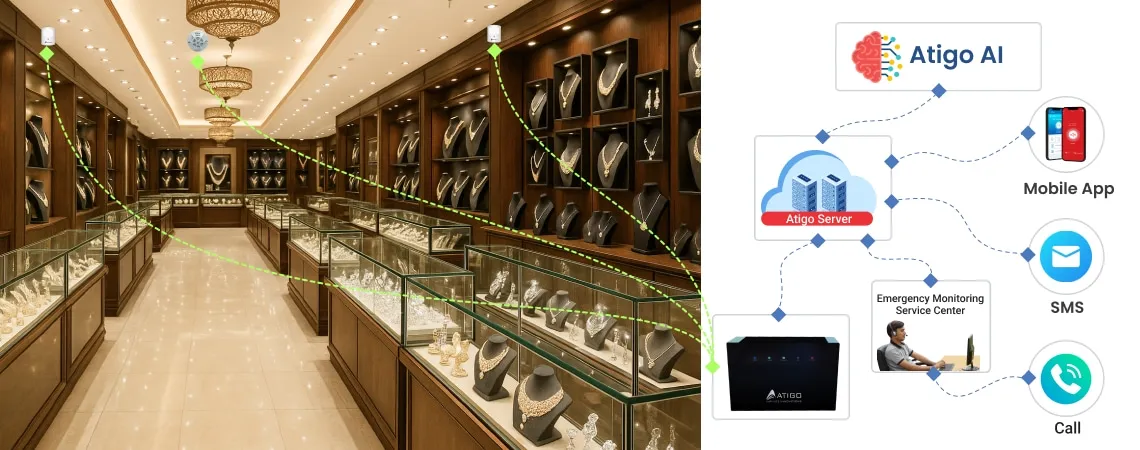
To effectively counter these risks, jewellery shop owners must adopt AIoT-powered, Professional Protection Platform.
Unlike traditional setups, these systems provide:
✔ AIoT-Based Threat Detection
Detects suspicious patterns across multiple sensors before a breach occurs
✔ Multi-Path Communication (Wi-Fi + GSM)
Ensures connectivity even if one channel is disrupted
✔ 24/7 Professional Monitoring
Trained operators verify events and initiate immediate escalation
✔ SLA-Backed Response
Guaranteed response times with documented accountability
✔ Compliance & Audit Trails
Required for insurance and regulatory purposes
Before the next audit or incident, evaluate your store’s preparedness.
The Atigo Alaris 2.0 panel uses three-pathway connectivity simultaneously — Wi-Fi, Bluetooth, and GSM. If any communication channel is disrupted, the system automatically continues operating through the remaining pathways. This triple-redundancy architecture is specifically designed for the threat environment where sophisticated criminal groups have been documented attempting to disable alarm communications before executing a break-in.
No. CCTV only records incidents. It does not provide real-time response or prevention. Jewellery shops require monitored alarm systems for effective protection.
When a security event is detected, the system sends alerts to a professional monitoring centre. Trained operators verify the event and escalate to emergency services immediately — all within defined SLA timelines.
Dual communication systems (Wi-Fi + GSM) ensure that your security system remains active even if one network is disrupted. This prevents criminals from disabling your system during a break-in.
Yes. Small shops are often seen as easy targets because they may have weaker security systems. Organized crime groups do not only target large showrooms.
India’s trusted security partner since 2013. Made in India manufacturer of 24/7 monitored alarm systems.
© 2013-2025 Atigo Security — A division of Atigo Enterprises Limited
Made in India. Monitored in India.