
A wake-up call for Indian banks: Understanding the rising threat of tunnel heists and why 24/7 monitored security is no longer optional
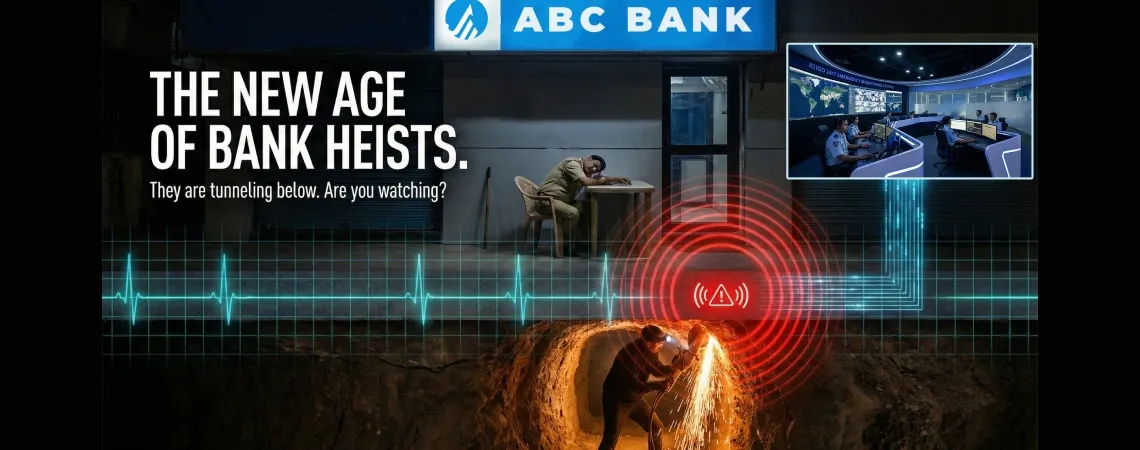
In October 2024, while the nation celebrated a long weekend, criminals in Karnataka’s Davanagere district executed what police later described as a ‘Money Heist’-style robbery. They breached the strongroom of an SBI branch in Nyamati, using gas cutters to slice through the vault. When bank officials returned after the holiday, 17.7 kg of gold ornaments — belonging to ordinary customers who trusted their bank — had vanished.
The mastermind? A local sweet shop owner who had spent six months watching Netflix’s ‘Money Heist’ and studying burglary techniques on YouTube. His target? A bank with no 24/7 monitoring, no intrusion detection on the vault structure, and alarm systems that went unheeded over the long weekend.
This is the reality facing Indian banks today.
What happened in Davanagere is not an isolated incident. A disturbing pattern has emerged across Indian banking — criminals are no longer storming through front doors. They’re going underground, through walls, and striking when banks are most vulnerable.
Recent Bank Vault Breaches in India
Location | Method | Loss | Security Failure |
Davanagere, Karnataka (Oct 2024) | Gas cutter vault breach | ₹13 Crore (17.7 kg gold) | No 24/7 monitoring; long weekend exploitation |
Surat, Gujarat (Dec 2024) | Wall drilling from adjacent office | ₹40+ Lakh | Alarms damaged; no monitoring response |
Navi Mumbai (Nov 2017) | 40-ft tunnel under 3 shops | ₹3-6 Crore | 5 months tunneling undetected; no seismic sensors |
Delhi Bhogal (Jan 2024) | Rooftop entry, wall breach | ₹20-25 Crore | No vault intrusion detection; alarms bypassed |
Combined losses: Over ₹40 Crore in just these four incidents.
Indian criminals have developed a sophisticated playbook for bank vault heists, and it exploits specific weaknesses in how most banks approach security:
Step 1: Adjacent Property Infiltration
In the Navi Mumbai heist, criminals rented a shop in the same building as Bank of Baroda, posing as operators of ‘Shri Balaji General Stores.’ They paid rent in cash, used fake Aadhaar documents, and operated the shop normally for months — all while secretly excavating a tunnel beneath it.
In Surat, they used an adjacent one-room office that shared a common wall with the bank. No bank security system monitored what was happening on the other side of that wall.
Step 2: Weekend & Holiday Exploitation
Every major vault heist in India has occurred over weekends or long holidays. The Davanagere heist targeted a long weekend. The Navi Mumbai robbery happened between Friday and Monday. The Surat breach occurred overnight between Monday and Tuesday.
Why? Because criminals know that during these periods:
Step 3: Neutralise Detection Systems
In Surat, the first thing criminals did was damage the alarm systems. In Davanagere, they worked through the strongroom knowing that even if alarms triggered, no one would respond until staff returned after the holiday. The criminals understand a fundamental truth:
An alarm that nobody monitors is just noise.
Most Indian banks rely on a security model designed for a different era — one where the primary threat was armed robbery during banking hours. This model includes door contacts, motion sensors, and alarm panels that send notifications to security guards or mobile phones.
Here’s why this approach is catastrophically inadequate against modern vault heists:
Problem 1: No Underground Detection
Traditional motion sensors detect movement in corridors and banking halls. They cannot detect excavation happening six feet below the floor or drilling through an adjacent wall. The Navi Mumbai criminals dug for five months — 40 feet of tunnel — without triggering a single alert.
False alarm fatigue is real. When 95% of alarms are false, the 5% that are genuine get ignored.
When an alarm triggers at 2 AM on a Sunday, who responds? In most banks, the alarm sends a notification to a security supervisor’s phone. That supervisor may be asleep, may assume it’s a false alarm, or may not have the authority to dispatch a response team. The $30 million GardaWorld heist in Los Angeles saw alarms trigger four times in one night — each was dismissed as a false alarm.
Problem 3: No Alarm Verification
Without professional monitoring and real-time alarm verification, there’s no way to distinguish between a genuine intrusion and a sensor malfunction. Banks either over-respond to every alert (unsustainable) or under-respond to all alerts (dangerous). Neither approach protects your vault.
When criminals damage the alarm panel or cut communication lines, the entire security system goes silent. A security system with single points of failure is a security system waiting to fail.
Preventing vault heists requires a fundamental shift from passive alarm systems to active, monitored security. This is exactly what Atigo Security delivers — India’s most advanced integrated security alarm system, purpose-built for high-value assets like bank vaults and locker rooms.
24/7 Emergency Monitoring Centre — Manned by Trained Professionals
At the heart of Atigo Security is our Emergency Monitoring Centre (EMC), operational 24 hours a day, 365 days a year. Unlike passive alarm systems that simply send notifications, our EMC is staffed by trained security professionals who
When criminals breach your vault at 3 AM on Diwali, our team is watching. When they trigger a seismic sensor by drilling through a wall, our team is responding. When your alarm goes off, it’s not a notification that gets ignored — it’s a verified emergency that gets action.
AIoT-Based Smart Monitoring Technology
Atigo Security leverages Artificial Intelligence of Things (AIoT) technology to deliver intelligent threat detection that goes far beyond traditional alarm systems:
Atigo Connect Mobile App — Command Centre in Your Pocket
While our EMC provides primary monitoring, the Atigo Connect mobile app puts real-time security visibility in the hands of your bank’s security leadership:
Central Monitoring Station (CMS) for Banking Organisations
For banks that prefer to maintain their own security operations centre, Atigo Security provides a complete Central Monitoring Station solution. This allows your bank to:
Security Aspect | Traditional Alarm System | Atigo Monitored Security |
Response at 3 AM Sunday | Notification to phone (may be ignored) | Live professional response in 50 seconds |
Tunnel/Drilling Detection | Not possible | Seismic sensors detect immediately |
False Alarm Handling | Creates fatigue; real threats ignored | AI filtering + professional verification |
If Alarm Panel Tampered | System goes silent; no alert | Tamper alert triggers immediate response |
Communication Backup | Single path (easily disabled) | Dual-path WiFi + GSM (redundant) |
Data Security | Basic or no encryption | AES 256-bit encryption |
Multi-Branch Visibility | Manual checking required | Unified CMS dashboard + Mobile App |
Since 2013, Atigo Security has been protecting high-value assets across India. Our track record speaks for itself:
After the Navi Mumbai heist, 19 of the 30 locker holders whose valuables were stolen sent legal notices to Bank of Baroda demanding compensation. They discovered a harsh reality buried in their locker agreements:
“The bank will not be responsible for any loss or damage of the contents kept in the safe deposit vault as a result of theft or burglary.”
When news breaks that criminals tunneled beneath your bank for months without detection, or that alarms were ignored over a long weekend, or that customer gold worth crores was stolen while the bank was ‘protected’ by security systems — the message to customers is clear: this bank cannot protect what I entrust to them.
In an era where customers have choices, reputation is everything. The cost of a single vault breach — measured in customer trust, media coverage, and regulatory scrutiny — far exceeds the investment in proper monitored security.
The criminals who target bank vaults are getting smarter. They study security protocols. They watch YouTube tutorials. They plan for months. They strike when you’re most vulnerable.
Your security must be smarter still.
Atigo Security offers India’s most advanced integrated security alarm solution for banking — combining AIoT-based detection, 24/7 professional monitoring, mobile command capabilities, and centralised multi-branch oversight. We don’t just install alarm systems; we actively protect your assets, every hour of every day.
Schedule a Security Assessment for Your Bank
Contact Atigo Security today to understand how monitored security can protect your branches, vaults, and customer trust.
Website: www.atigosecurity.com
Email: contact@atigosecurity.com
Atigo Security — India’s Most Advanced Integrated Security Alarm Provider
24/7 Emergency Monitoring | AIoT Smart Detection | Atigo Connect Mobile App | Central Monitoring Solutions
Made in India. Protecting India.
Share your contact to connect with us.
India’s trusted security partner since 2013. Made in India manufacturer of 24/7 monitored alarm systems.
© 2013-2025 Atigo Security — A division of Atigo Enterprises Limited
Made in India. Monitored in India.