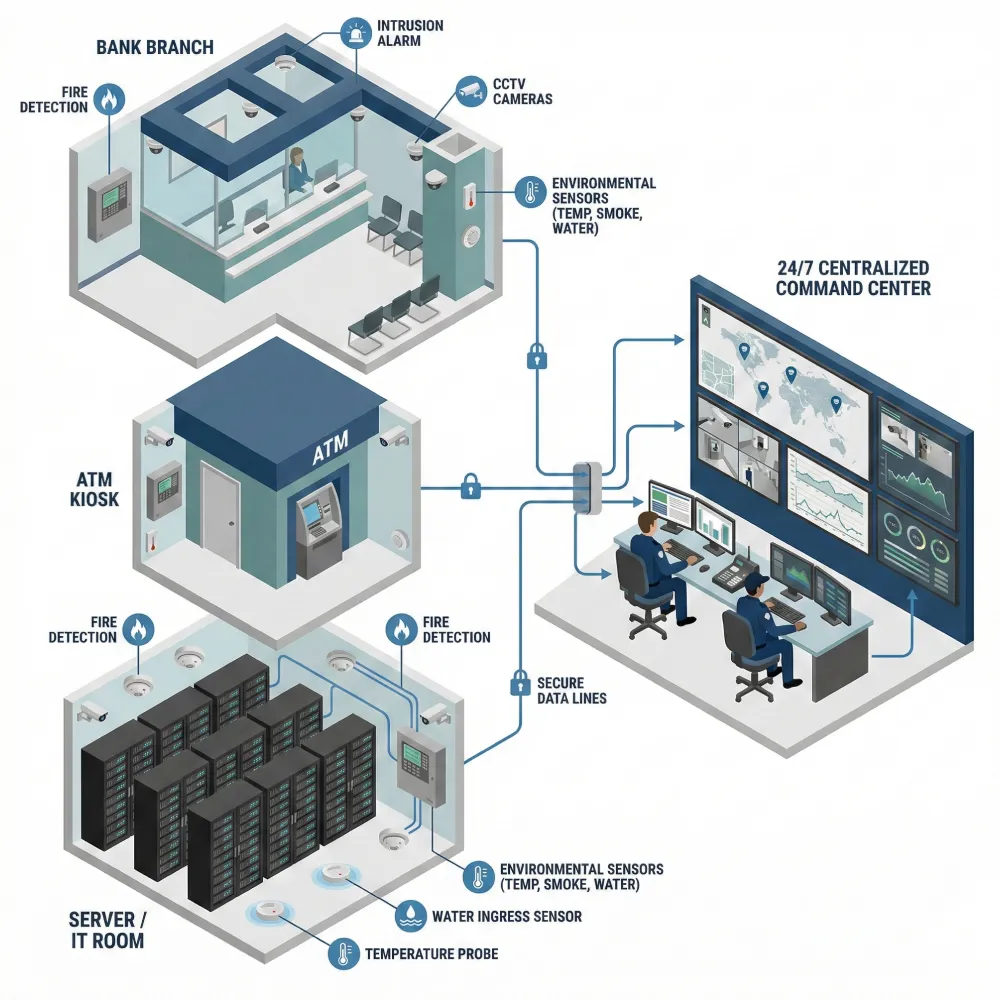
Indian banks operate under increasingly strict security and compliance expectations set by the Reserve Bank of India. RBI’s cybersecurity and IT governance frameworks now clearly extend beyond digital controls to include physical security, environmental monitoring, and time-bound incident response.
For banks, this means one thing:
Installed security systems are no longer enough. Continuous monitoring is essential.
Why RBI Compliance Now Demands 24/7 Monitoring
RBI security guidelines require banks to:
Detect security incidents in real time
Verify events quickly and accurately
Escalate incidents without delay
Report incidents to RBI within 2–6 hours of detection
Maintain audit-ready evidence and logs
Without 24/7 centralized alarm monitoring, meeting these expectations consistently—especially during nights, weekends, and holidays—is operationally impractical.
What RBI Expects from Bank Security Infrastructure
RBI-aligned physical security controls include:
Fire detection & suppression systems
Intrusion and access alarms
Environmental monitoring (temperature, smoke, water ingress)
CCTV with minimum 180-day footage retention
Integration across alarms, surveillance, and access systems
Audit logs and incident documentation
⚠️ RBI inspections increasingly highlight that standalone CCTV or unmonitored alarms do not meet compliance intent.
Why CCTV Alone Is Not RBI Compliance
While RBI mandates CCTV deployment, recording footage alone is insufficient.
RBI expects:
Detection (not post-event review)
Verification (not assumptions)
Escalation (not next-day reporting)
Evidence (not fragmented logs)
Only integrated, actively monitored systems satisfy these expectations.
The Role of a Central Monitoring Station (CMS)
A Central Monitoring Station acts as the security nerve center for banks by:
Monitoring alarms 24/7/365
Verifying incidents using live video and audio
Escalating alerts to bank officials and emergency services
Maintaining time-stamped audit trails for RBI inspections
Ensuring continuity through redundancy and disaster recovery
For RBI compliance, monitoring uptime matters as much as detection accuracy.
Environmental Monitoring: An RBI-Mandated Control
RBI explicitly requires monitoring of:
Temperature
Smoke and fire conditions
Water ingress
Infrastructure availability
In Indian conditions—high heat, humidity, and power fluctuations—environmental failures can shut down banking operations faster than cyber incidents.
Banks that ignore environmental alerts risk service disruption, audit observations, and reputational damage.
Built for Indian Banking Conditions
Imported alarm systems often fail under
40°C+ temperatures
High coastal humidity
Power and connectivity instability
Indigenous systems engineered for Indian conditions ensure continuous compliance across diverse geographies, from metro branches to remote ATMs.
Designed for RBI Audits & Inspections
An RBI-aligned alarm monitoring solution must support:
Incident reporting within mandated timelines
Verifiable audit logs
Vendor risk management requirements
Secure, encrypted communications (AES-256 or equivalent)