
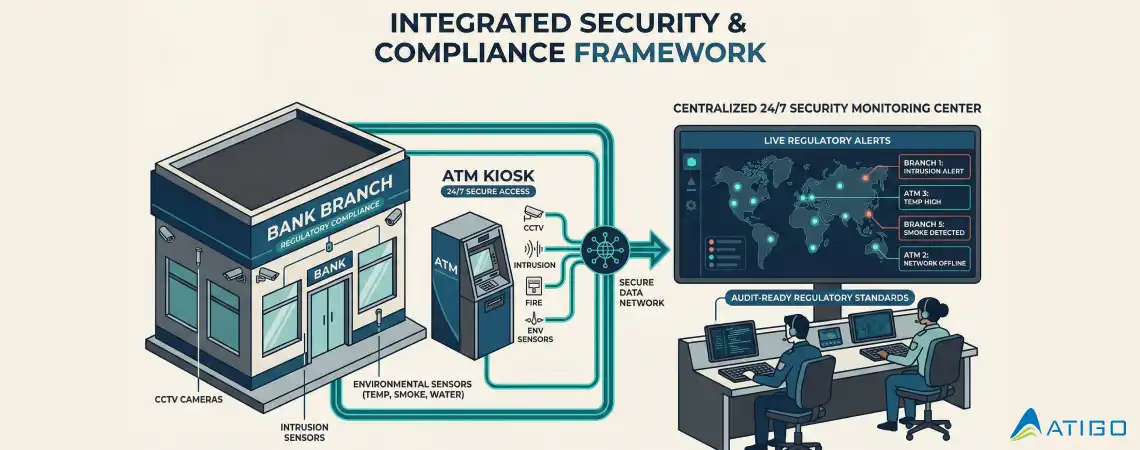
This document is a detailed compliance reference for banking security, risk, audit, and operations teams. It is designed to support internal assessments, vendor evaluations, and regulatory inspections by explaining how physical security systems, alarm monitoring, and operational processes align with supervisory expectations issued by the Reserve Bank of India
This is not a high-level overview or marketing brochure. Instead, it provides practical, operational clarity on how banks can design, operate, and evaluate alarm monitoring and physical security infrastructure in a manner consistent with regulatory intent.
RBI’s cybersecurity and IT governance frameworks extend well beyond software and networks. They explicitly include physical infrastructure that supports banking operations, such as branches, ATMs, vaults, data centres, and server rooms.
This approach reflects RBI’s view that operational disruptions, fire incidents, environmental failures, and unauthorised access pose risks comparable to cyber threats.
RBI requires security incidents to be reported within 2 to 6 hours of detection. This requirement fundamentally changes how banks must approach physical security.
Installed systems alone
In regulated environments, time of detection is as critical as time of occurrence.
Modern banking environments typically include multiple security systems installed over time—fire alarms, intrusion detection, CCTV, access control, and environmental sensors. RBI-aligned operations require these systems to function as a single, integrated security ecosystem
In an integrated setup:
This integration enables coordinated response and reduces dependency on manual intervention.
A Central Monitoring Station (CMS) acts as the operational nerve centre for bank security. It continuously receives and processes alerts from branches and ATMs, verifies incidents, and coordinates escalation.
Key capabilities of a CMS include:
– 24/7/365 staffed monitoring
– Live video and audio verification
– Time-stamped incident logging
– Escalation to bank officials and emergency services
– Redundant infrastructure for uptime and resilience
For banks subject to strict reporting timelines, monitoring continuity and redundancy are operational necessities.
Across the security industry, false alarms account for a significant majority of system activations.
Unverified alerts lead to:
Professional monitoring environments mitigate these risks through verification protocols such as live video review and two-way audio communication. This ensures genuine incidents receive immediate attention while false positives are filtered without disruption.
RBI explicitly expects banks to monitor environmental conditions that can disrupt operations, including:
Fire remains one of the most damaging risks to banking infrastructure, particularly in server rooms, data centres, and vaults. Environmental monitoring allows banks to detect abnormal conditions early and respond before failures escalate into service outages or safety incidents.
India’s operating environment—characterised by high temperatures, humidity, and power variability—further reinforces the need for resilient, climate-tolerant systems.
Regulatory compliance extends beyond avoiding penalties.
RBI inspections increasingly assess:
Instances of non-compliance have resulted in monetary penalties and reputational damage for banks. In contrast, institutions with integrated monitoring and documented response processes demonstrate stronger operational resilience and audit outcomes.
RBI requires banks to assess and manage risks associated with third-party service providers. When evaluating security and monitoring vendors, banks should consider:
Indigenous technology providers, such as Atigo indian fire and security systems company address additional considerations including climate suitability, supply-chain resilience, and alignment with national self-reliance initiatives.
On-Site Systems
Communication Layer
Monitoring Operations
Such architectures support continuous operation and audit readiness.
Traditional guard-based security models involve high recurring costs and inconsistent coverage.
Integrated monitoring models offer:
For banks operating large branch and ATM networks, this model improves both compliance outcomes and operational efficiency.
RBI’s approach increasingly emphasises detection, response, and recovery rather than absolute prevention.
Emerging capabilities include:
These capabilities allow banks to anticipate risks and address vulnerabilities before compliance or safety is compromised.
Banks can use this document to:
Maintaining detailed logs, test records, and incident reports remains critical for audit readiness.
RBI’s evolving expectations highlight a clear direction: banking security must be continuous, integrated, and verifiable. Physical security and alarm monitoring are no longer peripheral concerns – they are core components of operational resilience.
Banks that invest in integrated monitoring, resilient infrastructure, and documented response processes are better positioned to meet regulatory expectations, protect critical assets, and maintain customer trust in an increasingly complex risk environment.
This appendix maps key sections of this reference document to specific RBI circulars and clauses commonly cited during audits and inspections. The mapping is indicative and intended to support compliance discussions, gap assessments, and vendor evaluations.
Circular: RBI/DBR/2016-17/45
Title: Cyber Security Framework in Banks (2016)
Relevant Clauses: – Section 2 – Scope of the Framework
Includes the entire IT and digital ecosystem, covering physical infrastructure supporting banking operations.
Mapped Sections in This Document:
Year: 2023
Title: Master Direction on Information Technology Governance, Risk, Controls and Assurance
Relevant Clauses: – Section 6 – IT Infrastructure and Information Security
Mandates protection of data centres, server rooms, network equipment, and physical access points.
Mapped Sections in This Document:
Circular: RBI/DBR/2017-18/32
Title: Cyber Incident Reporting Guidelines (2017)
Relevant Clauses: – Section 4 – Incident Reporting Timelines
Requires reporting of cyber and security incidents within 2 to 6 hours of detection.
Mapped Sections in This Document:
Source: RBI supervisory observations and inspection frameworks
Key Expectations:
Mapped Sections in This Document:
Source: RBI circulars and advisories (2016 onwards)
Relevant Guidance:
Mapped Sections in This Document:
Source: RBI supervisory audits and inspection observations
Accepted Audit Standards:
Mapped Sections in This Document:
Year: 2023
Title: Outsourcing of IT Services – Risk Management Guidelines
Relevant Clauses:
Requires banks to ensure that service providers meet regulatory, security, availability, and audit requirements.
Mapped Sections in This Document:
This clause mapping is intended to:
Banks should always refer to the latest RBI circulars and supervisory communications for final compliance determinations.
India’s trusted security partner since 2013. Made in India manufacturer of 24/7 monitored alarm systems.
© 2013-2025 Atigo Security — A division of Atigo Enterprises Limited
Made in India. Monitored in India.