Author: Security Technology Editorial Team With insights from Atigo’s 24/7 Emergency Monitoring Center—operational since 2013 as India’s first emergency response service modeled on international standards
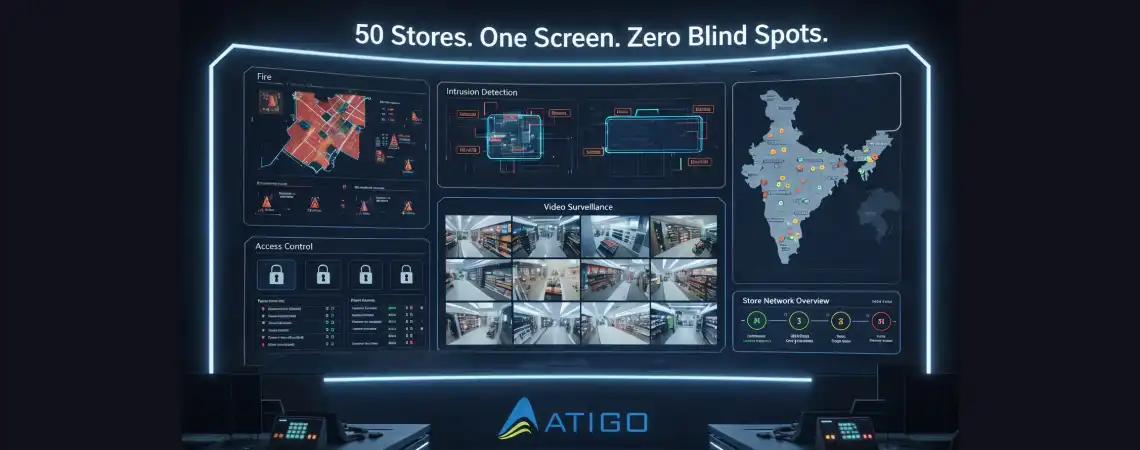
Centralized security integrates all security systems (fire alarms, intrusion detection, access control, video surveillance) across multiple store locations into a single unified dashboard and 24/7 monitoring center. Instead of managing 50 separate systems, retailers control everything from one screen with professional monitoring, mobile access, and automated emergency response.
This is the multi-location retail nightmare that keeps business owners awake at night.
Picture this:
According to the National Retail Federation’s 2025 report, retail shoplifting incidents surged by 93% between 2019 and 2023, with associated dollar losses climbing 90% during the same period. But here’s what most multi-location retailers don’t realize: the problem isn’t just theft itself it’s the operational chaos of managing security across dozens of disconnected sites.
Recent industry data reveals that retailers with multiple locations face a 68% likelihood of experiencing business downtime following a security incident, with 46% forced to shut down digital systems entirely. For a 50-store chain, this fragmentation translates into:
A 2024 study from the Retail and Hospitality Information Sharing and Analysis Center (RH-ISAC) documented this reality starkly: retail security incidents increased from 725 to 837 between 2023 and 2024, while confirmed breaches rose from 369 to 419. Multi-location retailers bore the brunt of this increase, with organized retail crime groups specifically targeting chains lacking centralized oversight.
What is centralized security? Centralized security is a unified platform that integrates all security systems across multiple locations—fire alarms, intrusion detection, access control, and video surveillance—into a single dashboard and professional monitoring center.
Modern centralized platforms don’t just consolidate alerts; they transform how you protect your entire retail empire. Here’s what changes when you move from 50 independent systems to one centralized platform:
Instead of switching between apps and calling individual store managers, you see every door, every alarm, every camera feed from a single interface. When Store 14’s back door opens at 3 AM, you instantly know who accessed it, can view live camera footage, and verify whether it’s your overnight cleaning crew or an unauthorized entry—all within seconds.
Modern AI-powered systems distinguish between a triggered motion sensor caused by a stray cat versus coordinated suspicious activity. The centralized platform learns your business patterns: it knows that Store 8 receives deliveries every morning at 6:15 AM, so it won’t bombard you with alerts when the delivery entrance opens during that window. But if that same door opens at midnight? Immediate escalation.
This is the same AIoT intelligence deployed across India’s critical infrastructure—where systems must differentiate between environmental factors and genuine threats in challenging climate conditions with 40°C+ temperatures and 90% humidity.
When a fire alarm triggers in Store 4, a centralized system doesn’t just notify you—it automatically unlocks specific emergency exits, sends alerts to the fire department, notifies store personnel, and captures video evidence of the evacuation. All of this happens simultaneously, without requiring human intervention for each step.
Know exactly who opened which store at what time. Track employee punctuality across all branches. Review access logs when investigating incidents. One unified system means one comprehensive record of every security event across your entire operation.
Let’s address what every Indian multi-location retailer knows but rarely discusses: reliability challenges are uniquely severe in our operating environment.
Traditional security often relies on guards who may fall asleep during night shifts, fail to follow protocols, or simply lack the training to recognize sophisticated threats. According to recent retail security reports, workplace violence incidents increased 17% year-over-year in 2024, with many incidents escalating due to inadequate on-site security response.
Local internet connections fail—especially during monsoons or in tier-2 cities with inconsistent infrastructure. A centralized system using dual-path communication (GPRS + IP) ensures the signal always gets through. If your primary internet connection drops, the system seamlessly switches to cellular backup, maintaining continuous monitoring without gaps.
This redundancy is critical. When a nationwide retail chain in western India deployed advanced centralized monitoring with dual-path connectivity across 50+ locations, they achieved 99.97% uptime—even during severe weather events that knocked out traditional internet service.
Here’s a fact most retailers learn the hard way: imported security sensors fail spectacularly in India’s climate. When temperatures exceed 40°C and humidity hits 90%, Western-designed equipment triggers false alarms or stops working entirely.
Systems engineered specifically for Indian conditions—the kind developed through R&D partnerships with institutions like IIT Gandhinagar—eliminate this problem. These indigenous solutions undergo rigorous testing in actual field conditions, saving thousands in false alarm responses and equipment replacement while maintaining STQC, EN54, and IS/ISO 7240 compliance standards.
Fire and security aren’t separate concerns—they’re interconnected risks that demand coordinated responses. When a centralized system detects smoke in Store 22’s electrical room, it simultaneously:
All within seconds. All automatically.
This level of integration is what makes India’s first wireless addressable fire alarm systems—deployed across critical infrastructure from Indian Railways to Tata facilities—fundamentally different from fragmented legacy approaches.
Modern centralized security isn’t desk-bound. With a professional mobile application, you carry your entire security operation in your pocket.
Real-World Scenario: You’re in a meeting in Delhi when you receive a notification: the Bangalore warehouse door has been unlocked outside business hours. Through your mobile app, you:
Total time elapsed: 30 seconds. This level of control would be impossible with fragmented systems requiring separate logins for each location.
The mobile app extends beyond emergency response. Use it to:
Did the staff forget to lock the Bangalore warehouse? Do it from your phone in seconds—whether you’re in Ahmedabad, Mumbai, or anywhere in the world.
Here’s the uncomfortable truth: you will miss mobile notifications. During meetings. While sleeping. When your phone dies. During family emergencies.
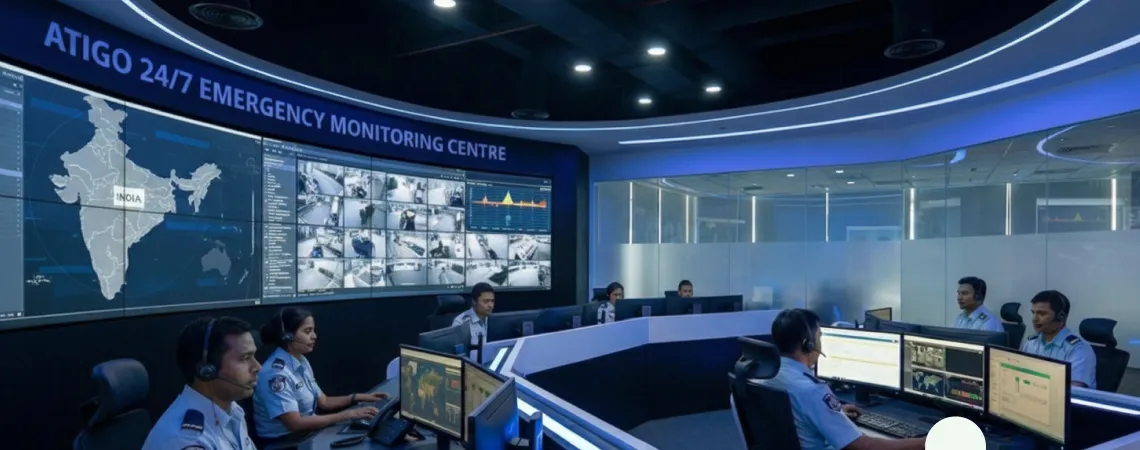
A professional 24/7 Command Center won’t.
Industry research on remote monitoring demonstrates that trained security professionals operating from centralized monitoring centers provide response capabilities human managers simply cannot match:
A Dallas shopping center implementing centralized remote monitoring saw an 80% reduction in property damage and increased Net Operating Income by $120,000 annually. The secret? Professional monitoring teams caught and prevented incidents before they escalated into major losses.
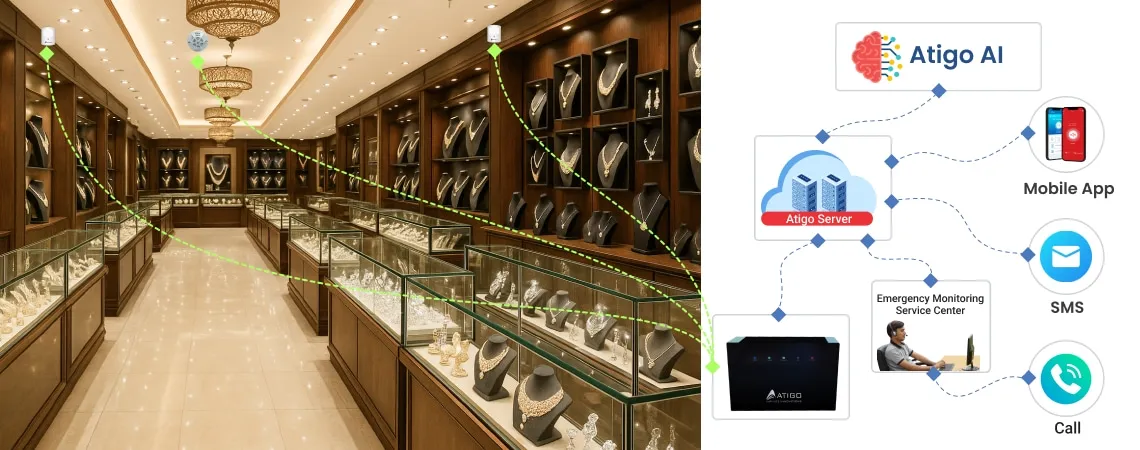
India’s first 24/7 emergency monitoring service, operational since 2013, uses processes modeled on international 911 standards—providing the same level of professional oversight that protects critical infrastructure worldwide. When fire alarm systems meeting EN54 standards are connected to trained monitoring professionals, response times drop from 10-15 minutes to under 3 minutes.
You might miss a mobile notification during a meeting or while sleeping. The monitoring center won’t. They verify the threat and dispatch help immediately.
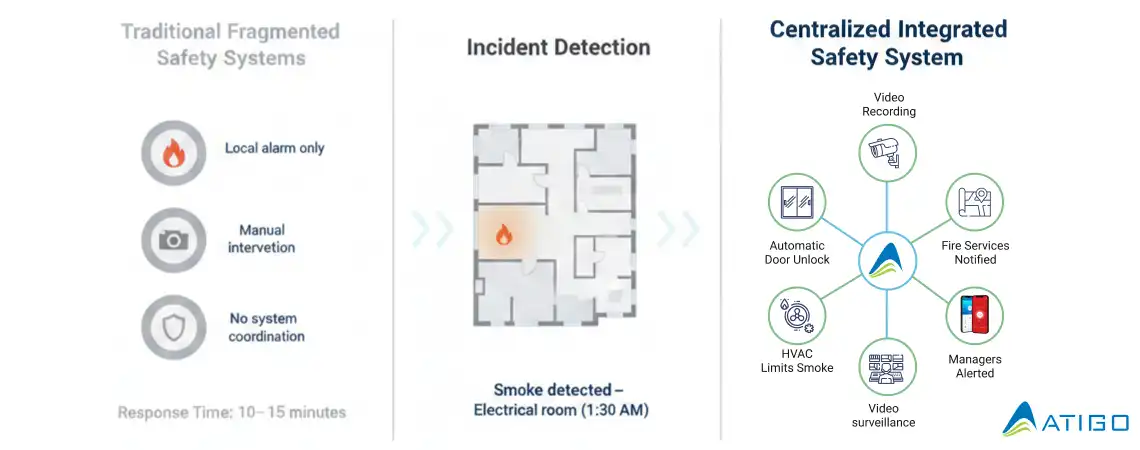
The true power of centralized security emerges when fire, intrusion, access control, and video surveillance operate as one integrated system rather than isolated tools.
Example Integration Scenario: Fire alarm triggers in Store 4’s storage area at 1:30 AM.
Fire and security aren’t separate concerns—they’re interconnected risks that demand coordinated responses. When a centralized system detects smoke in Store 22’s electrical room, it simultaneously:
Traditional Fragmented System:
Centralized Integrated System: Fire alarm triggers automatic response sequence:
This integration saves lives and minimizes property damage. It’s the difference between containing a small electrical fire and losing an entire facility.
Integration extends to daily operations:
If a fire alarm triggers in Store 4, the system automatically unlocks specific doors for exit and alerts the fire department—no manual intervention required.
Let’s talk numbers that impact your bottom line.
Real-World Scenario: You’re in a meeting in Delhi when you receive a notification: the Bangalore warehouse door has been unlocked outside business hours. Through your mobile app, you:
| Cost Category | Fragmented Approach | Centralized Approach | Annual Savings |
|---|---|---|---|
| Alarm Monitoring | ₹15,00,000/month (₹30,000 × 50 stores) |
₹8,00,000/month (enterprise service) |
₹84,00,000 |
| Hardware Investment | ₹1,25,00,000 (initial) |
₹2,00,00,000 (better quality) |
Amortized |
| Maintenance | ₹7,50,000/month (₹15,000 × 50) |
₹3,00,000/month (unified contract) |
₹54,00,000 |
| Security Guards | ₹12,50,000/month (₹25,000 × 50) |
₹6,00,000/month (reduced need) |
₹78,00,000 |
| Total Annual Cost | ₹4,20,00,000 | ₹2,04,00,000 | ₹2,16,00,000 |
But the real ROI extends beyond direct cost savings:
Incident Prevention Value: Industry data shows centralized systems reduce security incidents by 40-67%. For a 50-store chain averaging ₹2,00,000 in theft-related losses per store annually, that’s ₹40,00,000 in prevented losses.
Insurance Premium Reductions: Many insurers offer 10-15% premium reductions for businesses with professional centralized monitoring—potentially saving lakhs annually.
Operational Efficiency: Centralized management reduces the time security teams spend managing systems by 60%, freeing them to focus on strategic security improvements rather than administrative overhead.
Prevented Business Disruption: The 2025 IBM study estimated that the average cost of a retail security breach is $3.54 million (approximately ₹29.5 crores). Centralized systems with professional monitoring significantly reduce breach likelihood.
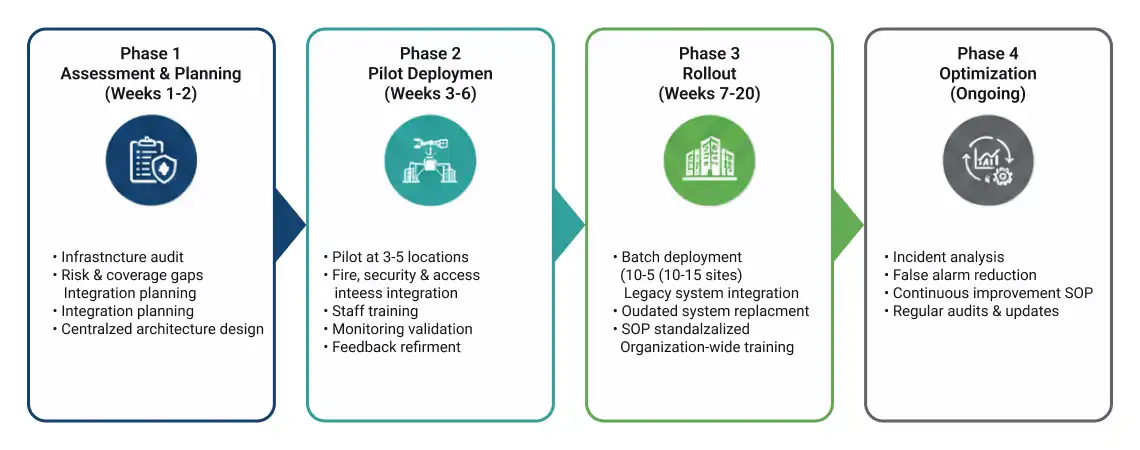
How long does it take to implement centralized security? Most 50-store deployments complete in 12-20 weeks using a phased rollout approach.
Making the switch from fragmented systems to centralized security doesn’t mean ripping out everything overnight. Strategic implementation follows a phased approach:
Beyond security benefits, centralized systems simplify regulatory compliance—a growing concern as India’s data protection and safety regulations evolve:
Fire Safety Compliance: Integrated fire alarm systems meeting STQC, EN54, and IS/ISO 7240 standards provide automatic documentation of all fire safety events, simplifying inspections and audits.
Access Control Auditing: Comprehensive logs of every access event across all locations satisfy regulatory requirements for employee tracking and visitor management. Know exactly who opened the store and at what time—perfect for monitoring employee punctuality across branches.
Data Protection: Centralized systems with proper security architecture help meet emerging data protection requirements by providing better control over who accesses camera footage and alarm data.
Insurance Documentation: Detailed incident records and response logs provide the documentation insurers require for claims processing and risk assessment.
Let’s address the legitimate concerns about centralized security:
Answer: Enterprise-grade centralized systems include redundancy at every level
Local guards fall asleep. Local internet fails. Our systems use dual-path communication (GPRS + IP) to ensure the signal always gets out—even during monsoons or power outages.
Local guards fall asleep. Local internet fails. Our systems use dual-path communication (GPRS + IP) to ensure the signal always gets out—even during monsoons or power outages.
Modern centralized platforms integrate with most existing security hardware. You typically can leverage 60-70% of existing equipment, replacing only obsolete or incompatible devices.
Military-grade AES-256 encryption protects all data transmission and storage. India’s first AIoT security systems with Wi-Fi, Bluetooth, and GSM connectivity use the same encryption standards protecting banking transactions.
The evolution doesn’t stop at centralization. Emerging technologies promise even greater capabilities:
AI-Powered Predictive Analytics: Systems that learn normal patterns across all locations and flag anomalies before incidents occur. Not just detecting fires, but predicting equipment failures that could cause fires.
Behavioral Analysis: Advanced video analytics that recognize suspicious behavior patterns, distinguishing between a customer browsing and someone planning theft.
Automated Response Protocols: Further integration with building management systems, enabling coordinated responses that involve lighting, HVAC, doors, and elevators during emergencies.
Integration with Business Intelligence: Security data flowing into broader business analytics, revealing patterns like which stores experience more incidents during specific hours, informing staffing and inventory decisions.
Centralized security is a unified platform that integrates fire alarms, intrusion detection, access control, and video surveillance from multiple store locations into one dashboard and 24/7 monitoring center, allowing retailers to manage all security operations from a single screen.
Centralized security reduces costs through: (1) consolidated monitoring contracts versus separate agreements per location, (2) reduced security guard requirements with professional 24/7 monitoring, (3) decreased false alarm fines, (4) lower insurance premiums, and (5) prevented theft and property damage. A 50-store chain typically saves ₹2+ crores annually.
Yes. Modern centralized platforms integrate with 60-70% of existing security hardware including most alarm panels, cameras, and access control systems. Only obsolete or incompatible equipment requires replacement.
Centralized systems use dual-path communication—primary internet (IP) plus cellular backup (GPRS/GSM). If internet fails, the system automatically switches to cellular connectivity within seconds, maintaining continuous monitoring without interruption.
Professional monitoring centers verify threats and dispatch emergency services in under 3 minutes—compared to 10-15 minutes with traditional fragmented systems. Trained operators assess video feeds, sensor data, and historical patterns to distinguish genuine emergencies from false alarms immediately.
Yes, when systems are engineered for Indian conditions. Equipment designed for 40°C+ temperatures and 90% humidity—such as indigenous systems developed through partnerships with IIT Gandhinagar and tested to STQC standards—maintains reliability where imported Western equipment often fails.
Implementation typically takes 12-20 weeks using a phased approach: 2 weeks for assessment, 4 weeks for pilot deployment at 3-5 locations, and 10-14 weeks for full rollout in batches of 10-15 stores.
Look for systems meeting STQC (Standardisation Testing and Quality Certification), EN54 (European fire alarm standards), and IS/ISO 7240 (Indian fire safety standards). Additional certifications include ISO 9001 for quality management, CE marking for European conformity, and RoHS for environmental compliance.
Reading about centralized security is one thing. Seeing your specific stores displayed on a unified dashboard—with real-time status, camera feeds, and alarm states—is entirely different.
Managing multiple locations? Book a Free ‘Security Architecture’ Demo. We will show you exactly how your dashboard would look.
During this consultation, we will:
The demo includes:
Managing security across 50 stores through fragmented systems isn’t just inefficient—it’s actively dangerous. Every minute spent juggling multiple apps, calling different security companies, or trying to verify if an alarm is real is a minute when your stores remain vulnerable.
Centralized security transforms this nightmare into a streamlined operation where you see everything, control everything, and respond to everything from one screen. Professional 24/7 monitoring ensures you’re never alone in a crisis. Smart integration means fire, security, and access control work as one coordinated system. Mobile apps give you control wherever you are.
The multi-location retail security landscape has changed. Organized retail crime increased 27% in 2023 and continues to grow more sophisticated. Violence during theft incidents rose 17% year-over-year. The threats are real, coordinated, and professional.
Your security needs to be more real, more coordinated, and more professional.
From 50 separate nightmares to one clear picture. That’s the power of centralized security.
This article draws on extensive industry research and real-world deployment experience with centralized security systems across India’s retail, industrial, and critical infrastructure sectors. Technical insights are informed by over 10,000+ active installations nationwide and 24/7 emergency monitoring operations that have prevented 500+ incidents and maintained zero fire fatalities at monitored sites.
For more information on implementing centralized security for your multi-location retail operation, including technical specifications, compliance requirements, and ROI analysis customized to your specific situation, contact our security architecture team.
India’s trusted security partner since 2013. Made in India manufacturer of 24/7 monitored alarm systems.
© 2013-2025 Atigo Security — A division of Atigo Enterprises Limited
Made in India. Monitored in India.