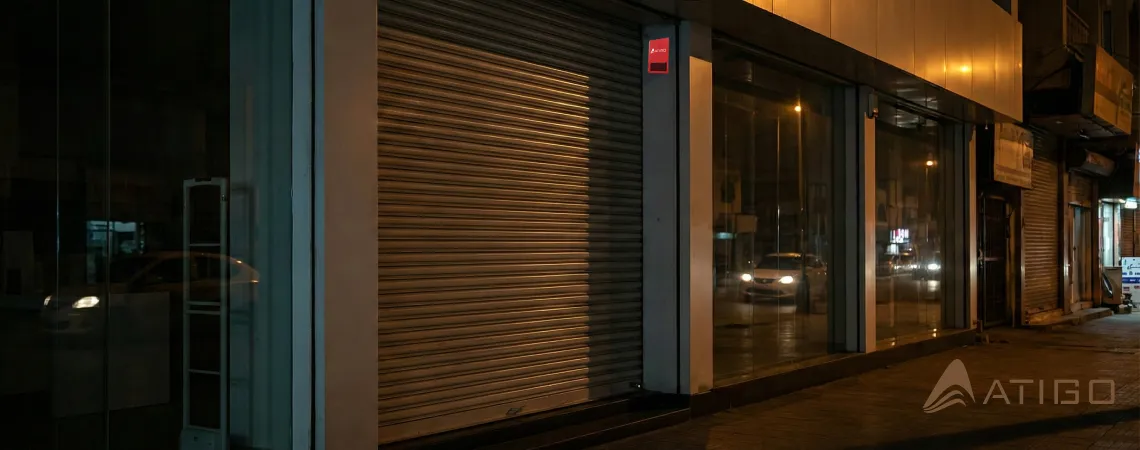
At 3:12 AM on a quiet weekday morning, a jewellery store owner received an unexpected phone call.
Moments earlier, a security sensor installed on the store’s shutter had detected suspicious activity. Within seconds, an alert was transmitted to a monitoring center. The event was verified, the owner was contacted, and response procedures were initiated.
The criminals fled before gaining entry.
The store’s inventory remained untouched.
While every incident is different, this story highlights an important reality facing jewellery businesses across India:
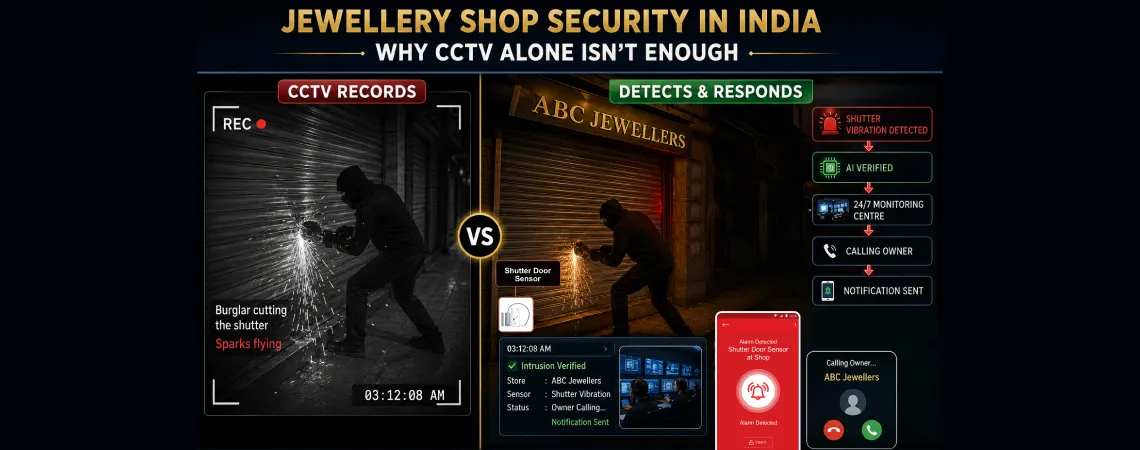
There is a significant difference between recording a crime and preventing one.
Many jewellery store owners invest heavily in CCTV systems, believing that cameras alone provide adequate protection.
Unfortunately, modern burglars understand exactly how to exploit that assumption.
India’s jewellery industry handles some of the highest-value retail inventory in the country.
That makes jewellery stores attractive targets for organized criminal groups.
Today’s burglars are not opportunists.
They are often coordinated teams that spend days studying a location before striking.
They observe:
When they attack, they typically use methods designed to bypass traditional security measures.
Using industrial angle grinders and cutting discs, criminals can breach standard shutters within minutes.
Most burglaries occur during late-night hours when business owners are asleep and neighboring shops are closed.
Professional gas-cutting equipment can damage shutters, grills, and access barriers quickly if no early-warning system is present.
Some criminal groups avoid front entrances entirely.
Instead, they gain access through adjacent properties and cut through shared walls.
Power outages create ideal conditions for theft when security systems lack battery backup or alternative communication pathways.
The question is not whether these threats exist.
The question is whether your security system can detect and respond before criminals reach your inventory.
CCTV remains an important security tool.
But it is important to understand what it was designed to do.
It captures footage for later review.
It provides evidence that may assist law enforcement and insurance providers.
It allows business owners to review activity inside and outside the premises.
However, CCTV has one critical limitation.
A camera can record a shutter being cut.
It cannot stop the cutting.
A camera can record intruders entering a store.
It cannot prevent them from entering.
A camera can record inventory being stolen.
It cannot recover the loss.
In most cases, CCTV tells you what happened after the incident has already occurred.
Effective security requires more than visibility.
It requires detection, verification, communication, and response.
That is where monitored security becomes essential.
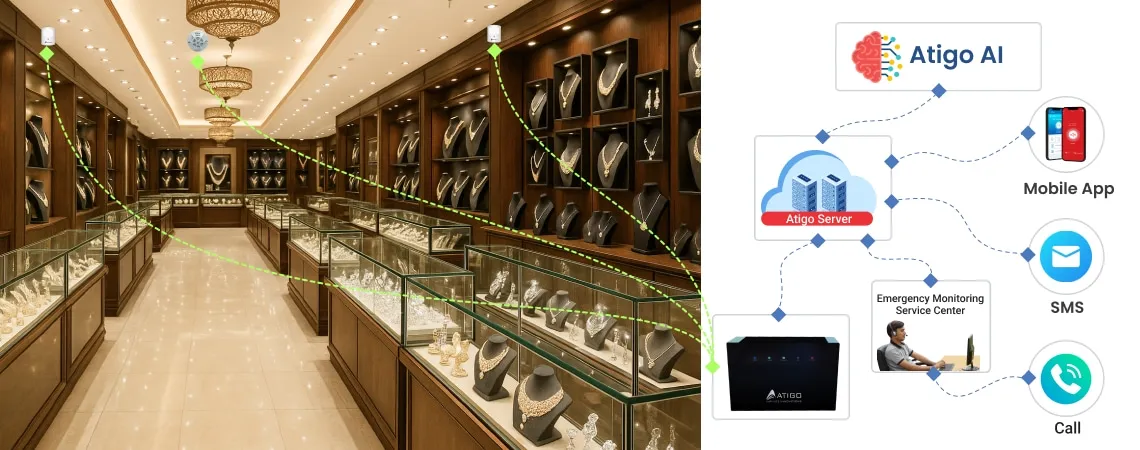
Most alarm systems stop at detection. Atigo Professional Protection Platform is designed around a complete security workflow:
Each layer supports the next — creating a connected protection ecosystem rather than a collection of standalone devices. Here is what each layer does, and why it matters for a jewellery store specifically.
At the foundation of the platform is Alaris 2.0, Atigo AIoT-powered security system, designed and manufactured in Ahmedabad with R&D collaboration from IIT Gandhinagar.
Unlike conventional alarm systems designed for European or North American conditions, Alaris 2.0 is built specifically for India for extreme heat, humidity, dust, voltage fluctuations, and variable GSM connectivity. These aren’t edge cases in Indian commercial premises; they’re daily realities that imported hardware fails to account for.
The sensor network covers every entry point that organized jewellery theft teams target:
The moment suspicious activity is detected the platform generates an AES-256 encrypted alert — transmitted instantly through whichever communication channel is available.
When a sensor triggers, the encrypted alert reaches Atigo cloud infrastructure immediately. The AI layer analyses multiple variables — time of day, sensor combinations, trigger sequence, historical activity patterns, and site-specific behavioral baselines — to distinguish genuine threats from non-critical events.
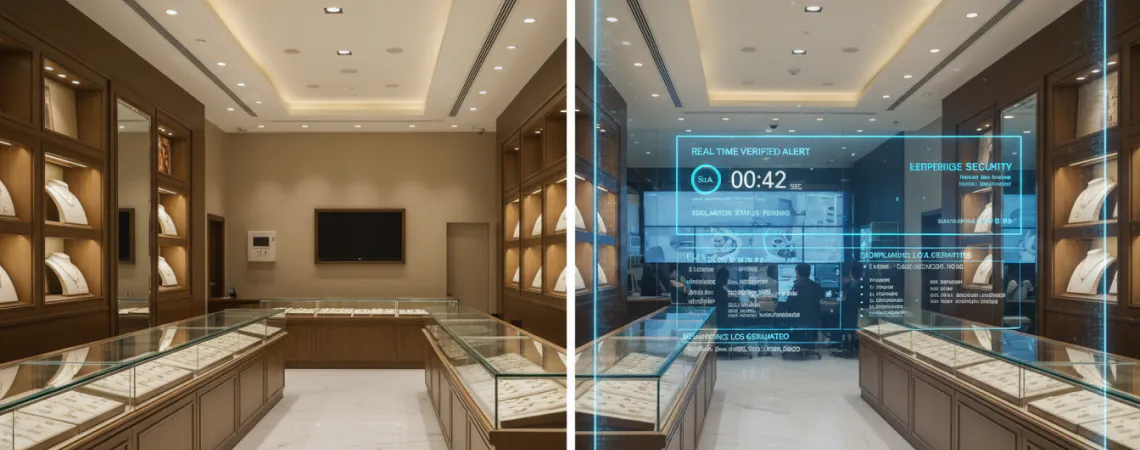
This verification step matters enormously for jewellery store owners. It means every genuine threat is escalated immediately, and false alarms are filtered before they cause unnecessary panic or desensitize the owner to real alerts. The entire verification process occurs within seconds — before a criminal team has finished cutting through a shutter.
At the same time as verification, store owners receive real-time updates through the Atigo Connect App. The moment a sensor triggers, you receive a push notification — before the monitoring team even calls. The app provides sensor-level event details, timestamped notifications, system health information, and remote arm/disarm capabilities.
For jewellery businesses operating multiple locations — showrooms across different markets or cities — the app provides centralized visibility across all locations from a single dashboard. You know what happened, you know it has been verified, and you know a response is already underway — all before you’ve spoken to anyone.
All communication is AES 256-bit encrypted.
Technology detects. People respond.
Atigo’s monitoring canter operates 24 hours a day, 365 days a year, staffed by trained Protection Monitoring Officers following structured emergency response procedures. When a verified threat is received, the team acts — average time from sensor trigger to emergency coordination: 60 seconds.
That response includes:
The difference between a professionally managed response and a standalone siren notification can be measured in minutes. In a jewellery burglary where a trained team can clear ₹1 crore of stock in under eight minutes — those minutes determine whether your inventory is protected or gone.
A notification tells you something happened. A monitored response ensures something is done about it — while it is still happening.
Many insurers evaluate security measures when assessing risk for high-value jewellery inventories.
A professionally monitored security solution can provide:
These records can be valuable during investigations and insurance claim processes.
Store owners should consult their insurance providers regarding specific security requirements and coverage considerations.
The reality is simple.
Modern jewellery theft is no longer a matter of breaking a lock and walking away unnoticed.
Criminals use sophisticated methods, exploit infrastructure weaknesses, and operate within very small windows of opportunity.
CCTV remains valuable.
But CCTV alone cannot detect threats, verify incidents, initiate response procedures, or help intervene while an intrusion is still in progress.
The difference between a recorded burglary and a prevented burglary is often measured in minutes.
And those minutes can determine whether your inventory remains protected.
Every jewellery store has unique vulnerabilities.
A professional site assessment can help identify security gaps before they become costly incidents.
Atigo Security’s team can evaluate your premises, review your current setup, and recommend practical improvements tailored to your business.
Request a free, no-obligation security assessment today.
Call: +91 90999 01674
Website: atigosecurity.in
No. CCTV is useful for recording events and supporting investigations, but it does not actively prevent burglaries. Effective security combines detection, monitoring, communication, and response.
The most effective systems combine intrusion detection, monitored alarms, backup communication channels, real-time visibility, and professional response services.
Yes. Systems with battery backup and redundant communication channels can continue operating during power outages.
Professional monitoring ensures that security alerts receive immediate attention, even when the store owner is unavailable or asleep.
At least once a year and before major festive seasons when inventory levels and operational risks typically increase.
India’s trusted security partner since 2013. Made in India manufacturer of 24/7 monitored alarm systems.
© 2013-2025 Atigo Security — A division of Atigo Enterprises Limited
Made in India. Monitored in India.