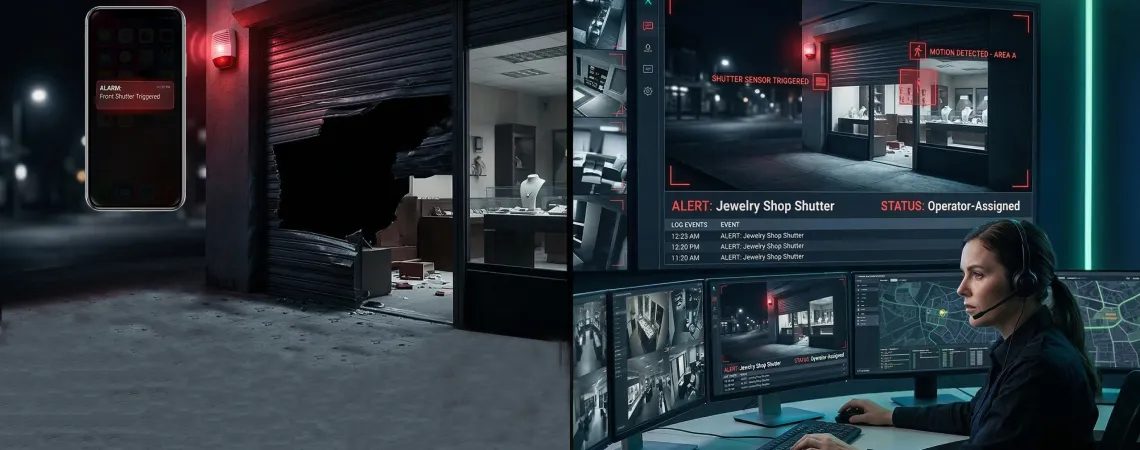
Retail theft is no longer an isolated issue—it is a growing, organized threat. Globally, retail shrinkage has increased sharply over the past few years, and in India, high-value items like mobile phones, jewellery, and electronics are frequent targets.
The uncomfortable truth?
Most retail stores are still protected by systems designed only to record crimes—not prevent them.
This is where AIoT (Artificial Intelligence of Things) security systems are changing the game.
Traditional retail security systems suffer from one fundamental flaw:
They react after the crime has already happened.
In reality:
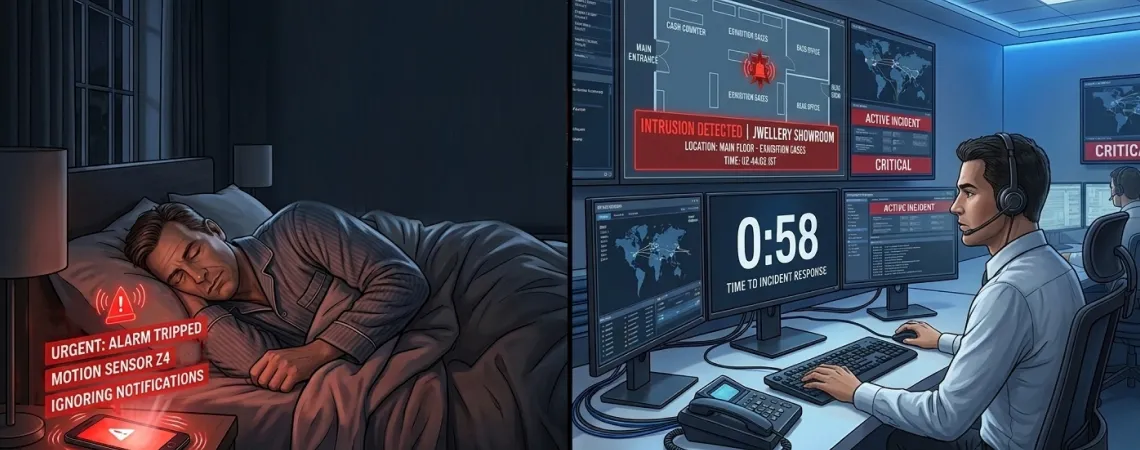
This creates a dangerous reaction gap—the time between detection and action—where the actual loss occurs.
AIoT stands for Artificial Intelligence + Internet of Things.
Instead of standalone devices, AIoT systems create an intelligent, connected security ecosystem that can:
1. Intelligent Sensor
Multiple sensors (motion, vibration, glass-break) work together.
AI verifies whether it’s a real threat—reducing false alarms.
2. Real-Time Connectivity
Systems stay connected through multiple channels (Wi-Fi, GSM backup), ensuring alerts are never lost.
3. AI-Based Decision Making
Instead of raw alerts, the system sends verified incidents, increasing response accuracy.
4. Human Monitoring Layer
Trained professionals validate threats and take action instantly.
This creates a dangerous reaction gap—the time between detection and action—where the actual loss occurs.
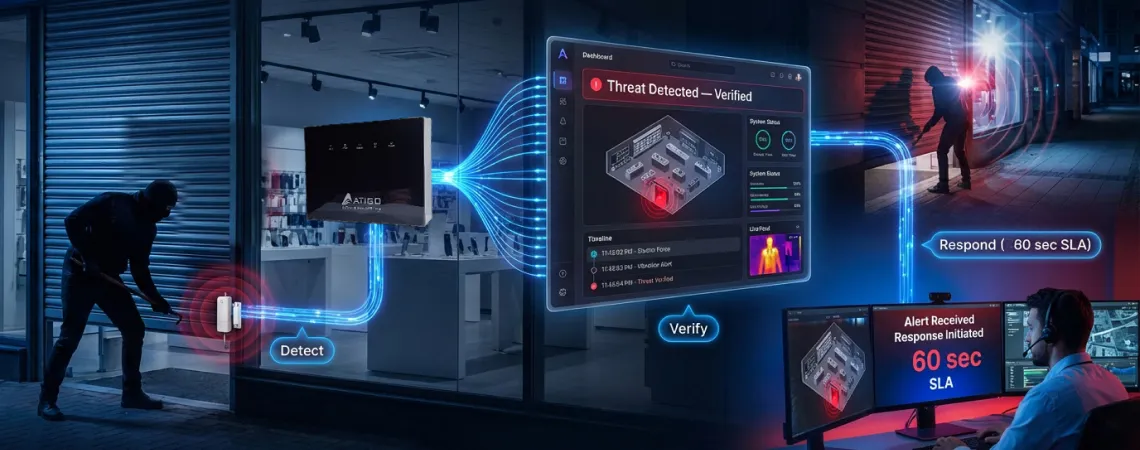
The Atigo Professional Protection Platform bridges the gap between detection and action.
Here’s how:
The result: A silent theft turns into a high-risk, high-noise situation—forcing criminals to abandon the attempt
Modern retail security is not just about protection—it directly impacts profitability.
With minimal monthly investment compared to the value of your inventory, AIoT-based protection delivers exponential ROI—often justified by preventing just a single incident.
Retail crime is evolving—and security systems must evolve with it.
Relying on CCTV footage after a theft is no longer enough.
Ignoring alerts at 2 AM is not a strategy.
The Atigo Professional Protection Platform doesn’t just detect threats—it responds to them instantly
Book your Free Security Risk Assessment secure your retail business before the next incident happens.
An AIoT (Artificial Intelligence of Things) security system combines smart sensors, real-time connectivity, and AI-based analysis to detect and respond to threats instantly. Unlike traditional systems, it doesn’t just record incidents—it helps prevent them.
CCTV systems only record footage, and basic alarms send alerts to the owner. AIoT systems go a step further by:
AIoT security is ideal for:
AIoT systems use sensor fusion—combining data from motion sensors, vibration detectors, and glass-break sensors. AI analyzes this data to confirm real threats, significantly reducing false alerts.
When an intrusion is detected:
Yes. Advanced AIoT systems use multi-path connectivity (Wi-Fi, GSM backup, etc.), ensuring alerts are transmitted even if one network fails.
Absolutely. AIoT systems are scalable and can be customized based on store size and risk level, making them suitable for both small shops and large retail chains.
India’s trusted security partner since 2013. Made in India manufacturer of 24/7 monitored alarm systems.
© 2013-2025 Atigo Security — A division of Atigo Enterprises Limited
Made in India. Monitored in India.