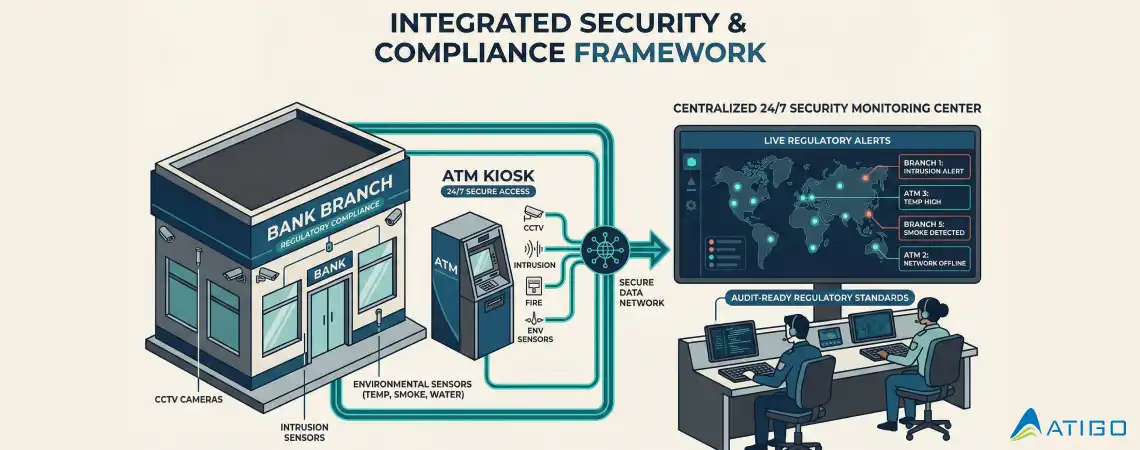
AIoT Security Intelligence Platform for Indian Banks

Centralized ATM & Branch Physical Security Monitoring for 2026 and Beyond
AIoT Security Intelligence Platform for Indian Banks

Executive Summary (For CSOs and Risk Leaders)

Indian banks operate some of the most geographically diverse and environmentally demanding security networks in the world. Thousands of branches and ATMs span metros, Tier-2 towns, rural highways, and coastal regions—each with unique operational and environmental risks.

Today’s core challenge is not the absence of alarms.
It is the absence of centralized intelligence.

Fragmented security systems create:

  • Blind spots across states and regions
  • Environmental false alarm fatigue
  • Delayed decision-making during genuine intrusions
  • Inconsistent documentation during RBI examinations
  • Maintenance gaps caused by climate and power stress

An AIoT Security Intelligence Platform transforms physical security from isolated site-level alerts into a national command framework—with encrypted, real-time visibility, predictive maintenance, and automated compliance documentation.

For Indian banking CSOs, this is not a technology upgrade.
It is an operational risk modernization initiative.

The Structural Security Challenge in Indian Banking

Distributed Networks Without Centralized Intelligence

Large Indian banks operate:

  • 500–5,000+ branches
  • Thousands of ATMs across varied geographies
  • Regional monitoring centers
  • Multiple legacy alarm vendors

This infrastructure was built incrementally over decades.

The result:

  • Multi-vendor systems
  • Inconsistent reporting
  • Regional silos
  • Manual coordination during incidents

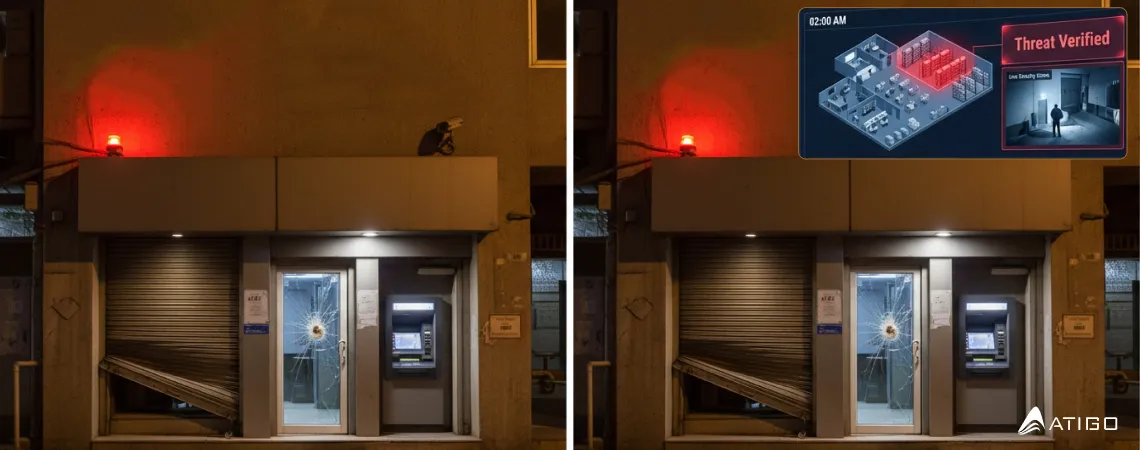
When an intrusion alert triggers at 2:37 AM in Pune, the key question is not:

“Did a sensor trigger?” It is:

  • Is this a coordinated pattern?
  • Is this environmental?
  • Is this a high-risk period (festival, high cash load)?
  • Has this location shown degradation recently?

Traditional alarm systems cannot answer these questions.

Environmental Stress: A Risk Multiplier

India presents unique operating conditions:

  • Sustained summer temperatures above 45°C in North India
  • High humidity in coastal regions during monsoon
  • Voltage fluctuations in Tier-2 and Tier-3 towns
  • Dust and particulate exposure in urban belts

Over time, these factors contribute to:

  • Sensor calibration drift
  • Increased false positives
  • Accelerated component degradation
  • Silent failures in remote ATMs

Security risk in India is not only criminal.
It is environmental plus operational.

Without predictive intelligence, degradation becomes vulnerability.

Why Traditional Alarm Architecture Is Obsolete

Most banks still operate site-level alarm systems that:

  • Generate alerts without contextual intelligence
  • Require manual cross-verification
  • Do not correlate activity across states
  • Provide limited equipment health visibility

This creates four systemic weaknesses:

1. Fragmented Visibility
No national dashboard. No macro threat analysis.

2. Alert Fatigue

Hundreds of false alarms per month across 100-location networks.

3. Reactive Detection

Alerts after intrusion has begun, not before damage occurs.

4. Maintenance Blind Spots

Failures discovered only during or after incidents.

Modern banking risk management requires a centralized control layer.
What an AIoT Security Intelligence Platform Actually Does

What an AIoT Security Intelligence Platform Actually Does

AIoT combines:

  • IoT-based intrusion systems engineered for Indian conditions
  • Artificial intelligence analytics trained on operational patterns

But at executive level, its value lies in architecture.

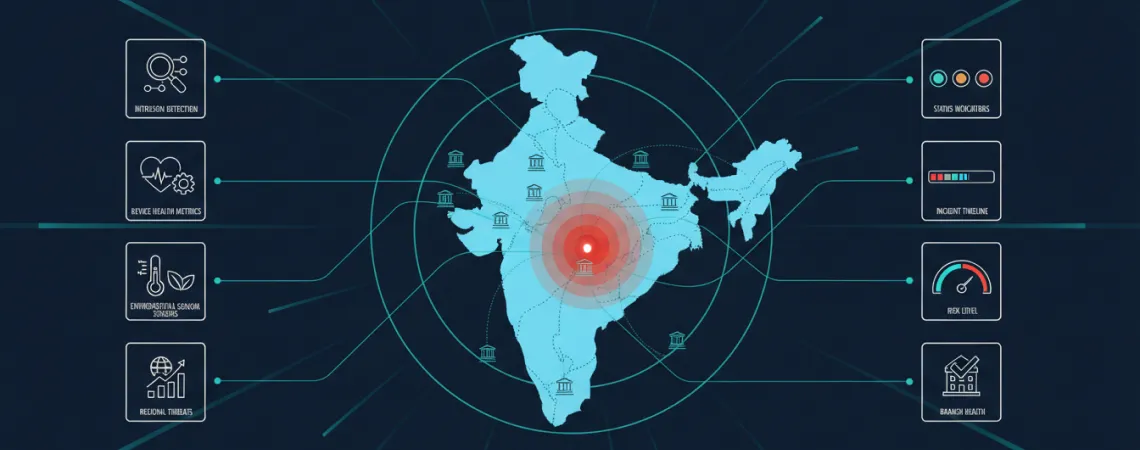
A. Centralized Intelligence Layer

A single national dashboard aggregating:

  • All branch and ATM intrusion systems
  • Device health metrics
  • Regional threat trends
  • Environmental correlation
  • Incident timelines

From Kashmir to Kerala, every location becomes visible in real time.

B. Encrypted, Bank-Grade Communication

Security infrastructure must itself be secure.

The platform uses:

  • AES-256 encryption for all device data transmission
  • TLS 1.3 secure communication protocols
  • Multi-factor authentication
  • Role-based access control
  • Comprehensive access audit logging

For banking networks, encryption is not optional.
It is foundational.

C. AI-Based Contextual Intelligence

The AI layer learns:

  • Regional operating patterns
  • Business hour variations
  • Seasonal trends
  • Environmental behavior of sensors
  • Historical location-level patterns

Instead of reacting to single triggers, the system:

  • Correlates multi-sensor inputs
  • Adjusts for environmental baselines
  • Assigns risk-weighted alert priorities

This reduces false alarms by up to 60% while preserving high sensitivity to genuine threats.

D. Predictive Maintenance

Every device continuously reports:

  • Signal quality
  • Temperature stress exposure
  • Humidity trends
  • Power quality impact
  • Calibration deviation

The system predicts failure before outage

This eliminates:

  • Silent protection gaps
  • Emergency maintenance premiums
  • Unplanned downtime

For geographically distributed banks, predictive maintenance is operational resilience.

Is your current infrastructure a liability?

Don’t leave your branch security to chance. Map your gaps with a professional evaluation.

From Alarm Monitoring to National Command Center

An AIoT platform converts security operations into a command framework.

Macro View (Board & CSO Level)

  • Real-time pan-India security map
  • State-wise threat analytics
  • Equipment uptime percentage
  • Seasonal performance trends
  • Incident frequency by geography

For any branch or ATM:

  • Exact device status
  • Maintenance history
  • Environmental stress indicators
  • Incident timeline
  • AI risk assessment

This eliminates guesswork during 2 AM alerts.

RBI-Ready Audit and Governance Enablement

RBI Master Directions emphasize:

  • Detection capability
  • Response documentation
  • Risk governance
  • Continuous improvement

While guidelines primarily focus on cyber resilience, physical security maturity directly influences regulatory posture.

The platform automatically generates:

  • Incident logs with timestamps and contextual data
  • Maintenance history with service validation
  • Equipment uptime metrics
  • Response time analytics

Access audit trails

Audit preparation shifts from manual compilation to structured export.

For institutions that previously required significant manual effort per audit cycle, centralized documentation dramatically reduces preparation burden.

Financial and Strategic Impact

Modernization of physical security should be evaluated across:

1. Operational Efficiency

  • 50–60% false alarm reduction
  • Reduced regional coordination overhead
  • Lower emergency maintenance costs
  • Improved device lifespan

2. Risk Mitigation

  • Reduced probability of major intrusion loss
  • Faster response cycles
  • Elimination of degraded equipment windows
  • Strengthened insurance negotiation position

3. Governance and Reputation

  • Stronger regulatory narrative
  • Board-level visibility
  • Reduced incident amplification risk
  • Competitive differentiation in security maturity

Security modernization is not an expense line.
It is a resilience investment.

At scale (200+ locations), operational efficiencies and risk reduction compound significantly.
Implementation Approach for Indian Banks

Implementation Approach for Indian Banks

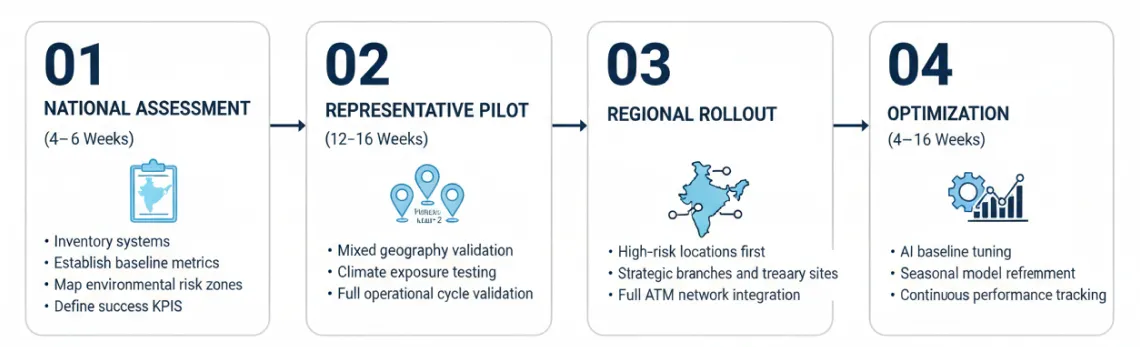
Modernization should follow phased rollout:

Phase 1: National Assessment (4–6 weeks)

  • Inventory systems
  • Establish baseline metrics
  • Map environmental risk zones
  • Define success KPIs

Phase 2: Representative Pilot (12–16 weeks)

  • Metro + Tier-2 + rural mix
  • Different climate exposure zones
  • Full operational cycle validation

Phase 3: Regional Rollout

  • High-risk locations first
  • Strategic branches and treasury sites
  • Full ATM network integration

Phase 4: Optimization

  • AI baseline tuning
  • Seasonal model refinement
  • Continuous performance tracking

Security transformation must be structured not disruptive.

Frequently Asked Questions

Yes. All device communication is encrypted using AES-256 and secured via TLS 1.3. Access is controlled with MFA and role-based permissions.

Yes. Multi-path communication with automatic failover ensures resilience. Local alarm functionality continues even during temporary connectivity disruption.

By learning location-specific baselines and correlating multiple inputs rather than reacting to single sensor triggers.

The platform integrates with Atigo IoT-based intrusion systems and can be deployed in phased modernization across legacy infrastructure.

Conclusion: The 2026 Imperative

Indian banking networks are too large, too distributed, and too environmentally complex to rely on fragmented alarm systems.

Security in 2026 demands:

  • Centralized visibility
  • Predictive intelligence
  • Encrypted communication
  • Automated compliance documentation
  • National-level command control

AIoT Security Intelligence Platforms represent the next phase of banking risk governance.

Next Steps for CSOs: Strengthen Your National Security Posture

Modernizing physical security across a distributed Indian banking network requires structured evaluation—not incremental upgrades.

Before initiating vendor discussions, leadership teams should first assess their current readiness across:

  • Centralized visibility across all states and zones
  • False alarm rates and environmental exposure risks
  • Device uptime and degradation patterns
  • Incident response timelines across jurisdictions
  • RBI documentation preparedness
  • Encryption and secure communication standards

Download the RBI Security Readiness Checklist

The RBI Security Readiness Checklist helps CSOs and Risk Leaders evaluate:

  • Network-wide monitoring maturity
  • Intrusion detection coverage consistency
  • Predictive maintenance capability
  • Encryption and data transmission security
  • Audit documentation preparedness
  • Incident response governance alignment

This checklist is designed to be reviewed at CSO level, Risk Committee level, and during internal audit preparation.

×
Download

 to benchmark your current security architecture against 2026 banking expectations.

About Atigo

Atigo is an Indian AIoT safety and security technology company focused on designing systems engineered specifically for Indian operating conditions.

  • Indigenous R&D with IIT Gandhinagar
  • Ahmedabad-based manufacturing
  • 10,000+ installations nationwide
  • Certified to ISO 9001, CE, RoHS, STQC, EN54, IS/ISO 7240

Designed for India’s climate, scale, and regulatory landscape.

Secure. Compliant. Connected. Made in India for India.