
In three separate break-ins at mobile phone shops this summer, the owners found out the same way: the next morning, standing in front of a damaged shutter. The alarm, the camera and the lock had all done their jobs. Nobody had been told in time to do anything about it.
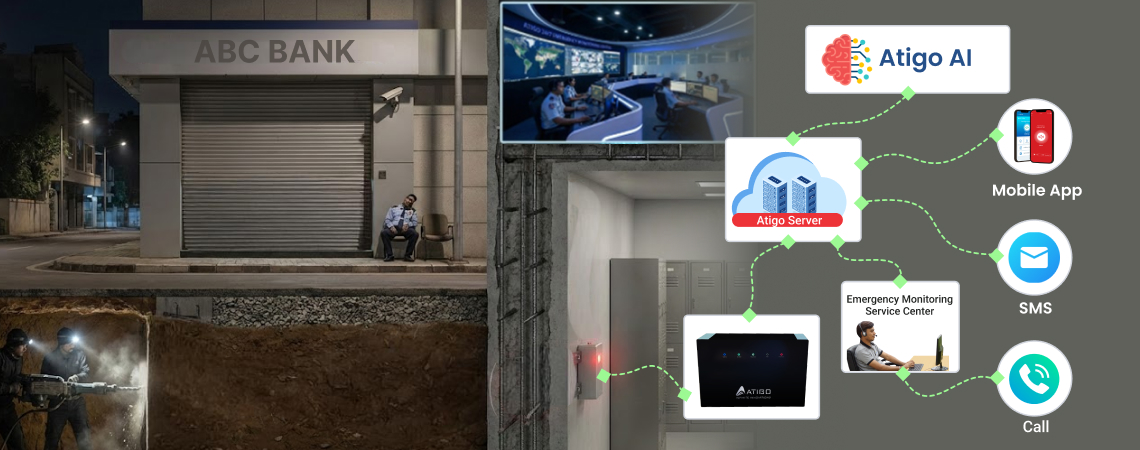
One where every alarm reaches a trained person within seconds, not just a siren. Atigo’s Professional Protection Plan (PPP) pairs intrusion sensors with 24×7 professional monitoring for about ₹40 a day per branch. The security alarm kit is free at activation, and the system stays under extended warranty while the subscription is renewed.
Because they hold what gangs want most, pledged gold, locker valuables and cash, often in small branches with no night guard. And break-ins usually come to light only when staff open the branch.
In 2015, dacoits cut through window bars with gas cutters and emptied the cash locker of a Nashik District Central Co-operative Bank branch. Police said it was the sixth heist on the bank’s branches in ten months. The branch manager found it at 10:30 the next morning (Deccan Herald).
Over a long weekend in October 2024, burglars used a gas cutter on the strongroom of an SBI branch and took gold worth about ₹12.95 crore. Staff discovered it on Monday morning (ETV Bharat); the gang also took the CCTV recorder (Deccan Herald).
The pattern is consistent. The shops were closed, the intruders had hours, and the first person to know was the owner arriving to open up. By then, the only thing left to do was file a complaint and hand over footage.
In January 2025, an armed gang robbed Kotekar Vyavasaya Seva Sahakari Bank in daylight and fled with cash and gold estimated at about ₹4 crore (ETV Bharat).
Most night-time break-ins follow the same pattern: entry through a rear wall or window, a long weekend or late night, cameras disabled, and nobody alerted until the shutter goes up. Daylight robberies add a second need: a way for staff to raise the alarm without being seen to.
Far more than the cash or gold taken. Three costs land on the CEO’s desk at once.
RBI’s revised locker instructions, in force since 1 January 2022, apply to all co-operative banks. If locker contents are lost to fire, theft, burglary, dacoity, robbery or building collapse because of the bank’s own shortcomings, or to fraud by staff, the bank is liable for up to 100 times the locker’s annual rent. The same instructions make the bank responsible for taking all steps to secure the premises housing the vault (RBI circular, Moneylife).
For illustration: at ₹3,000 annual rent, each broken locker can mean up to ₹3 lakh. Thirty broken lockers, as in a 2017 burglary at a Modinagar bank branch, would mean up to ₹90 lakh (Hindustan Times).
Gold held as loan security belongs to your borrowers. A theft leaves the bank answering to them, its insurer and the police at the same time.
A co-operative bank is owned by its members and runs on local reputation. Urban co-operative banks fund themselves almost entirely from deposits; borrowings were just 0.8% of their liabilities at end-March 2025 (RBI). Depositor confidence is the balance sheet, and one incident in the local paper travels faster than any reassurance.
Because gangs plan for both, and neither one guarantees that a person acts in time.
In a 2018 burglary at a bank branch in Prayagraj, the intruders cut the wires of seven CCTV cameras, disabled the smoke detectors and stayed for hours; the branch had no night guard (Hindustan Times). In Nyamati the gang carried off the recorder. In Ullal, the CCTV was reportedly under maintenance (Open).
A semi-urban branch on a market road is empty after 8 PM. A siren that nobody hears protects nothing.
Many branch alarms send a voice call or SMS to the manager. At 3 AM that phone may be on silent, out of charge or ignored as a false alarm.
Legacy panels are kept alive on annual maintenance contracts, and a fault can sit unnoticed for weeks. Banks re-tender these AMCs every year; Andhra Pradesh Grameena Bank’s 2026 RFP for burglar-alarm CAMC is a typical example (APGB).
The missing piece is not another device. It is a trained person who receives every alarm within seconds and keeps working the phones until someone responds.
The Atigo Professional Protection Plan (PPP) is a monthly subscription that combines AIoT intrusion sensors with Atigo’s 24×7 professional monitoring centre.
Atigo brings more than 12 years of monitoring experience and 100+ verified emergency responses. The system is sensor-based and does not depend on anyone watching camera feeds.
Shutter vibration sensors, door sensors, motion detectors and glass-break sensors pick up an intrusion attempt. Panic buttons let staff raise an alarm during banking hours.
The Alaris 2.0 panel sends the event instantly over two paths, GSM and Wi-Fi, encrypted with AES-256 and TLS 1.3. The alert has left the building before anyone can reach the recorder or the siren.
Within the 60-second response SLA, the officer calls your designated contacts in the agreed order (branch manager, CEO or security in-charge, alternates) and keeps calling until someone answers.
The officer guides that person through organising the response on the ground, including informing local police.
The platform also monitors system health, so faults are flagged instead of discovered after an incident, and it keeps an incident history and audit log for every event. Atigo is ISO 9001 and CE certified, runs R&D in collaboration with IIT Gandhinagar, and manufactures in Ahmedabad.
Because it removes the capital proposal, the yearly AMC tender and the replacement risk in one move.
Put in perspective: a 20-branch bank pays ₹2.88 lakh a year plus GST for PPP across every branch (₹1,200 × 12 months × 20). That is less than the maximum liability on a single broken locker rented at ₹3,000 a year.
How the expense is sanctioned depends on your bank’s delegation of financial powers. A recurring operating expense within the approved budget is usually simpler to clear than a new capital item, but confirm the accounting treatment with your statutory auditor, as it depends on the contract terms.
PPP replaces a device you maintain with a service that is maintained and watched for you.
| Feature | Conventional alarm + auto-dialler | Atigo Professional Protection Plan |
|---|---|---|
| Hardware cost | Bought by the bank, per branch | Security alarm kit free at activation |
| Who receives the alarm | One or two phones, often asleep | 24×7 monitoring centre, every time |
| Response | Depends on whoever picks up | Escalation within the 60-second SLA; officer keeps calling until someone acts |
| Transmission | Often a single line or SIM | Two paths: GSM and Wi-Fi |
| Maintenance | Annual CAMC, re-tendered | Extended warranty with every renewal |
| Fault detection | Manual checks | System health monitoring |
| Records | Limited, if any | Incident history and audit logs |
| Budget | Capital item plus AMC | One monthly fee per branch |
Conventional branch alarm vs Atigo Professional Protection Plan
It strengthens the area RBI holds banks responsible for, the security of the premises, and leaves a record of how every alarm was handled.
RBI’s locker instructions place on banks the responsibility to take all steps for the safety and security of the premises housing safe deposit vaults, and require a Board-approved locker policy (Moneylife). Co-operative banks have written this into their own policies; Pune People’s Co-operative Bank, for instance, states that the bank must ensure such incidents do not occur through its own shortcomings (Pune People’s Bank).
RBI’s 2009 branch security checklist, issued to Regional Rural Banks, suggests that branches without night security be given sensors connected to an alarm system and, where possible, an auto dialler, and that the alarm be checked daily (RBI). PPP adds a trained officer behind that alarm and continuous health monitoring.
The Board of a UCB is responsible for formulating policy in line with RBI directions (RBI UCB Governance Directions, 2025). Time-stamped incident logs give the Board and inspectors evidence of how security is working, branch by branch.
PPP complements CCTV rather than replacing it. Cameras provide evidence after the event; PPP provides detection and a managed response while it is happening.
A one-page note that answers the four questions directors will ask.
Board note outline: adapt for your bank
Atigo can carry out the branch security risk assessment that supplies the numbers for points 1 and 2.
About ₹40 a day: ₹1,200 + GST per month per branch. The security alarm kit is free at activation.
Yes. RBI’s revised locker instructions of 18 August 2021 are addressed to all co-operative banks. They set the bank’s liability at up to 100 times the annual locker rent for losses from causes such as theft, burglary or fire due to the bank’s own shortcomings.
The complete system stays under extended warranty for as long as the subscription is renewed, so there is no separate AMC or repair bill for covered hardware.
No. A trained protection officer calls the bank’s designated contacts in the agreed order until someone answers, then guides them through the response, including informing local police.
The Alaris 2.0 panel transmits over two independent paths, GSM and Wi-Fi, with AES-256 and TLS 1.3 encryption.
No. CCTV records evidence; PPP detects intrusion and drives a response in real time. They work best together.
Yes. It is priced per branch, so a bank can start with one or two branches. Most UCBs are small: 57.5% were classified as Tier-1 at end-March 2025 (Business Standard).
It is structured as a recurring subscription rather than an equipment purchase. Confirm the accounting treatment with your statutory auditor.
ISO 9001 and CE.
Ask three questions about your most exposed branch. If a sensor trips there at 2 AM on a long weekend, who hears it? How fast do they act? And what would the locker claims cost if nobody does?
If the answers are uncomfortable, request a branch security risk assessment from Atigo, designed and built in Ahmedabad.
Atigo Security – Protection that never sleeps
India’s trusted security partner since 2013. Made in India manufacturer of 24/7 monitored alarm systems.
© 2013-2025 Atigo Security — A division of Atigo Enterprises Limited
Made in India. Monitored in India.