
Peak stock, record gold prices and the longest closure of the year all arrive in the same week. Here is why that makes Diwali the riskiest time for a jewellery store, and how monitored protection closes the gap between an alarm going off and someone actually acting on it.
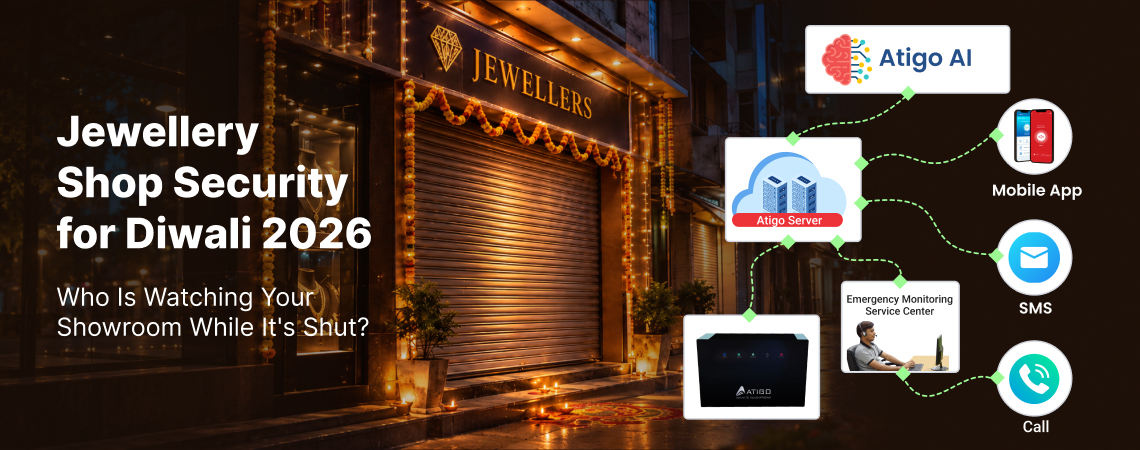
To protect a jewellery shop during Diwali, you need more than CCTV: you need someone who responds while the shop is shut. Stock peaks after Dhanteras and many shops close for several nights. A 24×7 professionally monitored burglar alarm detects entry at the shutter, wall or showcase and gets a trained officer acting within 60 seconds.
Consider three incidents reported between July and August 2026.
In September 2023, the owner of Umrao Singh Jewellers in south Delhi’s Bhogal market pulled down his shutter at about 8 PM on a Sunday. The shop stayed shut on Monday, its weekly off. When he reopened at around 10:30 AM on Tuesday, burglars had already cut into the strong room and left with ornaments police valued at more than ₹20 crore. The CCTV cameras had been damaged around midnight on Sunday.
Think about that window: roughly 38 hours between closing and discovery. The shop had cameras. What it did not have was anyone who knew, in real time, that something was wrong.
Now think about your own shop this Diwali. Not one closed day, but several. Not a normal week’s stock, but the most you will hold all year.
Burglars who target jewellers are rarely opportunists. They study the shop, plan the entry and, above all, look for time: hours when no one will come. Diwali gives them three things at once.
Dhanteras and Diwali are the biggest gold-buying occasions in India, according to the World Gold Council, and jewellers stock up for them. Ahead of Dhanteras 2025, the Council’s India head said retailers who had been cautious through the year were now well-stocked (PTI, Oct 2025). In a normal year, around 20 to 30 tonnes of gold is sold across the country on Dhanteras day alone (Business Standard). Whatever has not sold by Diwali night is still sitting in your showcases and strong room.
On 8 October 2026, 22-carat gold was trading at an indicative ₹13,710 per gram, before GST and making charges (PSU Connect, 8 Oct 2026). At that rate, a single kilogram of 22-carat jewellery is worth about ₹1.37 crore. A burglary that once meant a painful loss can now wipe out years of profit in one night.
In 2026, Dhanteras falls on Friday 6 November and Lakshmi Puja on Sunday 8 November. In Gujarat, many shops and markets stay closed after Diwali through Bestu Varas, the Gujarati New Year, and reopen on Labh Pancham, which this year falls on Saturday 14 November (Drik Panchang). Across India, Bhai Dooj and family travel stretch the break further. For many jewellers, that means up to five or six consecutive nights with the shop dark, the owner out of town, staff on leave and neighbouring shops shut too.
Police notice the pattern. During Diwali 2025, Pune police reported a string of burglaries at locked homes and shops and warned that such cases rise during festivals when premises are left unattended, advising people to keep their alarm systems working (The Bridge Chronicle, Oct 2025).
Approximate value of 1 kg of 22K gold at early-October 2026 rates
Share of property stolen in India in 2023 that was never recovered (NCRB)
Reported cases across India point to four entry routes, almost always used at night while the shop is closed: the rear wall, the roof, the shutter, and the shop next door. Almost none come through the front door during business hours.
Two details from these cases matter more than the entry route. First, burglars increasingly disable the cameras or carry off the recorder before they start, as in Bhogal and Tilak Nagar. Second, the Valsad attempt failed only because a friend of the owner who lived nearby happened to wake up and see the men at the shutter. That is luck. Luck is not a security plan, especially during a week when the neighbours are away too.
Because each one stops short of the one thing that saves stock: someone responding while the break-in is still happening. Most jewellers already have some security. Here is where each common tool falls short when the shop is shut.
| Protection | Detects entry? | Who acts at 2 AM? | Works if you are travelling? |
|---|---|---|---|
| CCTV only | Records it | No one, until morning | Footage only |
| Local alarm siren | Yes | Whoever happens to hear it | Rarely |
| Self-monitored app alerts | Yes | Only you, if you see it | Depends on you |
| Night guard | Partly (one view) | One person | Yes, within his line of sight |
| Atigo Professional Protection | Yes, at shutter, door, showcase | Trained officer, 24×7 | Yes: officer escalates to your contact list |
The pattern is clear. Detection is not the weak link. Response is.
Atigo is an Ahmedabad-based, Made-in-India AIoT security company. Its Professional Protection Platform (PPP) is a monitored burglar alarm service for shops, built on one idea: an alarm only protects you if it reaches someone whose job is to act on it. It works in three layers.
Shutter vibration sensors, door sensors, motion detectors, glass-break sensors and panic buttons, placed where burglars actually enter. Because they trigger at the first attempt on the shutter, wall-side zone or showcase, the alarm goes out at the start of the break-in, not after the stock is gone.
The Alaris 2.0 AIoT panel transmits each event instantly to Atigo’s server over two separate pathways, GSM and Wi-Fi, encrypted with AES-256 and TLS 1.3. Real-time event verification and system health monitoring help the monitoring centre see what is happening at your premises, not just that a siren went off.
Atigo’s 24×7 monitoring centre receives the alarm and a trained protection officer escalates it within 60 seconds. The officer calls you and your designated contacts in the order you agreed, keeps calling until someone answers, and then guides that person through organising the response: reaching the shop, alerting a neighbour, and contacting police on 112.
A note on cameras: PPP is sensor-based. Atigo does not watch your shop on live video, and it does not need to. Sensors at the entry points tell the monitoring centre exactly where and when the intrusion began, and they keep working alongside the CCTV you already have. That approach has a track record: in a warehouse case in Uttar Pradesh, sensor data alone, with no CCTV involved, led to the criminals being caught and saved goods worth more than ₹1 crore.
Here is how a response unfolds with PPP. This is an illustration of the process, not a specific incident.
1:40 AM. The shutter vibration sensor at the front of a closed jewellery store detects sustained cutting. The panel sends the alarm to the monitoring centre instantly over GSM and Wi-Fi.
Within 60 seconds. A protection officer escalates the event and calls the owner, who is at his in-laws' home 300 km away and does not pick up.
Next contact. The officer moves down the agreed list and reaches the owner's brother, who lives 10 minutes from the market.
Guided response. The officer stays on the line, helps him call 112 with the exact address and zone triggered, and keeps the owner updated by call and SMS. Every event is logged in the incident history.
Result. Instead of a discovery on Labh Pancham morning, the attempt is interrupted while it is still under way.
The difference between those two outcomes is not a better camera or a louder siren. It is a person, awake and trained, whose job is to make sure your alarm is never ignored.
For most jewellers, yes. A full year of monitoring costs roughly what one gram of 22-carat gold costs today, while a single kilogram of stock is worth over ₹1.3 crore.
For most jewellers, yes. A full year of monitoring costs roughly what one gram of 22-carat gold costs today, while a single kilogram of stock is worth over ₹1.3 crore.
Put that next to what is in your showroom: about ₹14,400 a year against stock worth crores.
And once gold is stolen, it rarely comes back. According to NCRB’s Crime in India 2023, property worth ₹6,917.2 crore was reported stolen across India that year and only 29.9% of it was recovered (PTI, Oct 2025). In other words, roughly seven rupees of every ten stolen never returned. Prevention during the act is far more reliable than recovery after it.
There is also the cost no policy covers: a week of Diwali spent worrying about the shop instead of being with your family. That peace of mind is part of the return.
Before closing for Diwali, secure the stock, close the weak entry points and make sure someone will respond at night. Whether or not you choose Atigo, run through this checklist before you lock up.
Dhanteras 2026 is on Friday, 6 November, about three weeks away. Once the festive rush starts, there will be little time for site visits and testing. The sensible path is to book a free Security Risk Assessment now, so that the survey, installation, sensor testing and your escalation contact list are all in place before the busiest and most vulnerable fortnight of your year begins.
Atigo brings 12+ years of monitoring experience and 100+ verified emergency responses. Its AIoT platform is designed and manufactured in Ahmedabad, developed with R&D collaboration with IIT Gandhinagar, and its quality management is ISO 9001 certified, with CE-marked hardware.
Move display stock to the strong room every night, check rear walls, roof and shutter for weak points, keep closure dates private, and make sure someone will respond to an alarm at night even when you are away. A 24×7 professionally monitored alarm covers that last step.
The strongest setup layers three things: a strong room or safe to slow burglars down, CCTV for evidence, and a professionally monitored intrusion alarm so a trained person responds the moment someone attacks the shutter, wall or showcase. The monitored alarm is the layer most jewellers are missing.
Three risks peak together: stock is at its highest after Dhanteras, gold prices make every kilogram worth crores, and many markets stay shut for several nights after Diwali while owners and staff are away. Burglars need uninterrupted time, and the festive closure gives them the most of it.
No. CCTV records what happens, but no one acts on it while the shop is closed. In several reported jewellery burglaries in India, thieves damaged the cameras or removed the recorder before stealing. CCTV is useful evidence; it is not a response.
The alarm reaches Atigo’s 24×7 monitoring centre in real time. A trained monitoring officer escalates within the response window, calls the owner and designated contacts in the agreed order until someone answers, and then guides that person through organising the response, including contacting police on 112.
No. Atigo’s Professional Protection Platform is sensor-based. Shutter, door, motion and glass-break sensors detect an intrusion at the point of entry and send the alarm to the monitoring centre. It works alongside your existing CCTV rather than replacing it.
The Professional plan works out to about ₹40 a day (₹1,200 + GST per month). The security alarm kit is free at activation, with lifetime extended warranty while the subscription is active. Additional sensors for larger showrooms are priced separately.
Dhanteras falls on Friday, 6 November 2026. Booking a free Security Risk Assessment now gives enough time for the site survey, installation, testing and setting up your escalation contacts before the festive rush. Call or WhatsApp +91 90999 01674.
Book a free Security Risk Assessment for your jewellery store before Dhanteras.
India’s trusted security partner since 2013. Made in India manufacturer of 24/7 monitored alarm systems.
© 2013-2026 Atigo Security – A division of Atigo Enterprises Limited
Made in India. Monitored in India.