
Temple thefts happen after midnight, when the mandir is locked and nobody is watching the screens. Here is what the verified cases show, and how trustees can make sure someone responds within seconds.
Temples are targeted because they hold silver, gold and antique idols in buildings that are locked and usually unattended at night. CCTV records a break-in but does not stop it, and thieves routinely turn, paint over or steal cameras and DVRs. Effective temple security combines early intrusion detection with a 24×7 monitoring centre that immediately alerts the trustees and helps them organise a response. That is the model Atigo’s Professional Protection Platform (PPP) is built on, with the security alarm kit free at activation and plans at about ₹40 a day + GST.
In January 2025, two men entered the Prachin Sheetla Mata Mandir in Ludhiana’s BRS Nagar at around 1:30 AM. According to the temple priest’s account of the CCTV footage, they stayed for about 90 minutes. They left with roughly 40 kg of silver ornaments, including a gold nose ring, taken from the idols, and desecrated the idols in the process. The temple committee said a watchman was present in the area. (The Tribune, 8 January 2025)
The cameras worked. They recorded an hour and a half of theft. What was missing was anyone who knew, in that hour and a half, that it was happening.
Closer to home, on 17 July 2026, thieves broke the lock of the sanctum at the Umiya Mata Temple on Sanand Bypass Road near Ahmedabad between 2:00 and 2:30 AM and took a silver canopy and a silver idol worth about ₹3 lakh in total. Ahmedabad Rural Police arrested five people within days. (IANS, 29 July 2026) That same month in Karnataka, a 32 kg silver idol of Sri Pavada Basaveshwara, valued at about ₹51.2 lakh, was taken from the sanctum of a temple in Vijayapura district on the night of 5–6 July. (PTI via ThePrint, 7 August 2026)
After a theft, devotees don’t ask the police what went wrong. They ask the trustees. This article is for temple trustees, managing committees and sevaks who carry that responsibility. It sets out what the verified record shows, why cameras and basic alarms keep failing, and what a monitored response model changes, including a one-page summary you can take to your next committee meeting.
Temple burglary and idol theft are a persistent, under-solved crime in India: in Himachal Pradesh alone, 57% of temple thefts over a decade remained untraced. There is no single national count that we could verify, so the clearest evidence comes from state police data and replies in Parliament. Both point the same way.
The ASI protects 3,686 monuments of every kind across the country, and deploys watch-and-ward staff, private security and CISF personnel at select sites. (PIB, 2025 and 2026) The overwhelming majority of living temples, though, are run by trusts, endowment boards and village committees, and they carry the security burden themselves.
There is a hopeful lesson in the Himachal figures. After the December 2014 theft of idols and about 10 kg of silver from the Raghunath Temple in Kullu, police issued guidelines for strict vigil on temples. Reported thefts fell from 163 in 2012–2014 to 71 in 2019–2021, a decline of about 56%. (The Tribune, August 2022) Organised vigilance works. The question for trustees is how to have it every night, not just after a headline.
Temples and Jain derasars keep high-value silver, gold and idols on open display in buildings that are locked and unattended at night, and thieves plan around that. The reported cases share the same conditions:
Because a camera is a witness, not a responder. It tells you the next morning who did it. It does not tell anyone at 2 AM that it is happening. The reported cases show every way this gap is exploited:
None of this means temples should remove their cameras. Footage helps police trace suspects, and it should be kept, with the DVR locked away from the prayer hall. But on its own, CCTV cannot prevent a loss.
Already have CCTV? Good, keep it. Atigo adds the part cameras can’t do: detecting the break-in the moment it starts and making sure a trustee is woken and guided within seconds.
A local siren makes noise, but no one is accountable for acting on it; at a temple outside the village, there may be no one within earshot. App-only alerts go to a trustee’s phone, which at 2 AM is often on silent. A watchman helps, but he is one person across a large complex, and in Ludhiana a watchman was in the area when the theft happened. Each of these is a detection step with no guaranteed response behind it.
| At 2 AM, during a break-in | CCTV only | Local siren alarm | Night watchman | Atigo PPP |
|---|---|---|---|---|
| Detects entry the moment it happens | Records it; no one is watching | Yes | Only if he sees or hears it | Yes, door, motion, shutter and glass-break sensors |
| Someone is told immediately | No | Only people within earshot | He must raise the alarm himself | 24×7 monitoring centre alerted instantly |
| Someone is accountable for acting | No | No | One person | Trained officer calls trustees in agreed order |
| Hard for thieves to silence | Cameras can be painted, turned or stolen | Can be cut or ignored | Can be overpowered or locked in | Two transmission paths, GSM and Wi-Fi |
| Useful for investigation afterwards | Yes, strong evidence | Little | Witness account | Incident history and audit logs |
How common temple security measures compare during a night break-in
The strongest temple security is layered: keep the cameras for evidence, keep the watchman for presence, and add the missing piece, detection that reaches a person whose job is to act.
Atigo’s PPP combines AIoT intrusion detection with 24×7 professional monitoring from Atigo’s own monitoring centre. It works in three layers.
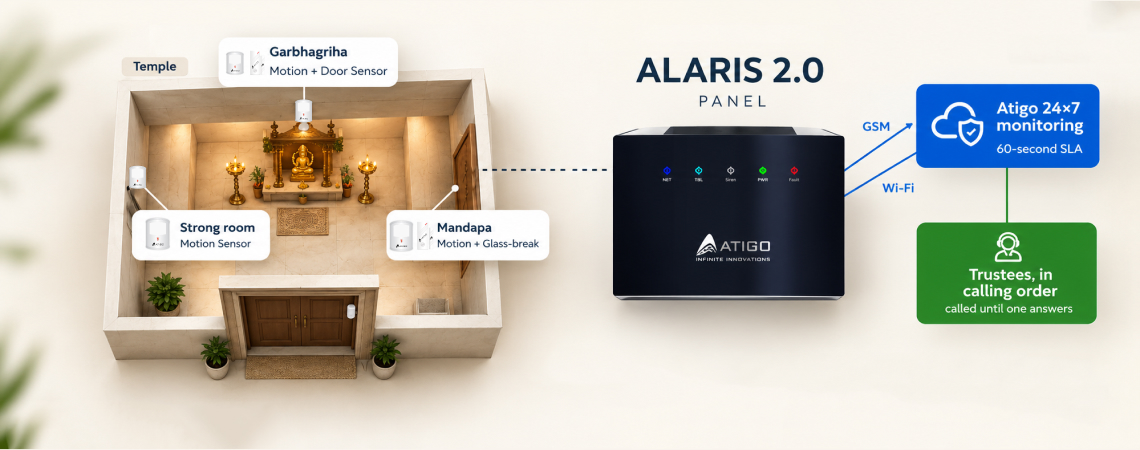
Every sensor reports to the Made-in-India Alaris 2.0 panel, which sends the alarm instantly to Atigo over two separate paths, GSM and Wi-Fi. Cutting a wire or switching off the router does not stop the alert. The platform verifies events in real time and keeps watch on the health of the system itself, so the committee knows its protection is working every night. (Alarm data is secured with AES-256 and TLS 1.3 encryption.)
When an alarm comes in, a trained monitoring officer at Atigo’s 24×7 monitoring centre calls the temple’s designated trustees or caretaker in the order the committee has agreed, and keeps calling until someone answers. The officer then guides them through organising the response: alerting the local police, getting volunteers or neighbours to the temple, and keeping track until the situation is handled. Atigo works to a 60-second response SLA.
Your trustees stay in control of the temple and the decisions. Atigo’s job is to make sure they are never the last to know. (Atigo’s platform is sensor-based; it does not monitor camera feeds or dispatch police directly.)
For a trustee committee, the day-to-day tools matter too: remote arm and disarm from the mobile app to match aarti and darshan timings, multi-user access so several trustees receive alerts, and incident history with audit logs for committee meetings and insurance records.
Atigo currently protects a temple in Saurashtra and Jain derasars in Mehsana, Surat and other districts of Gujarat. Their trustees use the same platform described here: sensors mapped to the sanctum and storerooms, a calling rota, and a monitoring officer on duty every night.
Proof that sensor-led response works: at a warehouse in Uttar Pradesh protected by Atigo, sensor data alone, without any CCTV, led to the criminals being caught and saved more than ₹1 crore worth of goods. (Atigo incident record)
From sensor to trustee: an intrusion at the sanctum reaches Atigo’s monitoring centre over two paths, and a trained officer calls the trustees in the agreed order until one answers.
Yes. Atigo’s sensors are small and wireless, so they need no cable runs across carved stone, painted walls or old wooden doors. Heritage structures demand restraint. India’s National Policy for Conservation (2014), which guides the ASI, emphasises minimal intervention and authenticity. (PIB, 2025; Ministry of Culture) Many older temples outside ASI protection deserve the same care.
The panel can sit in the temple office, and trustees decide where each sensor goes, including whether any are placed inside or outside the sanctum. For temples protected by the ASI or a state archaeology department, trustees should obtain the relevant authority’s approval before fixing anything to the structure. Atigo’s team can prepare the sensor plan to support that application.
₹40 a day for 24×7 monitored protection
₹1,200 + GST per month
Now set that against one night. The ₹3 lakh taken from Umiya Mata Temple in Sanand would pay for more than 17 years of Atigo’s Professional plan. The ₹51.2 lakh silver idol taken in Vijayapura would pay for more than 300 years. And neither figure counts what cannot be priced: the sanctity of the idol, the trust of devotees, and the committee’s standing in the community.
There is no equipment cost to approve upfront. The plan is about ₹40 a day + GST, and the committee can review it every month like any other running expense.
In the Manali theft, the goddess’s gold ornaments kept in a separate bhandar were not touched.
Three or four trustees plus the priest, with phone numbers and a calling order, so an alert always reaches someone awake.
Arm after the last aarti, disarm before the morning mangla, and review who did it.
Lock it in a room covered by a sensor.
so the sensor plan fits your building and, if needed, your heritage approvals
Atigo’s team will walk your temple, map every entry point, suggest a sensor plan that respects the structure, and help set up a calling rota with your trustees. Protection costs about ₹40 a day (₹1,200 + GST per month), with the alarm kit free at activation.
No. CCTV records a break-in but does not stop it. In reported Indian temple thefts, thieves have spray-painted or turned cameras, carried away the DVR, or simply worked in front of the cameras for over an hour because nobody was watching or responding. CCTV is valuable evidence; it needs to be paired with intrusion detection and a 24×7 response process.
Yes, with care. Atigo’s sensors are small wireless devices, so they do not need cable runs across carved stone, painted walls or old wooden doors. For temples protected by the ASI or a state archaeology department, trustees should get the relevant authority’s approval before fixing anything to the structure.
The Alaris 2.0 panel sends the alarm instantly to Atigo’s 24×7 monitoring centre over GSM and Wi-Fi. A trained monitoring officer calls the temple’s designated trustees or caretaker in the agreed order and guides them in organising the response, such as alerting local police and reaching the temple.
Atigo’s Professional Protection Platform is sensor-based, so it does not rely on anyone watching camera feeds. Monitoring officers do not dispatch police directly. Instead, they make sure the temple’s designated trustees are alerted within seconds and guide them in coordinating the response, including informing local police.
The Professional plan is ₹1,200 + GST per month, about ₹40 a day. There is no upfront equipment cost: the security alarm kit is free at activation, and the equipment carries a lifetime extended warranty while the subscription is active. Larger temples may need additional sensors, which are quoted after a site assessment.
Yes. Atigo currently protects a temple in Saurashtra and Jain derasars in Mehsana, Surat and other districts of Gujarat. Trustees decide sensor placement, including whether sensors go inside or outside the sanctum.
Reported cases cluster after midnight, when the temple is locked and unattended. Examples include break-ins at about 1:30 AM in Ludhiana (January 2025), between 2:00 and 2:30 AM near Ahmedabad (July 2026) and at 2:54 AM in Chandigarh (June 2017).
India’s trusted security partner since 2013. Made in India manufacturer of 24/7 monitored alarm systems.
© 2013-2025 Atigo Security — A division of Atigo Enterprises Limited
Made in India. Monitored in India.