The more useful way to size it, though, is against the stock rather than against the other bills.

Every showroom in India already has a shutter, a lock, a camera and usually a siren. Almost none of them have the one thing that decides the outcome: a person who is awake, accountable, and already calling you.
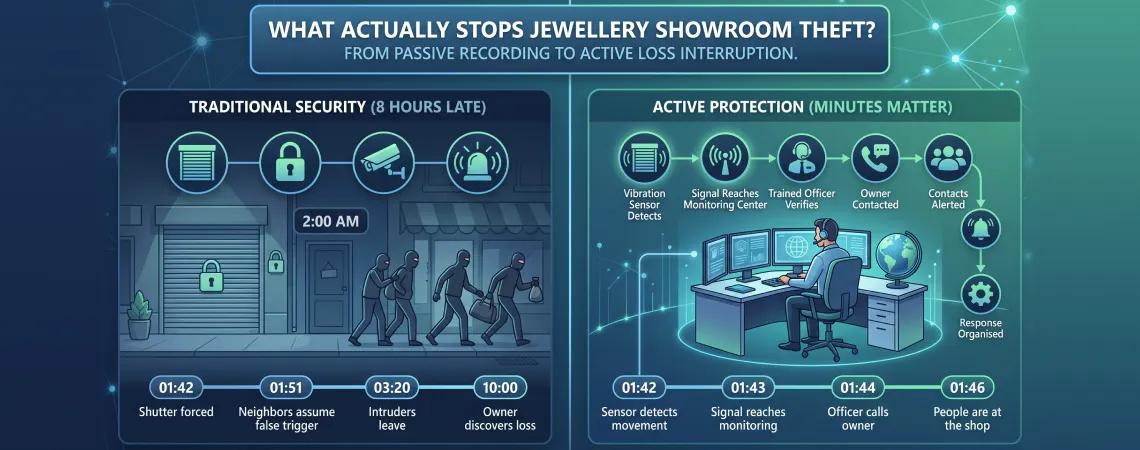
Traditional alarm scenario
Professional Protection Platform
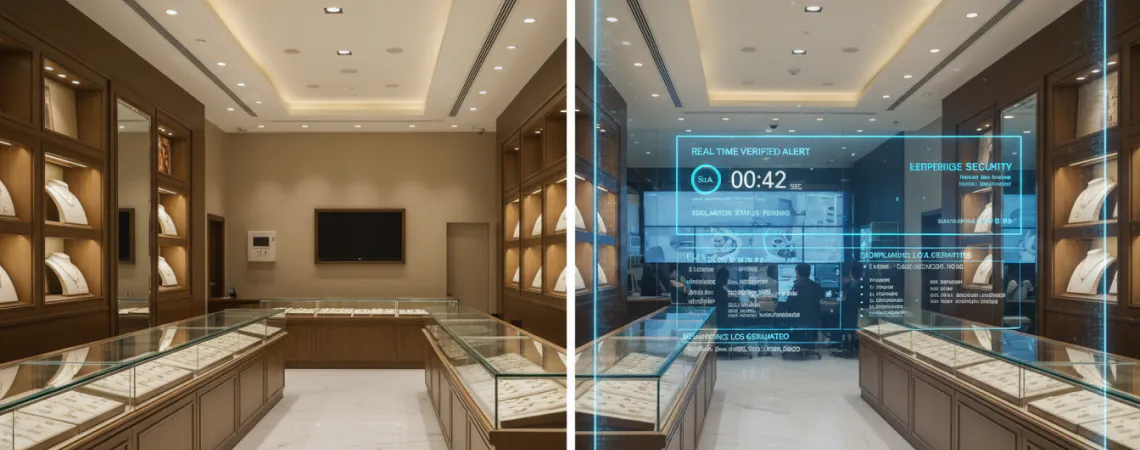
Illustrative comparison of the same event at two shops. The timings show the sequence of an alarm chain, not a specific recorded incident.
CCTV and a siren do not stop a jewellery showroom theft. They record it and announce it. What prevents loss is a monitored chain: a sensor that detects entry, a panel that transmits the signal off-site within seconds, and a trained officer at a 24×7 centre who verifies the event and immediately contacts the owner and a designated list of representatives to organise a response. In India only 29.9% of stolen property value is recovered, so the minutes between detection and response are worth more than the investigation that follows.
Ask a jeweller what he is afraid of and he will describe an armed daylight robbery. It happens. In one Bihar case, a group of masked men entered a Tanishq showroom in Arrah shortly after it opened and left with jewellery reported at around ₹25 crore. But that is the rarest of the three patterns, and the one a security system can least influence once it has begun.
The two patterns that quietly account for far more Indian showroom losses are less cinematic:
Not the front door, but the rear wall, the service passage, the staircase landing, the first-floor shutter. Patient, unhurried, and carried out on a shop nobody is watching.
When they attack, they typically use methods designed to bypass traditional security measures.
A well-dressed man asks to see chains, rejects two, and walks out while more are being fetched. In one Bengaluru case the whole episode took about fifteen minutes and cost the owner two chains worth ₹2.5 lakh.
In Thane, two men removed roughly 6.5 kg of gold ornaments, valued near ₹7 crore, from a jewellery shop close to the railway station. They broke the lock of a staircase door leading to the first floor, then forced the shop shutter. The entry happened between 1.30 AM and 4 AM.
Reported by PTI / Deccan Herald, citing Naupada police, Thane
Read that timeline again. It is not a thirty-second smash and grab. It is a two-and-a-half-hour working window inside a shop, in the middle of a city, with the owner asleep four kilometres away. Everything that was going to protect that stock had to work in the first sixty seconds, because after that nobody was coming.
Because CCTV was never designed to stop anything. It is a memory device. It answers “what happened” with excellent fidelity, and answers “is it happening right now, and who is doing something about it” not at all.
Worse, experienced crews treat the camera system as the first obstacle rather than a deterrent. In a well-documented Karnataka case, burglars reached a gold showroom through a narrow passage beside an adjacent bank, dug through a concrete wall, disconnected the CCTV connection, and only then gas-welded the lockers open, leaving with about 25 kg of ornaments and ₹5 lakh in cash. The cameras were present throughout. They contributed nothing to the outcome.
The financial consequence of relying on after-the-fact evidence shows up clearly in national data. NCRB figures for 2023 record property worth about ₹6,917 crore stolen against roughly ₹2,065 crore recovered. That is a recovery rate of 29.9%. Seven rupees in every ten of stolen value never come back, footage or no footage.
| What You Have | What It Does | What It Does Not Do |
|---|---|---|
| CCTV and DVR | Records for investigation and insurance | Alert anyone while the shop is being emptied |
| Local Siren | Makes noise at the premises | Reach anyone at 2 AM on a closed market street |
| Mobile App Alert | Notifies the owner's phone | Work if the phone is silent, charging, or unattended |
| Night Guard | Deters opportunists at one point of the boundary | Cover the rear wall, roof, and first floor at once |
| Monitored Alarm | Puts a trained, awake officer on the event within seconds | Works alongside cameras it does not replace them |
Broadly 8 PM to 4 AM. Those are the hours when the shutter is down, the street is empty, and the distance between an alarm and a human being is at its widest. The Thane entry sat squarely inside it, and so do most of the shutter-and-wall cases reported across Gujarat, Punjab, Maharashtra and Karnataka each year.
There is a second, less obvious reason to take this window seriously. In NCRB’s 2024 figures, theft declined by about 9.8% and robbery by about 13%, but burglary stayed essentially flat. The crime category that specifically targets closed, unattended premises is the one that is not improving while the others fall. A jewellery showroom’s exposure is concentrated precisely where the national trend refuses to move.
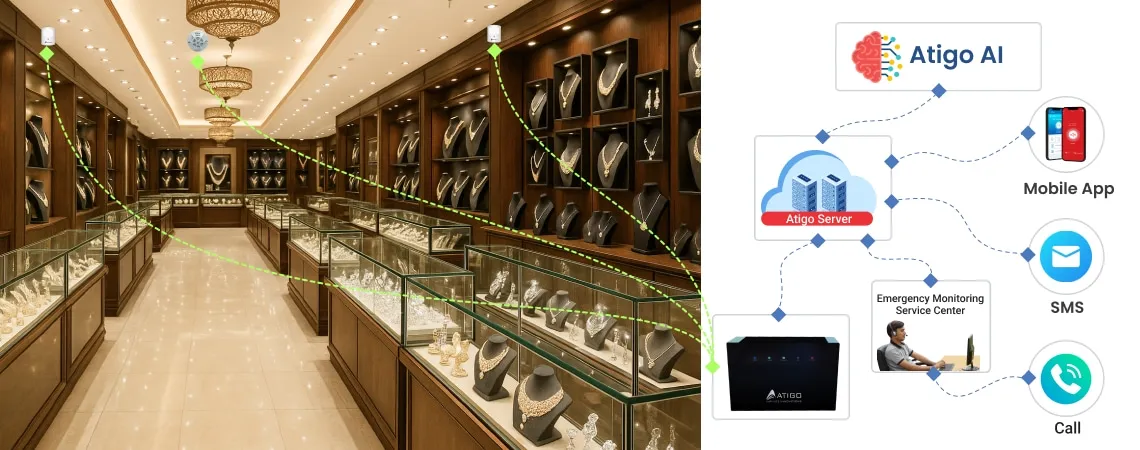
Sensors on the shutter, doors, display area and strong room register the specific physical event, whether that is vibration, opening, movement or glass breaking, rather than waiting for someone to be seen on a screen.
The panel sends the event off the premises immediately over GSM and Wi-Fi . Once the signal has left the building, cutting wires inside it no longer changes anything.
A trained protection officer at a manned 24×7 centre reviews the event in context: which sensor fired, in what sequence, whether the system was armed, whether it matches a known pattern. Every trigger is assessed instead of being treated as noise.
The officer contacts the shop owner and the designated representatives on the escalation list, guides them through organising an effective response, and stays with the event until it is resolved.
One point of honesty, because it is the question every serious buyer asks. Atigo does not dispatch police units to your shop, and no private monitoring provider in India can credibly promise that. What the centre does is compress the delay, so that within about a minute of the shutter moving the people who can act are awake, informed and already moving, instead of finding out at ten in the morning. If any provider tells you they will send the police directly, treat the rest of that conversation with caution.
Equally worth stating plainly: Atigo is a sensor-based platform, not a camera-monitoring service. Nobody is watching a video feed of your showroom. That is a deliberate design decision. Sensors detect the physical act of entry immediately, and cost a fraction of what continuous video surveillance costs to staff.
A showroom is not a warehouse and not a home. The protection layout has to follow the way jewellery premises are actually built in India: shutter at the front, stock in a strong room or safe, a service entrance nobody thinks about, and staff handling high-value items on open display during trading hours.
| Zone | Sensor | What It Catches |
|---|---|---|
| Front Shutter | Vibration Sensor | Lifting, prying, or cutting — before entry is complete |
| Rear & Service Doors | Magnetic Door Contact | The quiet entry route that is usually unprotected |
| Display Floor | PIR Motion Detector | Movement inside the closed showroom |
| Glass Display & Windows | Glass-Break Sensor | Smash-and-grab attacks at the counter |
| Strong Room & Safe Area | PIR + Door Contact | Approach to the stock itself, not just the perimeter |
| Counter & Cabin | Panic Button | Staff raising an alarm silently during trading hours |
| Whole System | Health Supervision | A dead battery or offline sensor, reported before it matters |
That last row deserves more attention than it usually gets. Most failed installations in Indian retail do not fail because the technology was wrong. They fail because a sensor stopped reporting four months ago and nobody knew. A system that supervises itself and escalates its own faults is the difference between protection and the appearance of protection.
This is the right question to ask any provider, and the answer should be specific rather than reassuring.
The Alaris AIoT panel reports over GSM and Wi-Fi . A broadband outage or a cut line does not silence the site.
The panel keeps operating and transmitting through a power cut, which is exactly when a prepared intruder prefers to work.
AES-256 with TLS 1.3 on the signal path, so alarm traffic cannot be read or spoofed.
Designed and manufactured in Ahmedabad, developed with R&D collaboration at IIT Gandhinagar, certified to ISO 9001 and CE. Support, spares and escalation sit in the same country and time zone as your shop.
More than 1000 verified emergency responses handled by the centre. The operational experience matters at least as much as the hardware.
Atigo monitoring plans start from ₹850 + GST per month. The Professional plan, which is what most retail sites activate on, is ₹14,400 + GST per year. The core panel kit, comprising the Alaris smart alarm panel, a PIR sensor, a door sensor and the power adaptor, is provided free at activation, and the extended warranty stays in force for as long as the subscription is active. Additional sensors for larger showrooms are priced separately.
Set that against what a showroom already pays for security that does not escalate: annual CCTV maintenance, hardware replacement every few years, storage, and in most cases a night watchman’s monthly wage. The monitoring subscription is usually the smallest line in that list, and the only one that puts a named person on your alarm at 2 AM.
The more useful way to size it, though, is against the stock rather than against the other bills.
Move the sliders. Every figure below is your own number, worked against national recovery data.
Include display stock, strong-room stock and customer orders held overnight.
Night guard wages, CCTV maintenance, storage and hardware replacement.
Unprotected between 8 PM and 4 AM
₹1 crore
The value physically present in the shop while nobody is there.
Unlikely to ever come back if it is taken
₹70.1 lakh
Based on the 29.9% national property recovery rate (NCRB, 2023).
Atigo Professional Protection
₹12 per lakh, per month
₹14,400 + GST a year. Panel kit free at activation, extended warranty while the subscription is active.
Against what you already spend
₹2,16,000 a year
Your current security spend. Monitoring adds to this rather than replacing it, but it is the only part of it that responds at 2 AM.
This tool gives an exposure estimate. It is not a quotation and not an insurance calculation. The recovery percentage is the all-India property recovery rate published by the National Crime Records Bureau for 2023, applied here as a general indicator rather than a prediction for any individual premises. Plan pricing excludes GST and additional sensors.
Eight questions separate a real monitoring service from a hardware vendor with a call-forwarding number. Ask them in this order, and ask for the answers in writing.
A provider who answers all eight plainly is worth more than one who answers three of them enthusiastically.
No. It produces evidence after a theft, not prevention during one, and in several reported Indian burglaries the camera system was disconnected before the lockers were opened. Keep the cameras, and add something that escalates.
In the closed-shop window, broadly 8 PM to 4 AM. Armed daylight robbery is a separate and much less common pattern.
No. The platform is sensor-based. There is no live video monitoring of your premises by Atigo.
No. Monitoring officers contact you and your designated representatives and help organise an effective response. They do not dispatch police units directly.
The panel runs on battery backup and transmits over GSM as well as Wi-Fi and Bluetooth, so the loss of any one pathway does not silence the site.
Plans start from ₹660 + GST per month. The Professional plan is ₹14,400 + GST per year, with the core panel kit free at activation and extended warranty for as long as the subscription is active.
Insurance is a recovery instrument and monitoring is a prevention instrument. A policy may return part of the value months later. It does not return the stock, the trading days, or a family jeweller’s standing in his own market.
Yes. The system is wireless, so installation does not require cabling through a finished interior or closing the shop for a day.
Every figure in this article is drawn from published national crime data or from named press reporting of specific incidents. The Atigo security platform is certified to ISO 9001 and CE. No claim is made here that Atigo would have prevented any specific incident described above.
India’s trusted security partner since 2013. Made in India manufacturer of 24/7 monitored alarm systems.
© 2013-2025 Atigo Security — A division of Atigo Enterprises Limited
Made in India. Monitored in India.