The best security system for a mobile phone store in India is not the one with the most sensors or the loudest siren — it’s the one that produces a response. A standalone alarm only detects and shouts; a 24/7 monitored system like Atigo’s Professional Protection Platform sends the event to a trained officer who verifies it and acts within a 60-second SLA, alerting you while there’s still time to stop the loss. In short: buy the outcome, not the hardware.
Mobile phone retail is one of the highest-risk categories in Indian retail — lakhs of rupees of resaleable stock packed into a small, glass-fronted space. Yet most stores are “protected” by a siren that nobody answers at 3 AM. This guide explains, with current India data, why a monitored mobile phone store security system is the only protection that actually changes the outcome — and what to look for before you buy.
In September 2024, CCTV from a mobile store in Delhi’s Vasant Kunj went viral. A masked gang broke in around 3 AM, swept the display shelves into sacks, and left in minutes. The alarm did sound — about three minutes in. The thieves heard it, kept working, and walked out, because nothing was coming.
That’s the whole problem in one sentence: the alarm worked, and it changed nothing. The siren did its job. What was missing was everything that should happen after the siren — and in most phone stores, nothing does.
Protecting a phone shop takes three things working together: (1) early detection at the entry point — shutter, glass and motion sensors that fire at the attempt, not the aftermath; (2) instant, reliable transmission of that alert; and (3) a 24/7 monitoring centre with a trained officer who responds in seconds. Detection alone is a notification. Detection + managed response is protection.
Most security sold to phone stores stops at step one. Sensors and a siren detect the break-in and make noise — useful, but a notification nobody acts on at 2 AM is not protection. The decisive layer is the professional response: a human being, awake, whose entire job is your alarm.
This is the core of how Atigo approaches it. Atigo doesn’t sell technology for its own sake — it sells the outcome, using AIoT sensors and trained monitoring officers as the means. The brand promise says it plainly: Protection that never sleeps.
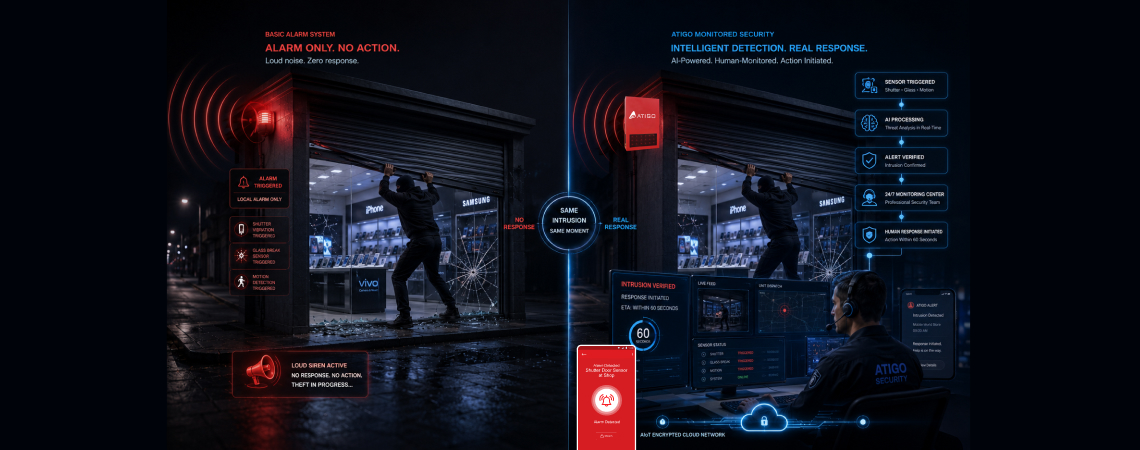
An unmonitored alarm detects an intrusion and triggers a siren and a mobile app alert — then it’s entirely up to you to notice and react. A monitored alarm sends the verified event to a 24/7 professional monitoring centre, where a trained officer responds within a fixed SLA (60 seconds for Atigo), alerts you and your designated representatives, and helps coordinate an effective response. The difference is who acts at 3 AM — you, alone and asleep, or a trained team that’s awake for exactly this.
| Feature | Unmonitored Alarm | Atigo Professional Protection |
|---|---|---|
| Detects Intrusion | ✔ Yes | ✔ Yes |
| Sounds a Siren | ✔ Yes | ✔ Yes |
| Sends You an App Alert | ✔ Yes | ✔ Yes |
| Verifies the Event | ✖ You decide | ✔ Trained Protection Officer |
| Guaranteed Response Time | ✖ None | ✔ 60-Second SLA |
| Acts While You're Asleep or Away | ✖ No | ✔ 24/7 Professional Monitoring Centre |
| Incident Logs for FIR / Insurance | ◐ Partial | ✔ Complete Audit Trail |
A standalone “smart” alarm that only pings your phone is an unmonitored alarm with a nicer app. When you’re 30 km away and asleep, the ping changes nothing.
With an unmonitored alarm, usually nothing — the siren rings into an empty street and stops. With Atigo’s monitored platform, the alarm is transmitted instantly to the 24/7 centre, a trained officer verifies it within 60 seconds, and immediately contacts the store owner and designated representatives to guide an effective, escalated response.
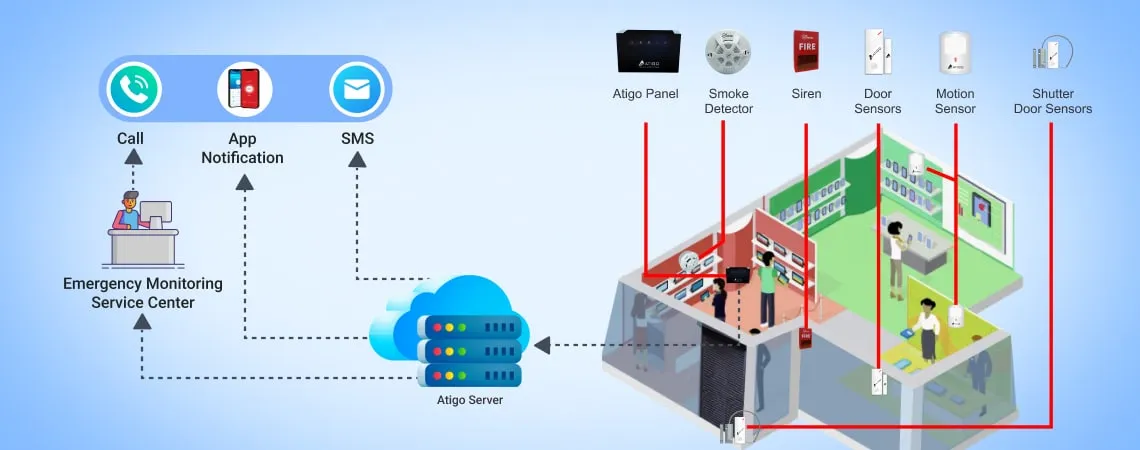
Here’s the Atigo response chain, layer by layer — every link exists to compress the time between intrusion and managed response:
Shutter-vibration sensors, PIR motion sensors, glass-break sensors and panic buttons catch the break-in at the attempt stage shutter being lifted, glass smashed, movement in a closed store. For a phone shop facing “smash, grab, gone in three minutes,” shutter and glass sensors fire at second zero.
The Alaris AIoT panel transmits instantly over a triple-pathway network (GSM / Wi-Fi / Bluetooth) with encrypted communications (AES-256 + TLS 1.3), and continuously monitors its own health so the system can’t silently be “down” on the night it matters.
The event reaches Atigo’s 24/7 monitoring centre, a trained protection officer responds within 60 seconds, verifies the event, and contacts you and your representatives to coordinate an effective response and escalate as needed.
Two honest clarifications, because accuracy matters more than marketing:
Mostly no. Per NCRB data, only about 30% of stolen-property value was recovered nationally in 2023 — roughly 70% was never returned. Even India’s flagship phone-tracing system, the DoT’s Sanchar Saathi, reports an average recovery rate of about 22.9%. Recovery is the exception, which is exactly why fast prevention and response beat “we’ll get it back later.”
Many owners quietly assume police investigation, CCTV footage or phone-tracing will recover the stock if the worst happens. The data disagrees. Property offences made up nearly a quarter of all cognizable IPC crimes in India in 2023, and commercial establishments, godowns and bank/ATM premises are all on NCRB’s list of recorded theft locations.
For phones specifically, Sanchar Saathi has traced 7 lakh+ handsets — a genuinely strong system — but it’s a consumer, after-the-fact tool: a customer blocks one phone by IMEI. It does nothing for a shop owner watching 40 devices leave in a sack. If your security plan depends on recovery, the numbers say you’ll lose most of it. The only reliable plan is to make sure the stock never leaves — which depends entirely on the first 60 seconds.
Mostly no. Per NCRB data, only about 30% of stolen-property value was recovered nationally in 2023 — roughly 70% was never returned. Even India’s flagship phone-tracing system, the DoT’s Sanchar Saathi, reports an average recovery rate of about 22.9%. Recovery is the exception, which is exactly why fast prevention and response beat “we’ll get it back later.”
Phone retail sits close to the worst-case theft profile in India:
Yes. CCTV records an incident; it doesn’t stop one and doesn’t summon help in real time. In the Vasant Kunj case the cameras captured everything — and the store still lost its stock. CCTV is evidence after the fact; a monitored alarm is a response during the fact. They solve different problems, and a phone store needs the response.
Think of CCTV as your record and a monitored alarm as your reaction. Footage helps an investigation that, per the recovery data above, most often doesn’t return the goods. A 60-second monitored response aims to prevent the loss in the first place.
The right question isn’t “what does monitoring cost?” It’s “what does one unanswered 3 AM alarm cost?” For a phone store, the answer is usually many multiples of a year’s subscription.
If a provider can’t answer 1 and 2 cleanly, you don’t have protection — you have a noise-maker.
The alarm in that Delhi store worked perfectly and changed nothing, because detection without a managed response is just a sound. With recovery odds where NCRB and Sanchar Saathi put them, phone store owners in 2026 can’t afford to buy features and hope. Buy the outcome: stock that stays, a trained officer who responds in 60 seconds, and nights without the phone on the pillow.
That’s the whole point of Atigo’s Professional Protection Platform — Protection that never sleeps.
Request a free Security Risk Assessment for your shop.
No. Atigo’s platform is sensor-based. Officers respond to sensor events (shutter, motion, glass-break, panic); they do not watch live camera feeds of your store.
Atigo’s officers contact the store owner and designated representatives and guide them in organising an effective, escalated response — the operationally realistic model in India.
Mostly no. NCRB data shows roughly 30% of stolen-property value was recovered nationally in 2023, and Sanchar Saathi reports an average recovery rate around 22.9%. Prevention and fast response matter far more than after-the-fact tracing.
Yes. CCTV records an incident; it doesn’t stop one or summon help in real time. A monitored alarm provides the live response CCTV can’t.
India’s trusted security partner since 2013. Made in India manufacturer of 24/7 monitored alarm systems.
© 2013-2025 Atigo Security — A division of Atigo Enterprises Limited
Made in India. Monitored in India.